Some Random Thoughts for the Next Posting

I had an insight into the way that I write articles. Recently I needed to write a paper to be presented at a conference in Cape Town. It became apparent my best modus operandi is to begin on Monday; write furiously for three days, each day starting by reading what I have already written; and then on Thursday and Friday I go back and edit. So the lesson is not to try to start an article in midweek but to save up and get on with it on a Monday. What I have not yet learnt is the best way to do the reading other than at the gym.

At the end of May I went to the conference mentioned where the paper was to be presented. The conference  was organised by the Center for International Governance Innovation, my new employer in Canada, and the American Political Science Association. It was on the future of South Africa and what Nelson Mandela’s legacy might look like.

I traveled from Durban a day before the meeting. I went up to Greyton, about two hours drive from Cape Town, in the Overberg mountains. I spent a night with Tim Quinlan, who worked for many years at HEARD as my deputy. Greyton is really beautiful and I much enjoyed the calm small town feel of the place. I’ve posted a couple of pictures of my stay with this blog. The question is, could I and would I want to live there and while it is great to visit I honestly do not think it would work in the longer term as it does feel very isolated.

This slideshow requires JavaScript.

The conference itself was fascinating, and I came away uncertain as to what the future of South Africa looks like. There were a number of criticisms of Mandela. Three stuck in my mind. The first was allowing Winnie to get away without answering for the murder of Stompie Moeketsie in 1991. She was convicted of kidnapping and being an accessory to assault, and sentenced to six years in jail, but this was reduced to a fine and a two-year suspended sentence on appeal. Second, was taking money for elections which allowed a culture of corruption to take root. Thirdly and of course, closest to my heart, not picking up on the threat that HIV posed to South Africa. We worked hard though. The meeting began with a dinner on Friday, on Saturday and Sunday we met from 9 am to 6 am and then had working dinners. Yet another weekend gone! I now need to complete my chapter.

Back in the UK there were a few small wins. We went to the beach, and although it was far too cold to venture into the water the dog had a good run. On the way back to Norwich we stopped at a garden centre and bought some pond weed and water plants. The pond was cleaned a month ago and looked very bare. There will be many happy frogs.

I mowed the lawn and it took nearly two hours. The first challenge is getting the lawn mower to start; it should never be taken for granted that it will indeed fire up with the pull of the cord. It was extremely satisfying when, on this occasion, it started first time. The grass was not too thick, but I still filled  nearly half of the garden waste bin. This activity was instead of going to the gym and it was probably nearly as good the work out as I would have had there. I put in my Zen Player, wore a headband to keep it on and listened to the BBC news.

The dog came out to help, which means her biting at the wheels and waiting for me to throw tennis balls for her. I was also joined by a friendly robin that perched on a nearby branch and talked to me, and a thrush that followed the mower to see what edible goodies I might be turning up. It was actually a rather pleasant and productive way to spend a couple of hours.

Just over six weeks ago we (HEARD) were asked to undertake a study for the Global Fund for AIDS, TB and malaria. The question posed was: how should resources be divided between the three diseases before being allocated to countries? This was asked by the Board. An earlier question: Should resources be divided between the three diseases before being allocated?, was not on the table. We were asked to work to a tight timeline to develop a formula to try  address this question. I put together a team of five staff members led by Catherine Sampson who has joined us for a year and who is a Peace Corps volunteer.

 We were sent a series of dates on which various things had to be delivered and we succeeded in doing the work. There were three groups invited to be involved in the work the others being from the USA and UK respectively. I was delighted to learn we had been the only group that had succeeded in making the technology of video conferencing work for all the meetings, and we were also the only ones to stick to the deadlines we were given. It was a real learning experience for us all and I was delighted by the way people stepped up to the mark.

Books

Ben Goldacre, Bad Pharma: How Drug Companies Miss Doctors and Harm Patients, Fourth estate, London 2012, 430 pages

Ben Goldacre hates sloppy and misleading science, ‘Bad Science’ was the title of his first book. It took a bit of time for me to get into this book, but once I did I really enjoyed it and was almost sorry it came to an end. Although I have to say that it peters out rather than ending with a bang. This may be because he is writing for primarily a British audience and finishes by setting out various things that patients, doctors and the community can do to respond to the mis-selling of drugs. It is an excellent book which describes how  deals? go wrong in the development and selling of drugs. There is a detailed explanation of how trials are carried out and why they so often don’t tell us what we need to know.

What is missing from this is an understanding of the difficulty of publishing null results. This goes beyond science broader research and public community. It then takes us into human psychology and an understanding of what makes us tick. We want news that is interesting and grabs our attention. When it comes to medicine we want to know what will work. The problem is healthcare is a form of market failure. When people are sick, they want to get better right now. Healthcare professionals need to be gatekeepers. It also means that they need to be more honest about what medicine can and can’t do.

We, as a society, need to be accepting of the concept of a ‘good death’, and that will take some psychological leaps. This is a book that should be read by every scientist and social scientist as well as the public who want to be informed about drugs and drug companies. My biggest criticisms are his lack of understanding of economics and an unwillingness to engage with this, but perhaps that is the subject of another  bigger book; secondly one has to ask who ultimately benefits from the pharma industry and why they do it. Given that most pharmaceutical companies are publicly listed it seems that we mislead ourselves willingly.

Stephen Grosz, The Examined Life: How We Lose and Find Ourselves, Chatto and Windus, London 2013, 225 pages.

This is the story of the experiences and learning of a psychoanalyst. Grosz was born in the USA but practices in London (how he got there would, in itself be an interesting tale). The book is divided into six parts: beginning; telling lies; loving; changing; and leaving. This style of the book for case studies of patients to be presented to illustrate points. Each is extraordinarily well written and extremely readable. There are some deeply interesting people, a professor who at age 72 realises  he is gay and wants to negotiate his relationship with his wife and family.

The book does not tell us the outcome for all patients out there on many lessons in it. The back cover says ‘this book is about our desire to talk, to understand and be understood. It is also about listening to each other, not just words but the gaps in between. What I am describing here isn’t a magical process. It’s something that is part of our everyday lives-we, we listen’.

This is a book for every therapist and everyone who goes for therapy. It is also a book for anyone who wants to have a better understanding of themselves and others and how we interact, or so often fail to. It is not very long but I was really sorry to come to the end of it, it could be twice the length and just as readable. There are no solutions in it: that is the point we have to look within ourselves. What I did find rather interesting is that we learn how each of the patients was affected and in many cases damaged by their parent’s and upbringing. It would be interesting to have had parents psycho analysed, did they know what effect they were having on their children? Even more important is, do we understand what we are doing to our kids at the moment. That is something I battle with all the time. An answer is to have two funds for our children: one for college and the other for analysis.

Andro Linklater, Measuring America: How the United States was Shaped by the Greatest Land Sale in History, Harper Collins, London 2003, 312 pages

Perhaps one of the most striking differences in flying across large parts of the United States or Canada or Europe is the way the landscapes are  regulated. In Europe human habitation tends to follow the contours, rivers and other natural features. In the USA the grid dominates. This book is about how the land was surveyed.

I picked up a copy at a secondhand bookstore and have to say I found it deeply fascinating. The significance of the measuring was that it allowed private property to dominate, unlike the feudal system of Europe and the United Kingdom. This in turn shapes the North American psyche. Clearly they went hand in hand but one that could not have happened without the other.

The author describes the measurement systems, not just for length but also wakes and liquids. At the core of the distances was the chain, a length of linked metal bonds devised by one Edmund Gunter, a clergyman who issued instructions on how to do this in 1623. He had first used the chain in about 1607 to measure the estates of the Earl of Bridgewater. I can remember ‘chaining’ the sports field at Waterford school as part of a geography lesson. A chain is 22 yards long which is the length of a cricket pitch. This last fact has no significance in the USA. Measuring has to do with politics, commerce and fairness. Politics determine what distances and measures are used, commerce demands certainty and consistency.

Gyms and Elephants

I am at the end of a long period in Durban. Most of the time was spent in the city although there were a few short trips. The first was up to Nairobi for an AIDSpan board meeting. I flew up on the last Thursday of March and returned on the Saturday. It was an interesting meeting with a great deal of progress in the organisation. It has a new executive director, last year one of the things the board did was to select the person. She is settled in and everything seems to be running smoothly. Although I was born in Nairobi I am not a great fan of the city as it is today. It has grown rapidly and the infrastructure simply does not cope. The theme of many of these successful African capital cities seems to be severe traffic congestion. Nairobi has a particular problem in that the city has roundabouts and the psyche of the drivers does not include giving way.

Image

In front of the White House during the Economic Reference Group Meeting April 2013

A couple of weeks later I went up to Lusaka for the Swedish Sida strategy meeting. This too was a short trip, going up on the Sunday and coming back on the Wednesday. Again it was a productive meeting with like minded people, who are committed to making a difference. It is evident though that the terrain of donors and recipients is changing.

In both locations I had excellent meals in nearby restaurants. In Nairobi we walked across the street to an Indian restaurant where the food was as good as anything I have eaten anywhere in the world. The Lusaka restaurant was also within a few hundred metres of the hotel. It is noteworthy that we now feel comfortable walking in these cities, albeit in a group. Things have changed. I am not sure that I would be happy sending people off on foot in parts of Durban. While one might be safe from assault in Lusaka the lack of streetlights made the walk quite hazardous. In both cities what passes for a pavement would keep Western lawyers happy with litigation four months.

The hotels were adequate: comfortable beds, clean bath rooms, reasonable restaurants, fresh bedding and not too noisy.  Horror stories from fellow travelers include pubic hairs in ostensibly clean beds and walking back into the room to find the cleaner using the guest’s toothbrush in the toilet! For me a decent gym is really important and I am happy to say that both the Jacaranda in Nairobi and the Intercontinental in Lusaka have these facilities.

Increasingly I look at what equipment is provided as both sons of the founder of my gym in Durban Fitness Company are involved with the importation of machines for the South African market. My most recent trip ended in Waterloo, Ontario where I got a great offer at a gym – 14 days for $15, pity I was only there for six days. Much of their equipment is the same as that in Durban. Interestingly rowing machines are not popular in Canada – perhaps because it is hard to watch the TV when the focal length keeps changing.

The international airports in Lusaka and Nairobi both urgently need an upgrade. They are small, crowded and rather dirty. I was extremely unimpressed when I asked a security guard a question in Lusaka. Before he answered me he inserted one grubby finger up his nostril as far as the first knuckle. He kept it there while talking to me. Disgusting! He was a singularly scruffy individual – but dressed in the uniform.

I waited at our wonderful airport in Durban on my return from Lusaka as my sister Gill was flying in an hour later. She had been in Cape Town visiting my brother and came up to spend five nights with me. We did various things around Durban, and she reconnected with a school friend that she had not seen for close to 35 years. It was a significant birthday for her and one of her presents was the trip to Durban.

 I took her up to the Zululand game parks. It is only about a three-hour drive from Durban on a really good road. We went in through the Umfolozi gate at the south of the park and drove through to Hilltop Camp where we spent a night. We did not see a great deal as the grass was thick; it is the end of the rainy season. We did however get close to a rhino and calf, giraffes and an elephant. Usually on visits to the game parks I see something that I have never seen before. On this occasion, we came around the corner to see a large Monitor lizard, locally called a leguaan, licking its lips looking very pleased with itself. The reason for this soon became apparent, a dung beetle had been busy creating the ball of dung it would roll to a suitable location and lay its eggs in. The ball was there, but there was no dung beetle in sight. I guess it was in fact inside the lizard.

Despite the lack of game the countryside was really spectacular. From the game park we gently made our way back to Durban. There was the obligatory stop beside the road at the craft market where Gill bought handicrafts and I got fruit, including fantastic avocados. I dropped her (and the hire car) at the airport and caught a taxi to my office.

I am feeling very much under the whip at work. There is a huge amount going on and so I am very busy. The problem is that much of it depends on input from others, which means that I have to wait. Tim Quinlan, HEARD’s former research director, came up to plan various projects and articles. We sat together on Saturday and worked through one we are co-authoring on the potential role of China in the AIDS response in Africa. What a pleasure to be academic.

I was supposed to travel to the USA via Swaziland where there was a big celebration at Waterford. For various reasons I decided that this was simply asking too much of myself and so did not make it. It is a pity because there was some wonderful press coverage on BBC and in the British and South African Guardian  . We have to make the most of this opportunity to secure funding for the next 10 years at least.

I want to get this posting up on the website so will stop there. The next will cover my travel to the US and Canada and the big news about my plans.

Babies on Board, Sport and Sunshine

I am at the beginning of a period of travel. This posting is a series of observations about places, planes and people.

The first, short, trip was to Johannesburg, to a conference venue and hotel near the airport. The place, which will not be named, is in Boksburg. It is under the flight path of the aircraft coming into or leaving OR Tambo airport. I don’t mind this – my liking for aircraft is well documented, however when the first scheduled flight of the day leaves at 05.45 it is a bit trying. The centre is best described as ‘having got fat on government money’. It is a sprawling slightly shabby complex: visitors are ferried round on golf carts. The guests comprise those there for meetings (and on per diems) and those whose flights have been cancelled and whom the airline is accommodating.

I really don’t like the place. This view was confirmed when it took three attempts, going on the golf cart from the reception area, to get someone to unlock the door to the only bar. Apparently access is controlled because ‘ladies’ hang out in the bar, drug the male guests, go back to the rooms and rob them. That did not happen to me – but then I guess when I asked for two bottles of water it was apparent I was not a likely target. I was stayed for one night and that was enough.

On my return to Durban I had a day in the office then had to get up at 04.30 to catch the 06.30 plane to Joburg and connect to Nairobi. The racial mix of the cabin staff has changed from mainly white to mainly black, they have however, retained one of the phrases that always amused me. The Afrikaans crew would come round before serving the meal (OK I must put my hand up and acknowledge that this only happens in business class) and offer the passengers “Hot owl sir”. It is, of course, a hot towel, and it is still being offered.

On the flight from Durban two amusing little instances occurred when we were boarding. First a mother got on clutching a baby of eight or nine months. She was festooned with a back pack, bags, changing mats and all the paraphernalia that goes with travelling with a small person. So much did she have, that she could not fit through the aisle to her seat – 28 – right at the back of the plane. Calmly she handed the child to the gentleman in row 1.

“I will be back in a minute”, she said, “Do you mind holding the baby?”.

Well he did it. Both the infant and the passenger looked a bit bemused. Sure enough she came back and collected the child a few minutes later.

The last passenger to board was a flustered looking blond woman. At a guess she was in her late 20s. As she walked past me a young man was hurrying up towards the door.

“Why didn’t you wait for me?” she said angrily.

“I thought you had gone ahead”, he replied.

It was clear that there would be a further exchange of words when they got to their seats. Not a good way to start your honeymoon.

It has been a busy time. The team at HEARD continue to work well. In pure academic article productivity terms, 2012 was a record year. The details are on the website. I managed to produce a good few articles and book chapters, and will take credit for creating the environment where others can achieve their potential.

At the beginning of 2013 we managed to recruit more staff with interns coming on board; our first ever Peace Corps volunteer; and a number of Post-Doctoral Students scheduled to join us. The Post Docs are funded through a new initiative from the South African National Research Foundation, and while it is not a fortune they are given a significant amount of money and a chance to write. We have also recruited our 10 Doctoral Candidates (six at the University of KwaZulu-Natal and the balance around the country).

The big question I ponder is where to take my own academic interest over the next 10 years. More on this is due course. There is so much that is really interesting to research. To some extent I am spoilt for choice, and I don’t need to prove anything.

I have been in Durban for over two months with very limited travel. Apart from work, this has been a chance to spend time at the gym, go running, and do a fair bit of yoga. There is no doubt that I am much more flexible as a result of the yoga, but will be the first to acknowledge that I am not very good at it. The most interesting class has been the Bikram or ‘hot’ yoga. This is done in the normal studio, but with the wall heaters turned on. In Durban! In summer! The sweat just pours off me. At the end my yoga mat has sodden, slimy patches and is banished to the veranda.

The yoga studio offered a three session course on meditation. There were ten people on it. When the teacher went round the group and asked why people were there, they all said it was because of stress and their need to manage it. That was not why I was there, I just wanted to learn something new, so I felt a bit of a fraud. Yoga is breathing and stretching, meditation is breathing without the stretching – although I am prepared to admit that I may not have entirely got it!

My trainer at the Berea Gym, Wade, decided I needed to relax more so loaned me eight DVDs. They are all, unsurprisingly, action films, and I am slowly working my way through them.  The advantage of a DVD is it can be stopped. It took three sittings to get through the ‘The Perfect Storm’, which was actually an excellent film, with George Clooney and the rest of the caste I did not know. It does not have a happy ending (spoiler alert): the boat goes down with all hands.

Running is done in the morning, ideally just as the sun rises. It is great, because the course I run, which is between six and nine kilometres, depending on how much time I have, has many hills and winds its way through the leafy suburbs. As we have reached the equinox the sun rise is at about 5.40 am. This run is a really good way to prepare for the day ahead. The alternative might be to go down to the beach with the body board, which I have only done once. However I did manage to catch a wave, the most amazing feeling but unfortunately rare event.

There have been a number of events I have attended. St Clements is a little coffee shop on – Musgrave Road with excellent music every few months. They have taken to holding salons or soirees on a Monday. Some are excellent, others simply indulgent. But it is all grist to the mill, and nice that it is happening. The recent book launches have been extremely poorly attended, which is unfortunate. The Centre for Jazz and Popular Music at the University has been full at the Wednesday performances.

My flat has been having its own set of experiences (without me). Durban and the surrounding areas have a problem with a pest called wood borer. These insects eat wood and paper and it has been known for chairs to crumble when one sits on them. The sign of wood borer are little piles of dusty droppings called ‘frass’. I got a pest control person in to deal with them. He claimed to offer an eco-friendly service. In my view that would involve enticing the little beast out and relocating them. As I write that I realize that would be a ‘humane’ service not an eco-friendly one. What he actually has is a pesticide that only kills insects, the geckos, mice and rats survive. Of course they then starve to death over a period of time. Wood supplied now is treated and does not have this problem.

There has been some fierce weather, thunderstorms and strong winds. I got back to the flat one evening to find the door to the linen cupboard in the hall had been ripped off its hinges. Clearly there had been a gale howling through the flat from the bathroom to the kitchen!

So that is the news from Durban for now. My next posting will, I think have some big news, and I will also send out my once a year mass email.

Waterford Kamhlaba: 50 Years of Outstanding Education

3 February 2013 marked 50 years since Waterford Kamhlaba United World College opened its doors in Swaziland for the first time. As a past student and present governor this is going to be a busy and significant year. We are planning to mark the anniversary in a number of ways over the next 10 months. One of the key targets will be to ensure that we have enough money for the school to continue for the next 50 years. A central value is to provide scholarships to deserving students. Currently about 30% of the children are recipients of such support. The link to the school website is in this posting and I do hope people will take a minute to visit it.

Image

Waterford School, 2 February 2013, alumni from the 1960s and 1970s

Image

Waterford School, 2 February 2013, Ian Khama at the podium

The first Waterford event, on the weekend of 2 and 3 February was so much fun. I flew into Swaziland on the Thursday evening and spent the morning with my friends at The National Emergency Response Council on HIV/AIDS (NERCHA) in Mbabane, and the afternoon at the school. The next morning events were scheduled from 11am to 2pm. I drove up early to avoid security. It was reported that there would be 80 Swazi security personnel, I am not certain if this was true. There was a Royal Swazi police van in the parking area with “Bomb Disposal Unit” written on the side, and lots of uniformed men with automatic guns wandering about. The security is part and parcel of having the president of a country coming to visit, even if he is an old boy. The president is Ian Khama who was two or three years ahead of me at school.

Image

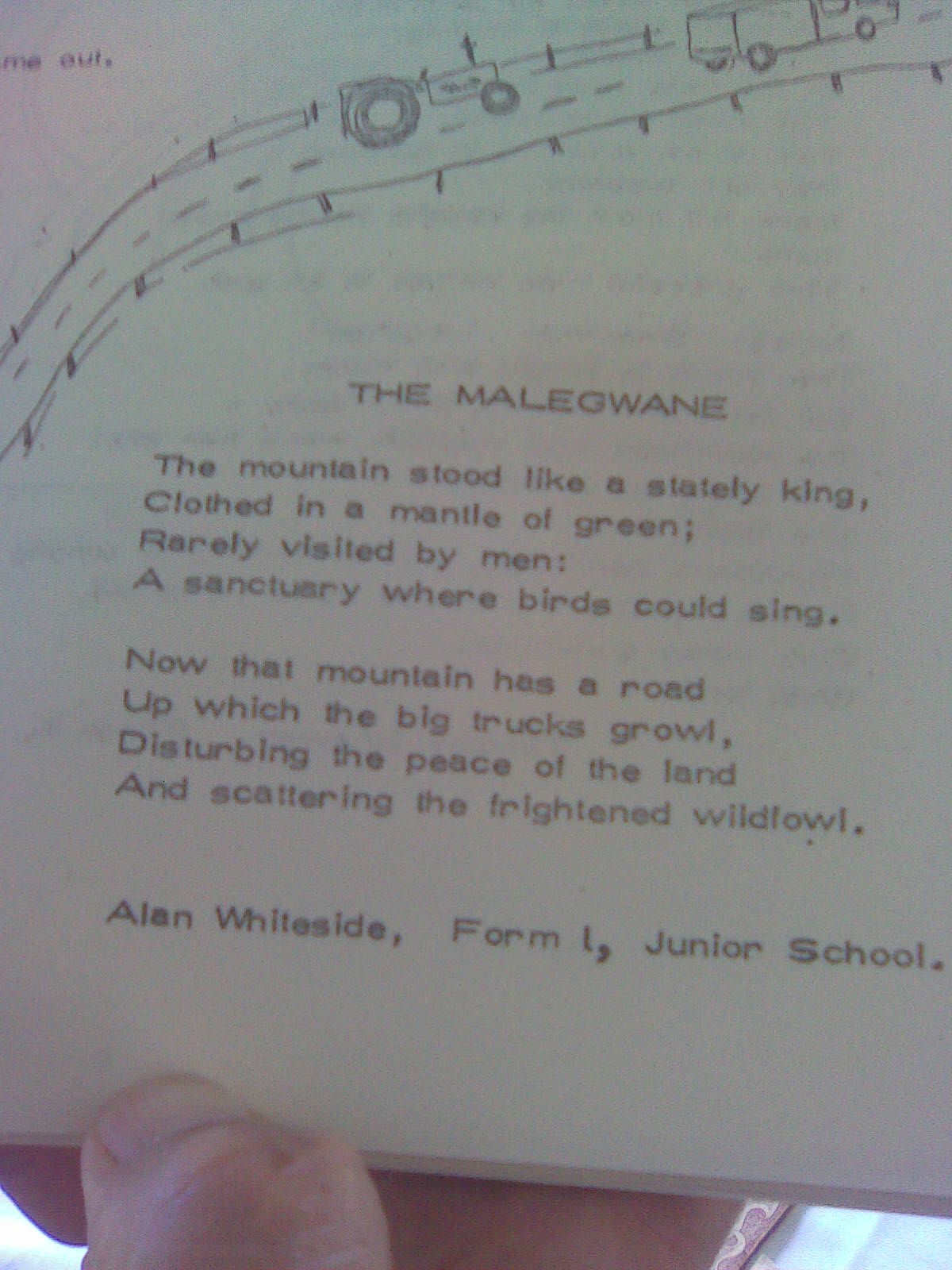
An example of how not to write: Form 1 poem

I gave one of our founding trustees, Martin Kenyon, a ride from the hotel. We then hung around until just before 11am when we were asked to go into the hall. Past copies of our school magazine were on display in the community service room. Flicking through them I discovered a poem I had written at about age 12. It confirms that my ability to write poetry, draw, or indeed to engage in any artistic pursuits is limited by a lack of talent. Judge for yourself !

Ian Khama was taught by our guest of honour Tony Hatton, one of the teachers responsible for establishing Waterford. His book Phoenix Rising: A Memoir of Waterford Kamhlaba’s Early Years had been published just in time for the event. This is reviewed at the end of this blog.

There were lots of people wearing smart uniforms with stars, medals and gold braid. Also present was the Deputy Prime Minister of Swaziland Themba Masuku whom I have known for many years. He started his career in the Ministry of Agriculture, held various ministerial posts and worked for the FAO.

It was a fantastic day. Ian Khama gave a brilliant tribute to Waterford and Tony. He began by talking to the students. He asked them if they had to go to church. Did they have to go to the classrooms and write the weekly letter to their parents on a Sunday? Were they allowed to enter the hall though all the doors? Did they have divinity lessons? A chorus of ‘no’ from the students present (except for service we all have to do it – but in our day it was physical labour – today it is community service). His masterstroke was to ask: did they have to wear uniforms? The answer was no!

He said, “Well we did, and I am wearing my tie – which is the original Waterford tie. We also had to wear blazers, and I still have mine, let me see if it fits.”

A uniformed man came from behind him carrying a jacket holder. He took out a Waterford blazer and then taking off his jacket put it on. It was a really wonderful moment and you can see bits of it on Facebook.

There will be a weekend of celebration at the end of April when the school is hosting a symposium. The guest of honor will be Archbishop Desmond Tutu. This will be followed by a series of reunions for alumni. Those who attended in the 1960s and 1970s will have the opportunity to return to the school and sleep in their old dormitories on the weekend of 9-11 August.

I have a real sense of incredible good fortune to have been educated at this school with the principles and values it inculcated in me. I was there because it was the local school, so many of my classmates battled to attend for financial and political reasons. I remember one having his passport refused by the apartheid officials in an act of pettiness that was so typical of the time. Indeed Tony Hatton was banned from traveling into South Africa for many years. This will seem like ancient history for the current cohort of students, but they too will certainly face numerous serious challenges. These will include employment, the environment, inequality and poverty, and new diseases such as HIV and AIDS.

As I travelled home I was taken aback by an event at the arrivals at O.R.Tambo airport. A young customs officer brought a teenage traveler to our queue, was about to put him in front of the ‘fever sensor’, a device that reads the temperature of the traveler from about two metres. He noticed me, and said, “Let the old man go first.”
“Eish”, I said, “who are you calling an old man.”
Indeed I have taken to avoiding the local spa in Durban on a Tuesday. It is the day they offer a 5% discount for pensioners, and I don’t like being asked if I qualify.

Back in Durban it has not been as hot as I would have expected in February. I have had to use my air-conditioning units on just three or four occasions. Although it must be said I am very glad I have them. There has been a great deal of rain and gray skies and I have not yet had the chance to get to the beach.

On Saturday I was invited to the Rumbelow Theatre in Umbilo. This is a working-class suburb and is where we first bought a house in Durban. The company uses a MOTH Hall. MOTH stands for the Memorable Order of the Tin Hats and was established after the First World War as an ex-serviceman’s club or community. The hall is extremely basic and has flags, maps and memorials on the wall. The show Suspects of Love consisted of four flamboyant men in drag miming to the words of love songs. It does not sound that promising but in fact was great fun. The Rumbelow has a great website.

Books

Phoenix Rising A Memoir of Waterford Kamhlaba’s Early Years By Tony Hatton, Kamhlaba Publications, 195 pages ISBN 978-0-620-55588-3
I really enjoyed reading this book. Because we lived in Swaziland, I felt that I knew something about the history of the establishment of Waterford and its early years. I was there as a student from 1969 to 1974 so lived through that period. The book is one view of what went on and is a valuable record. It is more than that though: it is well written, humorous and thought-provoking. I had seen an early first draft of the manuscript many years ago and know a little bit of the back story of getting it published in record time. Well done to Tony for writing it, my colleagues Catherine and Gwythian for putting it together, getting it printed and published and down to Swaziland in time for the weekend. It can be ordered from the school website. For those who went to Waterford do buy it, for people who are interested in the history of the school and the region it is a good read.

Films (two from the 10 hour flight from Amsterdam to Johannesburg in January)

Starbuck 2011

This French-Canadian film is the story of a man who is a sperm donor and fathers 533 children. He believes that he will be kept anonymous, but about 150 of them enter a class action to find out the identity of their father. The story centers on their attempts to find him while he seeks to retain his anonymity. At the same time, his girlfriend is pregnant with his child. An additional part of the plot is his relationship with his father and brothers who run a butchers shop. It is not a deep or meaningful film. It is light and enjoyable. The dialogue is in French with English subtitles. It is an example of the quality films coming out of Canada. The in-joke, which is beyond non-Canadians, is that Starbuck was a prize bull used to inseminate thousands of cows, something Canadians know.

Brave 2012(Pixar)

This computer-animated fantasy film is set in Scotland many centuries ago. The daughter of the King, Merida defies the age-old custom of marrying the son of a local chief and causes chaos. She heads into the forest and consults a witch for help. The result is her mother is turned into a bear and the story is about her putting this right. The voices I recognised were Julie Walters, Billy Connolly and Robbie Coltrane. It was good fun and technically brilliant. It won the Golden Globe Award for Best Animated Feature Film and BAFTA Award for Best Animated Film.

Catholics, Boats and Monkeys

Catholics, Boats and Monkeys

January 2013

The end of 2012 was a period of intense travel. On Friday, 16 November I went to Swaziland for the Waterford Governing Council meeting. There was also an event to say goodbye to the headmaster, Laurence Nodder who left after 14 years at the helm. He has a really exciting new position, starting a school in Germany. The farewell dinner was held at the home of the Italian consul in Swaziland. I’m not sure if this is because they love cooking or need to make a bit of extra money.

It was a time of reflection. I was one of the first Governors to meet Laurence in 1998. At the time we were desperate to find a head to get us out of terrible financial hole and lead the school in a new direction. The tributes to him and his wife Debbie have been posted on the school website and are well deserved.

On the Sunday I flew up to Johannesburg and then on to New York. This is a nonstop flight and takes over 16 hours. We left at 8:30pm and got in at 5amlocal time on Monday. I watched two movies on this flight. First Finding Neverland is the story of JM Barrie and Peter Pan. The cast included Johnny Depp as Barrie and Kate Winslet as Sylvia Davies and Dustin Hoffman. It was moving and informative. The second, a just released film, The Magic of Belle Island, starred Morgan Freeman as an alcoholic, disabled writer who moves into a house next to a divorced mother and her three daughters. I had to watch the last five minutes on the return leg; my neighbour started talking just before we landed.

I attended  Aidspan Board meetings on Tuesday and Wednesday and flew back to Durban on Thursday evening, arriving at midday on Friday. That was an excellent flight as the plane was virtually empty. We left on American Thanksgiving and no one else was traveling. I spread myself out, managed to do six very productive hours of work, sleep for about the same amount of time and got into Durban feeling reasonably refreshed. The advantage of such a short trip is that one does not have to deal with jet lag. I spent the Saturday in the office, meeting with Samuel Gormley, HEARD Operations Director, to catch up.

Then on the Sunday it was back to Swaziland for a conference. The meeting was a ‘Cross-Country Ministerial Consultation Workshop on Health Financing’ organised by the Clinton Health Access Initiative (CHAI). I flew to Joburg and drove from there. There were no seats on the flights in or out of the country because of the event. I do normally very much like the drive! However, unfortunately there was thick fog for over 100 kilometers. The CHAI began in 2002 with a focus on AIDS and health systems in resource-poor countries. It has expanded to include treatment for malaria, accelerating the rollout of new vaccines and lowering infant mortality. It has a presence in, and partners with the governments of 25 countries.

I presented in a special session: Spotlight on Swaziland. This gave an overview of the HIV and the health financing situation in Swaziland, and how the country has done in light of being faced with incredibly high HIV prevalence and a challenging fiscal environment. The meeting had high quality presentations packed with information and data. It will take time to digest.

So big plans? I have completed the medicals for moving to Canada. This is quite a process involving x-rays, blood and urine tests as well as a physical examination. As part of this process the doctor, who is the only one in Durban certified to carry out these medicals, determined that I have elevated blood pressure, and put me on medication. This means I now am experiencing the process of being on drugs for the long term. All was well, apart from the BP, and the papers have been granted. I will travel to Canada in the second week of January to complete the formalities and actually get on the pay roll at Wilfrid Laurier University. It is all very exciting and, if I am honest, scary. I really am moving out of my comfort zone. A new country, new job and driving on the right hand side of the road.

One of the real pleasures in Durban is the fresh fruit. In the two weeks I was away from the city in November the fresh fruit for 2012 arrived. There are plums, grapes, watermelons, mangoes and litchis. I always buy Victoria plums, dark red ones. One of the first things my mother did when we moved into our house in Swaziland, was to plant fruit trees. In fact she may even have done this before we took possession of the place. We had oranges, lemons, grapes and two plum trees. Whenever I bite into a plum I am immediately taken back to picking them off our trees in December every year. Sun warmed and sweet. I ate so many grapes one year and developed an allergy to that particular variety: Katoba. The one failure was a quince tree which, in 10 years, produced only two quinces.

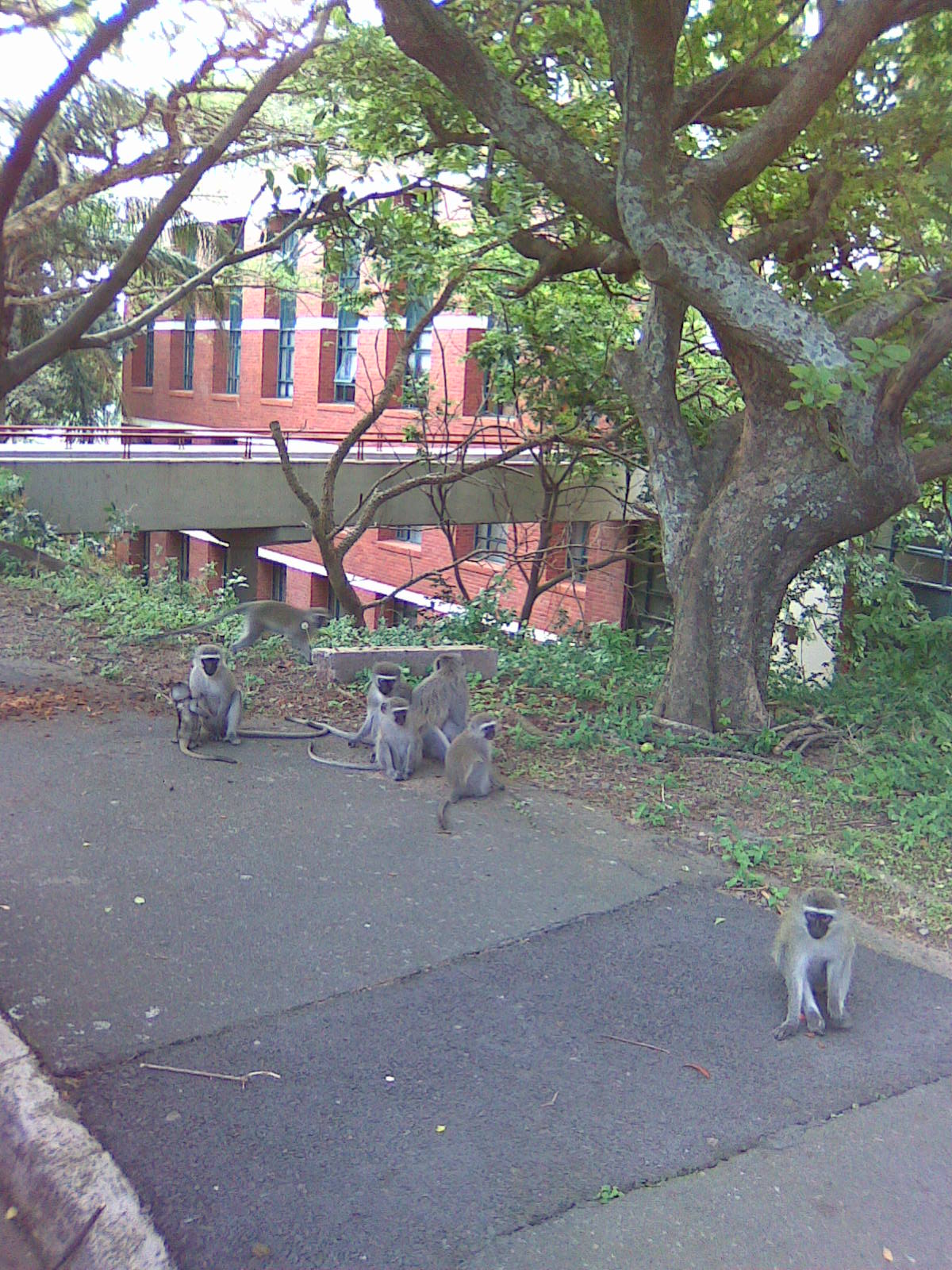
The end of November is exam time at the University and there were notices on the campus inviting students to attend the pre-exam prayer meetings. I am not certain what form divine intercession would take: presumably for those who have studied it is that they are articulate and calm. For those who have not, who knows? With the departure of the students the troop of monkeys that hang around the campus have become more aggressive. The reason is that there is not as much waste food. They have even been bold enough to come up to the fourth floor and steal food from our offices. This has caused much hysteria. Interestingly they are more likely to mug females, and the women working for HEARD are made quite nervous. One (of the women) was in the office when the animal came in.

The Gang planning the next strike

The gang planning the next strike

There have been notable departures in 2012. The owner of my Durban gym, Auguste Gant died in December. He was a magnificent old man, born and grew up in Egypt, had a passport from Luxembourg and immigrated to South Africa as a young man. I went to his funeral in a Catholic church where mass was celebrated. On the shelf in front of us were guidelines as to who could take communion, and how they should do it. The answer, by the way, is only Catholics. There was, however, a PS on the notice which I have to share: “The Eucharist is always received from a minister. Holy Communion Is not a ‘self-service’ action. Communicants, therefore, should never attempt to ‘dip’ the sacred host into the chalice”. Cosmos Desmond, one of the struggle heroes, died in March. He trained as a Catholic priest but left the priesthood, married and had three children, one of whom worked at HEARD. There were a number of obituaries. Both were deaths mourned but lives celebrated. I fear the year ended with another, unnecessary, HIV related death in my neighbourhood, but don’t have enough information to be certain yet.

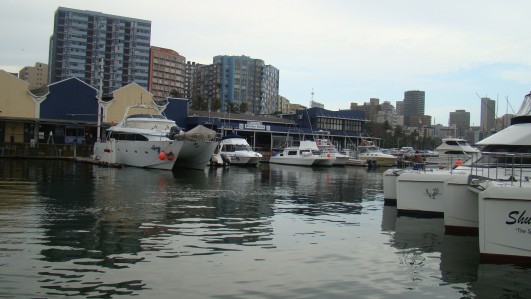
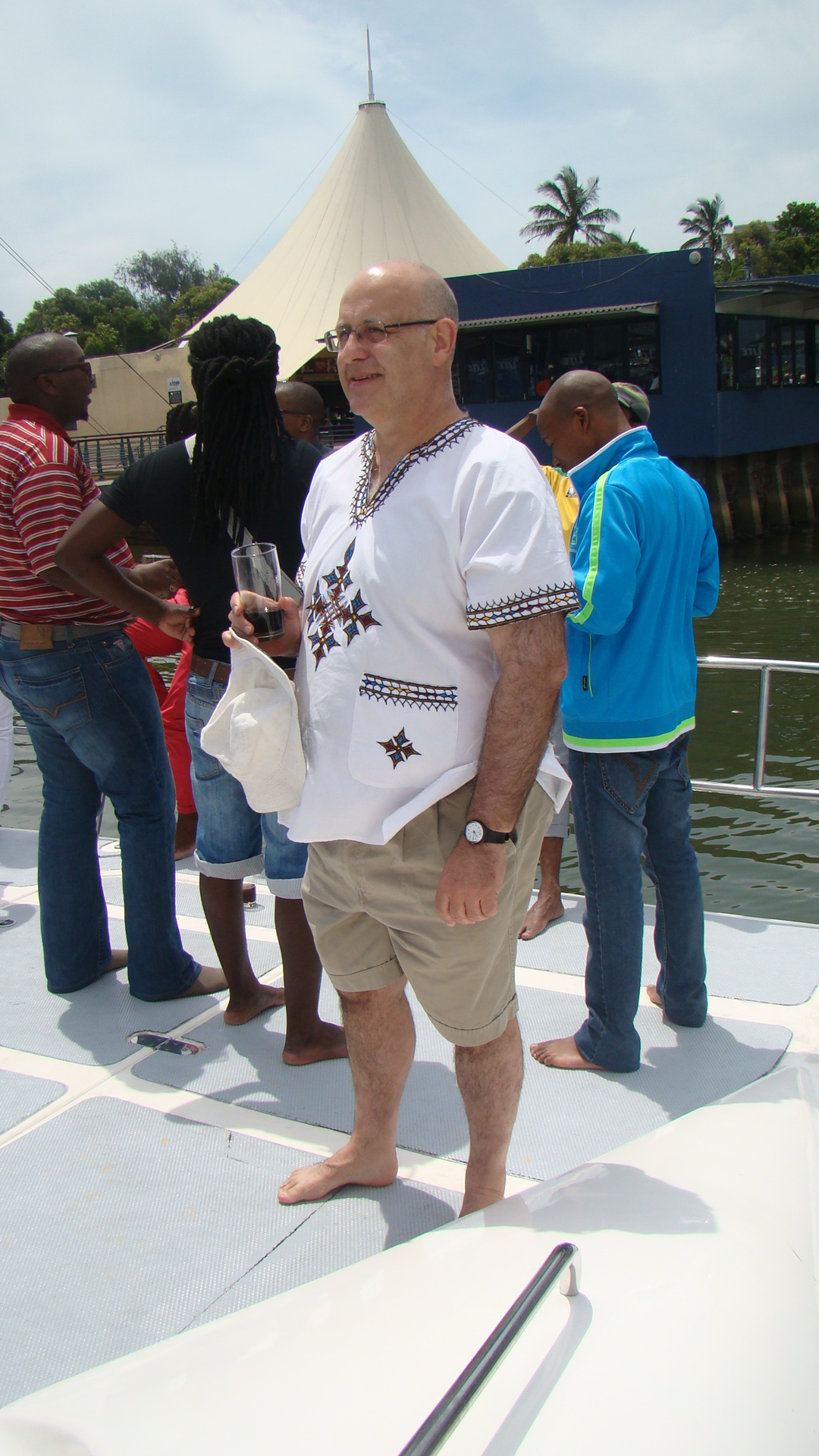
It has been an extremely successful year for HEARD. A quick count in mid—December showed we have at least 36 peer reviewed publications, journal articles and book chapters, and the count may go up. This means the output is over three per research staff member, which is outstanding. The communications team has been excellent, evident from the website. Everyone was ready for the end of year break, and our staff event was to go on a catered cruise on the Durban bay. There was a braai (barbeque) on the back of the boat. It was great fun, but unfortunately there was quite a gale blowing which meant we could not go out of the harbor mouth as the swell was too high. There were a total of 41 people on the boat which came as a slight shock because I had not realised the payroll was quite that big. A number are fieldworkers from one of the projects on the outskirts of Pietermaritzburg. Only one person could not make it.

HEARD 2012 office party

End of year office party

Durban city and bay strip

And so 2012 ends and 2013 begins. The next year should be a time of change. It is now just under 30 years since we arrived in Durban and I took up a position as a Research Fellow in the Economic Research Unit at the University of Natal. It is time to take up new challenges while recognising the luck and the excellent mentors I have been fortunate to have in my career so far.  I will continue posting on my website every six weeks or so, (and posting the blog to those family and friends who do not have computer access.)

With Rowan New Year 2013

With Rowan New Year 2013 – we have the same taste in jackets

Books

Jeremy Poolman, The Road of Bones: A Journey to the Dark Heart of Russia, Simon and Schuster London 2011, 342 pages.

This is the story of the Vladmirka Road which stretches through  Russia to the bleak expanses of Siberia. It is based on a painting by Isaak Levitan, which is in the front and back covers of the book. Essentially it is a travelogue as the author journeys across the country. There are two interpretations of the road; the one is the bleak picture that Poolman paints of people going into exile at best and travelling to cool captivity and frozen deaths. There is an alternative view which is that the road opened up the country, and allowed commerce and communication. This is never hinted at in this gloomy book. It was given to me for Christmas and I was quite captured by it which is why I continued reading it. Was it worth it, I know a great deal more about Russia and in particular the barbaric excesses of the Stalin era. I love the idea of taking a painting and writing from it. At the end of the day though I think Poolman has a lot more work to do before he is a mature and captivating travel writer stop. He is certainly someone to watch.

Falling Leaves: November 2012

Autumn has arrived in Norwich (and in Canada). I head for Durban soon with the dual goal of topping up on sunshine and getting a great deal of work done. There is a lot happening and, at the moment, life is exciting so read on for more details. The big occasion taking me back to Durban is the HEARD World AIDS Day function. On 14 November, in conjunction with the Africa Centre, CAPRISA the University of KwaZulu-Natal Press, we are holding an event at the KwaZulu-Natal Society of Arts Gallery www.kznsagallery.co.za . The theme is taken from UNAIDS, Getting to Zero: Zero New HIV Infections, Discrimination, and AIDS-Related Deaths. We have advertised it as an event ‘Showcasing KZN research on HIV and AIDS’.

HEARD’s highlight will be the South African premier of our documentary Manguzi: Raising Children in Rural South Africa. This film is set in an area close to the Mozambique border where we did a project. I have seen it a number of times, checking it from an accuracy and political point of view. It will be great to be just in the audience. The team who did the work deserve high praise for overcoming many logistical challenges, collecting some fascinating data, and now are writing it up.

This will be the occasion where I formally tell my research colleagues and friends in Durban that I will be leaving HEARD in 2013. (I feel I need to put in a footnote here that says: subject to the paperwork being completed). This should not come as a big surprise to most people as the news has been out for a while. It is however a chance for me to combine some of my favourite things: the Gallery; the research and academic communities; and many friends. The idea of doing such an event germinated at a book launch at Ike’s Books and Collectable – also a Durban institution – a few months ago. Authors who have books launched there put their signatures on the wall. My name is up alongside the likes of JM Coetzee and many others. The walls are probably worth more than the stock.

At the end of October Ailsa and I travelled to Canada for a week – hence the leaves in the title of the posting, and yes they were amazing. We flew to Toronto and were taken down to Waterloo in Ontario. We spent four nights there and then a further two nights in Toronto. The reason for the visit is that I have been offered, and have accepted, the International Governance and Innovation Chair in Global Health Policy by Wilfrid Laurier University (WLU). This will be housed in the Balsillie School of International Affairs, a partnership between WLU, the University of Waterloo (UW) and the Centre for International Governance Innovation (CIGI), a public policy think tank. I have put in the links to these organisations and they are all worth looking at. The CIGI campus is amazing, part is a brand new, state of the art building while the old Seagram’s distillery has been converted and incorporated as office space.

The School represents a large global initiative in social sciences with over 60 faculty members who teach in three programmes: the PhD in Global Governance, the Master’s in Global Governance and the Master’s in International Public Policy. There are three new staff members: Simon Dalby, CIGI Chair of Political Economy and Climate Change; James Orbinski, CIGI Chair in Global Health; and in due course, myself. We had a ‘Blue Skies’ thinking session which was a great fun – the staff have very interesting ideas and a range of experience. One of the exciting opportunities for me will be working in an interdisciplinary manner. I am also very much looking forward to teaching and interacting with students at various levels.

Quite a lot of the visit was spent exploring the area. The streets are wide and driving on the right hand side is challenging. What I found particularly difficult was the traffic lights being suspended over the streets instead of on poles at the side. I nearly ran a red light. On the other hand, the hire car was automatic and seemed very powerful. We went out to an amazing farmer’s market at St Jacobs north of Waterloo. The area was settled by German Mennonites and there were a number of stall holders dressed in traditional attire. Indeed Waterloo was originally called Berlin. The name was changed at the beginning of the First World War. I am not clear where the decision to call the town Waterloo came from but I am sure I will learn in the next few years (or I could go on Wikipedia now of course).

On the Thursday we began seeing news of Hurricane Sandy moving out of the Caribbean and towards the east coast of the United States. There was a real sense of foreboding and many warnings. We were scheduled to leave Toronto airport at 18.30 on Monday and feared that there might be a disruption of travel. Indeed there was, most flights to and from New York airports and other American east coast destinations were cancelled. The storm hit Toronto at about midnight on Monday so we were able to get away, although I note with hindsight there was comparatively little disruption in that part of Ontario.

What an interesting visit. I spent a couple of days with the colleagues I will be joining. We also had a discussion with the immigration lawyer who is handling the paperwork. He gave us a great deal of material, everything from taking a dog to getting a social insurance number, which is abbreviated as the SIN. Being asked ‘Have you got your SIN?’ left me quite flabbergasted. It all looks feasible. The plan is to begin with a fractional appointment once the paperwork is done and move to full time by the middle of 2013. I started at the University of Natal (UN) as a Research Fellow on 1 September 1983 so I will be just a few months shy of having spent 30 years at UN and now University of KwaZulu-Natal (UKZN). There is a great deal of planning going on to make sure the transition works for HEARD. All staff, Board, donors and Senior Management at UKZN are aware of my plans.

Because I travel a great deal, and almost always on KLM, I have the highest grade of frequent flyer card they give. I also have it for life (my life not theirs). This means when they work their way down the list for people to be upgraded when there is overbooking in economy class I am usually close to the top. On the plane from Toronto to Amsterdam, as we handed over our boarding cards mine beeped on the machine. I was told I had an upgrade. Ailsa was also given one: she was in the front row of the premium economy class, not quite the same, but she graciously allowed me to go in the business section. We had sat next to each other on their way to Toronto in the ‘real economy’ class at the back of the plane. The return flight is only six hours and so was not too bad; however one arrives in Amsterdam at the equivalent of 2am North American time, and gets into Norwich at the equivalent of 5am. I am not sure how I will cope with all the transatlantic flights in my new position.

My son Douglas gave us time to unpack and spend a night in Norwich before heading up to Yorkshire to visit his girlfriend. He was in charge whilst we were gone and took good care of the animals, fed himself and his sister who was here a part of the time, and generally behaved in a responsible manner. On Fridays he delivers a free local paper to about 150 households in the neighbourhood. If he is away someone else has to do this, Ailsa and I shared the task. I think I am one of the most academically qualified people delivering newspapers. I find it deeply interesting, a window into another world.

I also recognise I am pedantic and quite hard to live with. I had a good example of this characteristic the other evening. Because Rowan has moved out there is more space in the house but we have vast quantities of books. These belong to all members of the family however I think the majority are hers. The other evening I set out to count how many books we have. I went from room to room and book case to book case. The answer I came up with was 1724. This is by itself quite staggering. The next morning I met Rowan for lunch. As we were walking from the bookshop she works in to the restaurant, I told her what I had done and asked her to guess how many I had counted. Quick as a flash she said, ‘About 1700’. I wonder how she did it. However on Sunday I discovered two more bags and half a book case that had been excluded from the count. At this moment I think we have about 1850 books although that excludes the ones in my office.

Films
Rock of Ages: This is a recent (2012) American musical comedy adapted from a 2006 rock musical. The stars include country singer Julianne Hough and Diego Boneta, also in it are Russell Brand, Paul Giamatti, Catherine Zeta-Jones, Alec Baldwin and Tom Cruise. It can best be described as light and fluffy. The story is of a girl going to Hollywood to seek fame and fortune as a singer. She meets a boy, loses the boy, and re-finds him as well as having a chance to perform. I enjoyed seeing Russell Brand in this film; he did a really good job.

Seeking a Friend for the End of the World: The un-promising premise for this film is that an asteroid is hurtling, inexorably, towards the earth. Humankind will be wiped out. The film opens with the news coming over a car radio that attempts to deflect it have failed. At this point the wife gets out and walks away leaving her husband of some years. He then links up with his neighbour and romance blossoms, all with a clear timeframe. It is a good, touching and thought provoking film. How would I react to the news of the end of the world? I had seen the reviews for this and wanted to watch it simply to see how the story was developed. I might even have gone to a cinema but as it was on the aeroplane I watched it there and enjoyed it. What was striking was the conclusion that most people would be phlegmatic and just get on with it.

Dark Shadows: This is a 2012 American horror comedy film. It is a Tim Burton film starring Johnny Depp. The story is of a 200-year-old vampire who has been imprisoned in a coffin. When he is released, after murdering all the workmen who unearth him, he makes his way back to his mansion, inhabited by his rather odd descendants. It is fun fantasy and horror film – but aeroplane only!

Snow White and the Huntsmen: This is definitely a ‘watch on the aeroplane’ film. It is a new version of the Brothers Grimm German fairy tale Snow White. I watched it for the actors, in particular Charlize Theron and British actor Bob Hoskins for whom it was his last role before retiring. The special effects were quite outstanding. It was a British and American production.

Books:
Michael Lewis, Boomerang: Travels in the New Third World, WW Norton New York 2011. The first book I read by Michael Lewis was also his first book, Liar’s Poker. This told the story of the culture in the investment houses and hedge funds before the crash in the 1990s. In Boomerang he visits a number of locations to try understand why the world faces such a financial crisis today. Each chapter is a fascinating insight into mismanagement. The first, ‘Wall Street on the tundra’ looks at Iceland. The second ‘and they invented maths’ is about Greece. He then looks at Ireland in the chapter ‘Ireland’s original sin’, passes through Germany ‘the secret lives of the Germans’ before ending in the United States, this final chapter is called ‘too fat to fly’. My main insights is the idea that we have ‘lizard brains’ which are set to acquire as much as we can of scarce things, especially food, safety and sex. This is ultimately the main lesson – the need to find ways to self-regulate rather than sacrificing long-term planning for short-term rewards. While the book is a very good read, it tells only half of the story, people do plan and regulate. The best example I have is the new airport built in Durban ahead of the World Cup in 2010. This is designed to last the city until 2070. How do we combine that sort of planning with the type of society we need? I think a spiritual life is necessary.

Shulasmith Firestone, The Dialectic of Sex: the Case for the Feminist Revolution, The Woman’s Press London 1979. This is not, I will be the first to admit, my usual reading. The reason for getting it is that I marked a feminist PhD thesis that left me feeling the need for more information and insight. This classic book has provided me with some perception into where the student was coming from. I really love the fact that The Woman’s Press has as its logo an iron. This sense of humour and forgive the pun, irony, is so refreshing and reminds me of the exciting times in the 1970s. It is a classic book and while not hugely readable is certainly worth glancing at.

Birds and Country Songs October 2012

It is spring in southern Africa. The swallows are back, sweeping around the buildings at the university and across the freeways. That last comment may seem a little strange but bridges across these roads provide good nesting sites for swallows. I well remember, over 30 years ago, driving across the Highveld on my way to Swaziland. Two swallows flew suicidally in front of the car. The sadness I felt on seeing, in the rear view mirror, their bodies tossing and turning behind me is something that still resonates. I really felt terrible. It may of course be Darwinian! The surviving swallows and their offspring do not take these risks and there were none darting across the road this trip.

I feel very fortunate as I recently had reason to drive up to Swaziland and then on to Johannesburg. The occasion was the visit of Kim Duncan and Marina Galanti of the Rush Foundation. Their goal is to fund disruptive ideas around HIV prevention. I first met them at a meeting in Washington in September 2011, and then worked with them on a symposium in London held in June of this year. They have many good ideas – see www.rushfoundation.org.  I suggested they visit HEARD and I would take them up to Swaziland and introduce them to the folk at The National Emergency Response Council on HIV and AIDS (NERCHA).

Kim and Marina arrived in Durban on Tuesday 2 October and spent the day at HEARD. In the evening we hosted a dinner with some of Durban’s key people in the HIV world. On Wednesday, I picked them up and we set off for Mbabane. The roads were clear, partially because of the Road Freight Association truck drivers’ strike which meant there were few heavy vehicles on the road.

It was a sunny and bright day and as a consequence we had a most enjoyable drive, although it did take rather longer than I had hoped. We stopped for coffee at Mtunzini, lunch in Mkuze at the Ghost Mountain Inn, and got to the Mountain Inn just before dark. We then had just a few minutes to change before going to Malkerns to Marandela’s Resturant  for dinner with colleagues from NERCHA. This is also the location of House on Fire, where every year there is a major festival.

On Thursday morning I dropped Kim and Marina off at the NERCHA offices and drove to Johannesburg to catch the flight back to Durban. It took me four hours to get from Mbabane to the airport and eight from Durban to Mbabane so it probably made more sense to go that route. As always it is a chance to reconnect with some very beautiful parts of both countries. The drive through Swaziland from the border to Mbabane is always a pleasure. The contrast between the flat Lowveld with the Lebombo Mountains on the right hand side; the rolling Middleveld; and then the jagged hills of the Highveld makes the journey interesting and scenic.

It was great to have interesting company for the first stage of the journey. On the second day I played CDs and for the first time really listened to a country music song called Letter to Heaven. What a desperately miserable song. The brief synopsis is: little girl asks her grandfather to write a letter to her dead mother; included in the letter are the lines: ‘Tell mommy I miss her since she went away
I coming to see her real soon I hope’; the girl goes out to the post box; gets knocked down and killed while crossing the road; the postman sees this happen and remarks on the puissance of her words; and the letter gets delivered! Oh dear it is terrible – almost as bad as the one about the two orphaned children who freeze to death on the porch of the church. It shows I do not listen properly to the lyrics.

I was delighted by the greenness of the countryside all the way from Durban to Johannesburg, an indication there have been good spring rains across the region. The area from Lavumisa to Big Bend in Swaziland seems to fall in a rain shadow area, but this year it is looking good. We passed one field where the farmer had harnessed his donkeys and was plowing the rich black earth. This is also the part of the journey where the Lilac Breasted Rollers perch on the telephone wires. They are stunning birds. Back in Durban the Pied Manikins, very attractive but tiny little birds, are furiously nest building outside my office window.

Spring is a great time of year. It does have two downsides as far as I am concerned. The first is mosquitoes. They are back. Folklore has it is they do not fly very high and in theory my flat on the third floor should be a mosquito-free area. Unfortunately it is not and there are currently four patches of mashed mosquito on the wall of my bedroom. Scarlet blood and black body parts. The second is that the birds begin the dawn chorus a little earlier every day. By 4.30 am they have cleared their throats and are singing. After many years of waking in the very early mornings I now have taken to using ear plugs. This means I can sleep for a little longer. I fear that not even industrial ear plugs would keep the noise of the Hadedas out. Raucous and very loud. They roost in the trees around the flat and if a noisy vehicle, or ambulance with its siren blaring goes past they wake up and announce to the world that their rest has been disturbed. No consideration from those birds.

Is it the problem or the advantage of being an academic that one’s work is never done? There is always something new and interesting to read. At the moment I am on a number of news lists and fortunately they summarize the main articles that they believe would be of interest but there is still far too much to read. And then, of course, one of our main functions in our job descriptions is to add to the corpus of knowledge. I will have marked two PhDs in the last month. One was on gender-based violence and its links to HIV; the second a history of the epidemic and response to it in South Africa from 1980 to 1995. This is a really good way of getting a literature review and current thinking but it is daunting to be presented with a 300+ page document.

South Africa is going through a difficult period, with a great deal of labour unrest. We were appalled by the recent police shooting of 34 miners in Marikane in the North West province. At issue here is more than money; it is about how our society will be structured. If all these pay rises are awarded then we will create a labour aristocracy. Those who are not in employment will be increasingly desperate and dispossessed. There will not be enough jobs to go round. However given the huge amounts of money being earned by some people and the perception that there is wide spread corruption, who can blame those with low salaries from wanting more? The tragedy of the commons is that there are finite resources. The solutions in my view are: tax the rich and don’t flaunt wealth. I wonder why the Reconstruction and Development tax imposed in 1994 was not kept. It was not much and I did not know people who resented paying it. There is an excellent commentary by the Jonathan Jansen looking at what is going on here. Please do read it – far more insightful than I can ever be.

Finally, I have been running at the weekends. The first run was 6.1 kilometers – and yes the way I do it is to run round the neighbourhood, then get in my car and measure the distance. My goal is eight kilometers – five miles. So the last run was longer and I was sure I had cracked it. No! The drive round afterwards showed I had covered just 7.2 kilometers, and at a very slow pace. My excuse for the speed is that I do like running up and down the hills in Glenwood and some are exceptionally steep. Perhaps the key is to simply keep going at this. With less weight (the goal and reason for running in the first place) and stronger legs I will make the target and manage something faster than the current snail’s pace of only nine kilometers per hour.

After the Conference and the Party 2 August 2012

After the Conference and the Party 2 August 2012

The HEARD team are home from the XIX International AIDS Conference in Washington and hopefully are reflecting on what we did and learnt. I am currently in the UK, and was in DC the longest (from Wednesday 18th to Saturday 28th July). This was my last official meeting as Treasurer and Governing Council Member of the International AIDS Society (IAS). On Saturday 21st July we had a breakfast Finance Sub-committee meeting at the absurd hour of seven thirty am, followed by the Executive and Council Meetings (until three pm). The IAS members’ meeting was the following week. I completed my duties as Treasurer by presenting the 2011 Financial Report.

I have learnt a number of lessons attending conferences over the years. The paramount order of business is to get a suitable room at the hotel. The one I spent the first night in faced a busy street and was very noisy, with buses stopping outside from about four o’clock. I spoke to the receptionist and spent an hour the next day looking at rooms before identifying the one that I would call home for the next nine nights. I do not for example; want a room with two king-size beds, I only use one at a time. I walked around the hotel with the concierge, a thick set Liberian gentleman called Shakespeare. He let me into rooms until we identified the best option. I did not in fact make him carry the luggage but he did not seem to appreciate this. I ended up on the seventh floor. It was fortunate that we were at the conference all day because the hotel was being renovated. The work was going on immediately above me, drills and jackhammers from nine o’clock to five o’clock, sleeping during the day would have been impossible.

A second lesson is that airlines do not look after your luggage! When I last went to South Africa, the handle of my case was destroyed. I only remembered that I needed a new one towards the end of my stay in Durban. I dashed to the luggage shop and chose what I thought would be a sturdy case. Arriving back in Norwich I discovered it was missing a wheel and I had a fairly bad tempered exchange with Linda, one of the grounds staff in Norwich. The bag has since been collected and company will decide whether to replace it or repair it. Packing for the Washington trip was not a problem because we have plenty of cases in the house in Norwich. However the return connection from Washington via Amsterdam to Norwich was tight and we were further delayed due to thunderstorms. My bag was not on the carousel at the airport, but I kind of expected this. The person on duty was, unfortunately, Linda.

I walked over to her and said, “So, if you don’t destroy my bags you lose them.”

She responded, “I will get the forms, Mr Whiteside.”

It is rather alarming that I had made enough of a (bad) impression on her that she knew my name, although not my title! As I had anticipated the bag came in on the next flight and was delivered to the house.

I attended bits of two pre-conferences. The first on Social and Political Sciences, where I presented Thinking Politically …With a Focus on the Politics of AIDS Exceptionalism vs. Taking AIDS out of Isolation: Reflections from South Africa, it was surprisingly painful to put this talk together as it brought back the dark days of denialism. The second was the International AIDS Economics Network (IAEN) pre-conference. HEARD was one of the co-sponsors and organisers of this meeting. It is always a pleasure to be surrounded by other economists as it makes one feel ‘normal’. Another spiritual event was the special AIDS service at the Washington National Cathedral, a magnificent mock gothic building. Every faith, sexual orientation and gender was represented (except I think for the scientologists).

There were numerous presentations and meetings at the International AIDS Conference. Of particular interest was a ‘round table’ event organised by the International AIDS Alliance at the British Embassy on the importance of human rights approaches to HIV and AIDS. My conference highlight was facilitating Swazi special interest meetings, held in the IAS offices. We had no idea how many people would turn up: it was billed as an opportunity to hear what was going on in Swaziland for people who work in, do research on, or simply care about the country. To our surprise and delight the room was full for both meetings. It saw the birth of the Swaziland AIDS Research Network (SARN). Unfortunately I was not able to attend the second meeting because I was chairing the rapporteur session (which I did in Vienna in 2010). This is the last formal assembly of the conference before the closing ceremonies. A key attribute required of the Chair is they be able to keep people to time. I can and did. I even made a few jokes. It was fun.

At the Conference, HEARD organised two side presentations at the IAS office. Mine Step Forward the Economists: the changing dynamics of AIDS Funding – was attended by just five people! Kay’s (HEARD’s Research Director) turnout was slightly better (seven). Media events included doing interviews for the Centre for Strategic and International Studies and for a film Positively Beautiful.   The second interview was under lights. Given my lack of hair and the heat I needed make-up to reduce the glare! This worked so well I made sure I powdered my head for the Rapporteur Session, sadly I doubt anyone noticed. I have now got a reputation for rushing about and asking who has make-up available! All HEARD’s outputs presented at the Conference are on http://www.heard.org.za/heard-resources/aids-conference-2012

As I was also present at the meeting as a DFID Senior Research Fellow I had the opportunity to work with my colleagues from London and South Africa. This was a real learning experience as they produced both a ‘Telegram’ and an excellent ‘Back to Office’ Report. I am lifting from my contribution to the report for my reflections on the meeting.

There were two major tensions. First biomedical science now rules. There was little discussion of behaviour change. Second participants heard much about the cost of response and what the funding gap is, but there was no reality check on how the gap might be filled and what to do if it is not. The central theme was moving to ‘an AIDS free generation’. I understand this to mean everyone who needs it is on treatment (thus people living with AIDS, but not dying from the disease) and there be zero new infections. One quick and obvious win will be to eliminate mother to child transmission. Mead Over of the Centre for Global Development has consistently pointed to the concept of an ‘AIDS Transition’ where the number of new infections falls below the number of AIDS deaths. Until this happens the number of people living with HIV and AIDS will increase (as will the need for resources).

Funding was a hot topic. There was an excellent debate at the World Bank offices on the motion: Continued AIDS investments by donors and governments is a sound investment, even in a resource-constrained environment on Monday (which I missed as I was at the British Embassy). It was well attended and put many of the issues out in the open. Here is the podcast. One argument was money is not a constraint! We live in a rich world. Others responded that low and middle income countries do not have access to this money, sadly, true. Interestingly capacity constraints were not mentioned. Bernhard Schwartlander of UNAIDS noted: “The lives of more than 80% of the people who receive AIDS treatment in Africa, depend every morning on whether or not a donor writes another check.”

Much has been written about the Conference. I can especially recommend the blog of Laurie Garrett of the Council for Foreign Relations in New York.

In summary it was worthwhile and fun. The fact that the IAS has been able to bring the conference back to the US (due to the lifting of the travel ban for HIV positive people) was mentioned frequently, and is significant. This was the conference where economists should have stepped forward but did not. Hopefully they will be present, vocal and listened to in Melbourne the site of the XXIAC in 2014. My prediction is that Melbourne is the conference where behavioural science should be prominent and probably won’t. Despite this I do have a sense that we are beginning to win the battle against the epidemic. The challenges will be, as always, to prevent new infections; treat people already infected; and provide for those who are impacted, the orphans, the elderly, and address the needs of the health care services.

At the end of the conference there is always a party for the IAS staff, volunteers and Governing Council Members. It started at about eight o’clock and finished at one o’clock the next morning. Generally these are great fun and this was no exception although I was a little taken aback when my neck was nuzzled by an unshaven male. Clearly I was sending a wrong message.

This posting would not be complete without mention of the Olympic Games which are going on in London. It very much reminds me of the mood we experienced in South Africa at the time of the Soccer World Cup. A major sporting event, it is an opportunity to have a party, and unite in supporting one’s own teams, while making all the visitors feel comfortable and welcome. Britain had not done all that well in terms of winning medals at the time of writing but there is time. On Wednesday I saw two women win the first British gold medal for rowing. Cyclist Bradley Wiggens (who had just won the Tour de France) took gold in the final trials, an amazing achievement. The speed at which they ride is a dangerous 50kph. All the venues are great, and because they are spread out across London and the South East there is a sense that it is more than just one city hosting the games. The train from Norwich to London goes past the Olympic site and I have watched with interest as the building began and was completed. I do hope that this provides a sporting legacy for the country.

Books

Peter Piot, No time to lose: a life in pursuit of deadly viruses, WW Norton & Company, New York 2012, 387 pages.

This autobiography tracks the progress of the HIV epidemic since its earliest days. Peter was the head of UNAIDS from its inception to 2008 – a total of 12 years. This is his story, from the early adventures in Zaire where he was part of the team engaged in the identification of Ebola virus, through to his stepping down from the executive directorship of UNAIDS. It is a fascinating book and an easy read. I took it to my gym and found myself losing track of time. Any book that does this for me has to be excellent. It is particularly engaging since I both know the history and was a part of it. Having finished the book and reflected on it I feel that it is a factual account of what went on and Peter could have put more of his personal story into it. There are gaps, for example the Commission on HIV/AIDS and Governance in Africa, set up by Kofi Annan is not mentioned. I was a member of this, which may be why I wanted to see it cited. The last 50 pages appear to have been written in a rush. Nonetheless this book is an important chronicle of the time of AIDS and deserves to be widely read. One thing that is clear is that we were all ‘making it up as we went along’, there is no way we could have done anything but this. Peter’s comments on the origin of the denialism in South Africa show how bizarre this period was. “Mbeki was an intelligent, indeed coldly rational man; and yet here he was impervious to my reason. What could be the origin of this denialism? I had thought maybe it was economic – the cost of treatment – but after that evening I was convinced that this could not be the case. Psychological, then. …”. Page 280.

Andrea Camilleri, The Track of Sand, Picador, London, 2011, 279 pages.

This is one of a series of books featuring Inspector Montalbano, a Sicilian detective. As always when reading a book that has been translated from a different language I wonder how important the original style of writing was and how important the translation is. The Scandinavian crime writers are a good example of this as they are extremely popular and include Swedish, Norwegian, Danish, and even Icelandic genres. This Montalbano series of books is great fun. It gives a sense of the complex society of Sicily and the characters are kindly portrayed. There is an awful lot of food and a little bit of love in the stories. This particular mystery centres on the body of a horse which appears in front of the inspector’s apartment. It is whisked away while he is trying to get his men to come and assist with the investigation. The story takes off from there and, pardon the pun, gallops to a thrilling end. I recommend these as something more than a light read.

Films

The Best Exotic Marigold Hotel a 2012 British film directed by John Madden. It has a starring cast of older actors Judi Dench, Bill Nighy, Maggie Smith and Tom Wilkinson are the ones I recognised. It is about British pensioners moving to a retirement hotel in India, run by an eager young Indian entrepreneur. He sells the Best Exotic Marigold Hotel, in Jaipur as a hotel “for the elderly and beautiful”. There are a series of stories: an impoverished widow; a gay High Court judge who grew up in India, and who is seeking his first love; a working class racist, retired housekeeper who needs a hip replacement operation (quicker and cheaper in India); and a couple of love stories. The acting was outstanding, the story plausible, and I really enjoyed the fact that I have spent time in Jaipur and so recognised the setting.

Salmon Fishing in the Yemen a 2011 British romantic comedy-drama film. This is the story of a sheikh who decides to introduce salmon into the Yemen as part of a ‘civilising’ and economic development process. His consultant asks the British government for help and the press secretary decides that this is a good news story and a time of really bad news from Afghanistan. The main character is the Scottish expert in salmon fishing who also has mild Asperger’s syndrome: “You can’t insult me because I don’t understand it.” It is also a love story and there are probably many metaphors in it. It has the potential to become a cult film. I am pleased to note that it has been a box office success. The Internet chat between the press secretary and the Prime Minister is beautifully captured on the screen and in the story.

The Girl with the Dragon Tattoo a 2011 American made thriller.

This is the first of what, I hope, will be a trilogy of films since there were three books. It is based on the Swedish novel by Stieg Larsson and stars Daniel Craig and Rooney Mara. It is the story of journalist Mikael Blomqvist’s (Craig) commission for a wealthy Swede to find out what happened to his niece who disappeared 40 years earlier. The film builds and then introduces computer hacker Lisbeth Salander (Mara), who is the ‘Research Assistant’ and while being extremely capable on computers is gauche and uncomfortable with people. There are some violent and distasteful scenes, and it does not end happily for all the characters. I had been hoping to watch it for some time. The flight from Washington to Amsterdam is about seven hours and this film is nearly three hours long. Given that I was in economy class (well premium economy) I decided this was the chance I had been waiting for, although, frustratingly it took over an hour for my seat’s entertainment system to start working, it was reset about three times. An excellent series of books and the first film in series is fantastic; I will look forward to the rest.

The Role of the Fool

It is about a month since I last put anything on the website so this is timely. I travelled from Durban to Norwich early in May. The main reason was Douglas’s 18th birthday on 9 May, hard to believe that time has passed so quickly. I managed many other events and meetings. The first was a seminar on the ‘Political Economy and Social Drivers of the Epidemic’ held at the School of Oriental and African Studies in London. There was a public meeting the day before the main seminar and I was invited to present, along with Hein Marias, a South African colleague, who has written widely and wisely in this area. It was a smallish meeting and a chance to interact with a group of mostly United Kingdom-based academics. Perhaps the major lesson was we are still not taking enough notice of the political impact of AIDS. Obviously the epidemic is not homogenous and it will not have the same effect in every country, but it does have an important, and usually, ignored political impact. All the other meetings in the past month have reaffirmed this view.

After a few days in Norwich I flew to Berlin for a conference on Financing for Health and Social Protection. The title was: ‘A Global Social Protection Scheme – Moving from Charity to Solidarity’. It was organised by a friend of mine, Gorik Ooms, who is currently at the University of Antwerp. Among other things I was one of the examiners for his PhD, and he came on a course in Durban over 10 years ago. The main sponsors were Medico International and the Hélène de Beir Foundation with two  German Funders: Deutshe Gesellschaft für Internationale Zusammenarbeit (more easily known as giz) and Bundesministerium für wirsschaftliche Zusammenarbeit und Enteicklung (the Foreign Ministry, I think). These names are dreadfully long.

The idea being put forward is to develop a global compact to provide a basic level of social protection, as a right, to everyone across the world. It is a most interesting, but probably very difficult to sell, idea. The key point Gorik makes is, while today the rich world would expect to provide support to the poor, in years to come the situation might be that countries such as Brazil might be providing support to others. It works on the principle that the poor are not going to always be with us. This, of course, goes against many deep beliefs about how we operate. The Christian hymn ‘All things bright and beautiful’ included a verse.

The rich man in his castle,

The poor man at his gate,

He made them, high or lowly,

And ordered their estate.


The website where I got this, says of this stanza: “Most hymnals omit the following verse.” It points to the concept that wealth and poverty are divinely predetermined. Then there is the question of whether we need to feel better than people around us, materially and spiritually. Nonetheless I think there are very good arguments for the universal social protection and I shall, in my small way, be supportive of it. There is a role for people like Gorik to be bold and imaginative. The concept of the Fool in the medieval court was an individual who could tell truth to power, all the while in the guise of humour and fun. King Lear, which I studied for my ‘A’ levels, has a Fool who plays the role of commentator on the events around him. I think it is a part I play on occasion, certainly humour is important in messaging.

It is standard practice with meetings and conferences for there to be some kind of outing: a reward to the participants for their involvement. In Berlin this was a trip on the river through the centre of the city. We got on one of the tourist riverboats and went up and down the river for a couple of hours. There was food on the boat, German cuisine at its best, and this included sauerkraut, which I am very fond of, and plenty to drink. Perhaps the most striking thing was the remnants of the Berlin Wall. In one place, where the river had constituted the border between East and West, there were a number of crosses painted on the wall to commemorate those shot while trying to swim to freedom, very poignant.

On Sunday 20 May I flew to Toronto and was taken to the town of Waterloo. This part of Canada was mainly settled by Germans: Mennonites and Lutherans. The next town was originally called Berlin, but in 1916 the patriotic Canadians changed the name, calling it Kitchener after the British general who was Secretary of State for War. They turned their backs on the German heritage – but today it has (apparently) one of the best Oktoberfest’s in Canada. I will say more about this trip in a future posting. The town has two universities: Waterloo and Wilfred Laurier and is only about an hour and 20 minutes away from the international airport at Toronto, along an excellent road network. This was a pleasant surprise because I had thought it was a long way. I got back to Norwich on the Thursday and, as is usual with these transatlantic trips, it took me about a day to catch up with myself.

Then it was the Queen’s Diamond Jubilee! This was marked in a number of ways: in London there was a river pageant, concert, service of thanksgiving at St Paul’s and procession through the city. It was marked in the provinces by street parties and various festivities organised by the local communities, cities and counties. Many places were supposed to have street parties but sadly the weather was rotten: raining and cold. I watched the river pageant and was hugely impressed by the level of organisation, the number of boats and the sheer spectacle including many events on the banks as the royal barge passed by. That really was about all I saw of the whole thing. It struck me that the level of public involvement was rather lower than normal (and than expected). While the Queen is hugely respected, with good reason, the rest of the Royal family is rather letting her down. I hope she enjoyed it.

I went down to London on the second of the two public holidays, 5 June; to help run a meeting for the Rush Foundation www.rushfoundation.org This website is well worth looking at. Rush is a new foundation focused on funding disruptive, innovative ideas in the fight against HIV in Africa. The founders, Marina Galanti and Kim Duncan, set out to ‘provide fast, effective funding for alternative ideas to address the pandemic and its social effects’. They have, in two short years, managed a number of innovative initiatives.

The meeting was set up to ask: What is ‘A new economic framework for better HIV decision making in sub-Saharan Africa’? The basic underlying premise is there will have to be choices made on how to deploy money, especially in the context of declining resources. When we started thinking about who to invite to such an event we made a list of people we really wanted to see there. We sent out the invitations and to my delighted amazement nearly everyone accepted. We had Sir Roy Anderson from Imperial College giving the keynote speech. Peter Piot the current head of the London School of Hygiene and Tropical Medicine and former executive director of  UNAIDS and Paul Collier of the Centre for the Study of African Economies at Oxford University gave the opening presentations. Nearly everyone stayed for the full two days (as they should have). Careful planning meant that each person had something to do: presenting, chairing or reporting. Round tables also worked in ensuring engagement. The catering was the best I have had a meeting, not stodgy and very tasty. Even the coffee was reasonable.

The calibre of participants was exceptional and international. I was particularly delighted that there was representation from Swaziland, South Africa and Botswana. Everyone was invited in their personal capacities rather than representing institutions. The background paper, written by Chris Desmond who began his working career at HEARD, was excellent. The venue was the Royal Geographical Society, located opposite to Kensington Gardens. The room we used had a scale model of Mount Everest and the surrounding peaks. In addition there were photographs and portraits of explorers of earlier eras on the wall. It was a great place. I was pleased with the outcome of the meeting. There were both innovative and important new ideas, including some which can be put into action soon; it will be good to see some quick wins.

Our outing for this meeting was amazing and I don’t think anyone will ever be able to beat it. It was to go to the Royal Opera House in Covent Gardens to see the Royal Ballet performing ‘The Prince of the Pagodas’, choreography by Kenneth MacMillan and music by Benjamin Britten. This is the first full-length professional ballet I have ever seen. It was an amazing experience and we were treated like royalty. We arrived early and were given a backstage tour, taken to a private area for drinks, and our glasses were refilled in both the intervals. After the event we had a sit down dinner with members of the cast. There were two cast members on my table – one of whom had played the Fool. In the ballet his role is to orchestrate the events for the principles. The venue was plush and wonderful, there are some new bits and they have been well designed and built.

Details of the ballet can be found on Wikipedia (of course), and there are not very kind reviews in the press- the Independent’s is at  www.independent.co.uk/arts-entertainment/theatre-dance/reviews/the-prince-of-the-pagodas-royal-opera-house-london-7814941.html . Reading the review it struck me the reviewers know a huge amount about the art of ballet and the scores and their complaints are with Britten more than the cast and directors. However I thought it was amazing. The director of the Royal Ballet, Dame Monica Mason, joined us for dinner. Apart from having been with the company for 54 years (she retires in a few months), and being completely elegant and gracious, she was born in Johannesburg and came to London with her family to dance at the age of 16. The whole event: meeting, accommodation and outing were so well organised and it was an intellectual treat as well.

Films

The long haul flights to Canada gave me a chance to catch up with films.

Iron Lady. The story of Margaret Thatcher. In it she is shown as an old lady and it is a series of flash backs. As I lived through a part of the Thatcher Government it was most interesting to see this interpretation of the time. She took power in 1979 and was Prime Minister until 1990. I was in Botswana during the Falklands War (and my view was that of course they had to be taken back, but this was not everyone’s feeling). It was rumoured that when Argentine invaded the Islands the British High Commission was told to open their safe and take out a particular envelope. When it in turn was opened it had instructions on ‘what to do if the Falklands are invaded’. Meryl Streep is excellent as Thatcher especially the portrayal of the struggle with dementia; she deservedly got an Oscar for the part. It is actually quite sad to reflect how old age can, but not necessarily, rob a person of independence and a place in life.  Richard E Grant from Waterford and Swaziland had a part in the film.

 J Edgar. A second movie about a powerful individual, this is the story of J Edgar Hoover who set up the Federal Bureau of Investigation in 1935, having been director of the Bureau of Investigation the predecessor to the FBI from 1924. He died, in harness in 1972 aged 77. The film was directed by Clint Eastwood and starred Leonardo DiCaprio. Part of the plot was the possible gay relationship between Hoover and his deputy; this was more than hinted at in the film. We learn from the film that Hoover’s mother was anti-gay and this clearly had a deep impact on him. The story of the Lindberg baby kidnapping was presented as one of the main reasons the FBI gained so much power through the use of science to track down and convict the kidnapper.  I found it a deeply fascinating story, but troubling to see how power can become the end rather than the means, and how, once it is entrenched, it is so hard to shift.