Xenophobia, football and books

I am not sure why I didn’t get this written and posted before the end of June. There have been a few things going on, the World Cup for example, although I have not been paying that much attention to it. I am saddened that South Africa got knocked out but pleased that they got as far as they did. I hope that England continues their run of success. Mind you by the time you see this posting they may not be in the running anymore!

Probably more dominant, in terms of distraction, was a day of action called by a xenophobic group in South Africa. They go by the name of March and March, and they have a website if anyone really wants to look at it. It was founded by Jacinta Ngobese-Zuma, ostensibly to “give voice to citizens’ concerns about undocumented immigration, resource access, and national priorities.” Actually, their aim is to get all undocumented migrants out of the country.

This is not a dissimilar attitude to some of the right-wing parties in the United Kingdom. One of the key questions is who is supporting these odious parties around the world, and I have seen suggestions ranging from the Kremlin to Elon Musk. As with Nigel Farage of Reform in the UK, it is not at all clear (he got a donation of five million pounds). Here he is being questioned. He gets an absolute grilling and, in my opinion, ends up squirming.

Obviously, and understandably, people the world over are prepared to take risks crossing borders to get employment to support their families. Getting to the UK is not simple or cheap and can be very risky for these people. This is obvious from the pictures of overloaded small boats crossing the Channel. These appear on the national news with great regularity. South Africa is more accessible since it has such a long land border with Namibia, Botswana, Zimbabwe, Mozambique and Eswatini. People can simply walk across, although the Kruger National Park is a deterrent along the Mozambique border in the east.

As I understand it, as it is everywhere, here there are two main groups of people who are considered illegal: the ones who crossed the border without valid papers, and those who had permission to be in South Africa but have overstayed their welcome and no longer have the right to remain. Of course, there are also those who are born to illegal migrants in the country.

This is precisely the dilemma that Donald Trump was facing. The recent court ruling, which reinforced the pre-existing law that being born in America gives you the right to remain, is something that most commentators have welcomed. It is complicated and I found a good ‘explainer’. It will be interesting and informative to see how this plays out in the United States and globally.

How does this affect me? Well, South Africa was on tenterhooks on Tuesday 30th July, when the day of action was called by March and March. Effectively everyone was expected to stay home, and, in many ways, it was successful at different levels and to different groups. There was an extensive stay away, the streets were deserted and many shops were closed.

Everyone understood that this was a protest, albeit organised by a small number of xenophobic people. Sadly, it seems, the most extreme ones live in this province: KwaZulu-Natal. But it was also successful because there was virtually no violence and the demonstrations were peaceful. I went out for coffee in the middle of the day and had dinner with friends in the evening, but at no time did I feel threatened. I fully recognise that I am privileged and have more resources than most.

I know someone from the Democratic Republic of Congo who makes wonderful shirts, who has been here for many years. He was very nervous even though he has all the necessary papers to remain here and so should be all right. The same is not true for the Congolese car guard who works at the local shopping center, he had just received a letter from the Department of Home Affairs to say that his right to remain was being revoked. He was being helped by customers of the center to mount a legal challenge. I will contribute and suggest they establish a ‘Back a Buddy’ page.

Changing the subject, I have come across one very interesting and encouraging trend among the Uber drivers in Durban. The background is: if I am going to have alcohol in the evening, I will take an Uber rather than drive. I don’t get the cheapest option; I go for what they call the ‘Uber comfort’. This is a slightly bigger, more powerful, and comfortable car. Recently every driver has been a Zulu man in their early 20s, well-spoken and competent. I usually have a conversation about what they are doing, have done and want to do. It has emerged, in every case, that the car was purchased by their parents. The young man has something to do and a way to earn his own money.

The weather in Durban at this time of the year is delightful, day after day of blue skies and sunshine. This is typical for the season, but some rain would be welcome. There was a 30 second shower, hardly enough to wet the road. It shocks me that there are still climate change deniers, and I guess the current political situation in America means there is little cause for optimism.

Ike’s second-hand bookshop in Durban hosts many book launches and I try to attend. They will also order books in. I managed to get hold of a book on the architecture of Bulawayo published in 1979. I originally picked it up while at a conference in Harare and gave that copy to my half-sister who was born in the city in 1931. It is a large ‘coffee table’ book with pen and ink drawings, the sort of thing that you would only want if you had links with the city, I fear. Still, it is nice to have it and it may mean something to my children in the future. The reason I wanted another copy is because it has three mentions of my father.

The most recent event was the launch of ‘Facing the Heat in South Africa’ by Vishwas Satgar and included a discussion with the author. This book documents the effects of climate change across the country. In April 2022 Durban experienced a ‘rain bomb’ when the province was inundated. Property was destroyed and lives were lost. It was interesting how the author and moderator managed to focus on South Africa. I wanted to ask how the current incumbent of the White House can produce as much greenhouse gas in a weekend as my suburb does in six months.

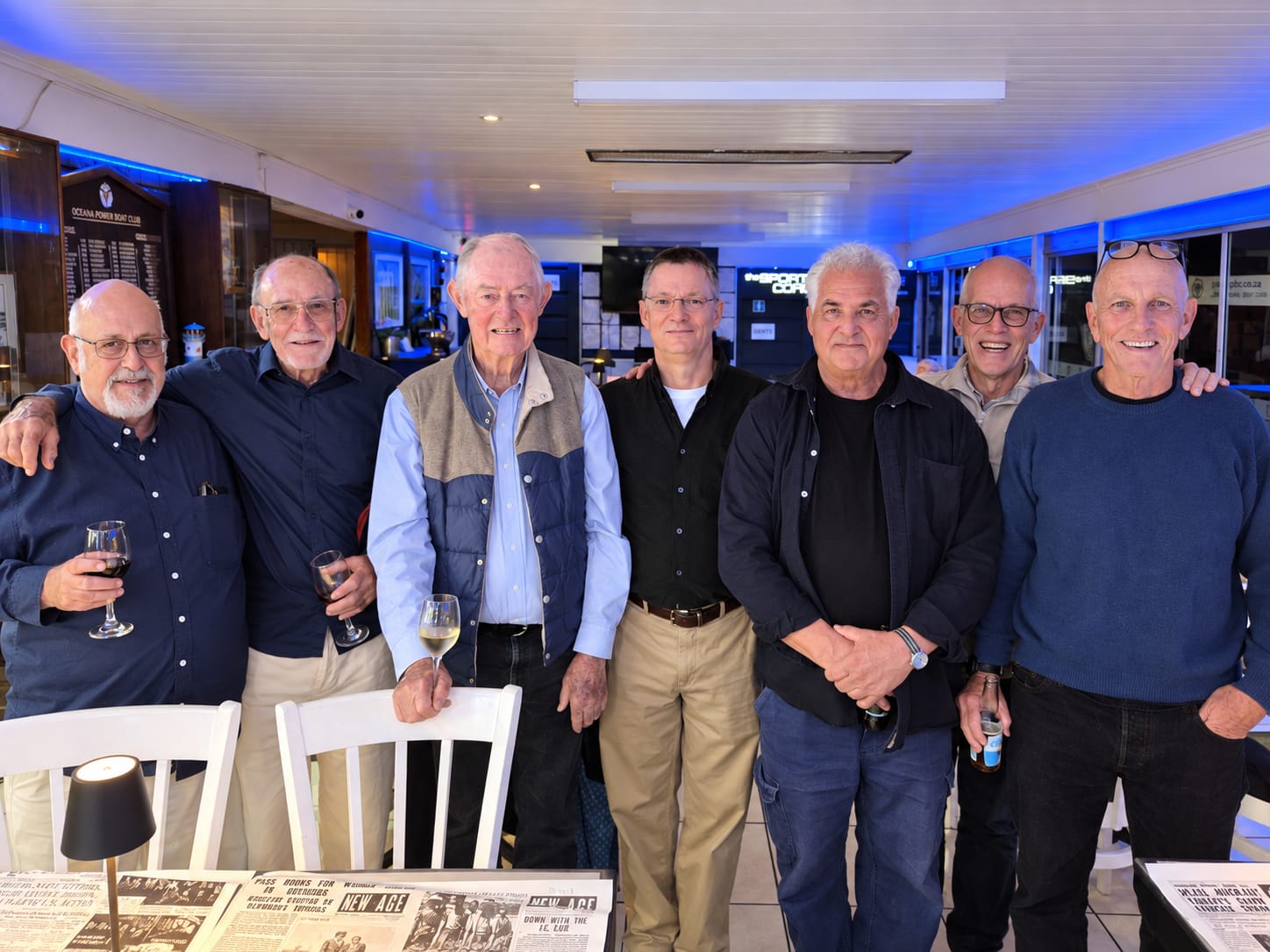
Once a year a group of Sunday cyclists have lunch in Durban North. For the last two years I have been invited. It is great fun, they are almost all my age, and it is good to mix with other active people. Having said that, I have not been able to be as active as I would like recently. My Achilles tendons have been very painful, and I have been seeking care from a sports physiotherapist. He does make a difference but unfortunately it does not last for very long. On my last visit I had him write out a range of exercises I can do, and it feels as though they are already making a difference. Of course, I sometimes feel just being given the exercises is enough, though this never lasts long!

A guest contribution

I occasionally invite people to contribute to my monthly blog. This guest piece is by my and Rowan’s friend Jessica Bothma. I believe Jessica epitomizes the best of the next generation of South Africans. She is a South African artist, sculptor, and writer currently pursuing a PhD at the Hochschule für Künste (HfK) in Bremen, Germany. She holds a Master of Fine Art with distinction from the Durban University of Technology. Her interdisciplinary practice explores materiality, transience, memory, identity and transformation through sculpture and writing, often employing humour as a critical tool to unsettle, question, and reframe familiar narratives.

It’s Never Too Late for Letter Bombs

I sometimes think what we miss most in modern politics is not civility but honesty. At least when people hated you in the old days, they were fully committed. Now our change-makers rely on projection, performance, skincare routines, and a therapised trauma-informed vocabulary.

The new South Africa is remarkable. I am a product of its rainbow-infused nationalism, sans the critical thinking that was quietly eaten by the borer somewhere in our education reforms, between outcomes-based optimism and whatever administrative fatigue followed.

We have somehow managed to become both deeply progressive and spectacularly unequal, which feels like a magic trick. Some say South Africans had more fifteen years ago. That we are regressing, not transforming. We speak the language of healing while living behind electric fences, and discuss land justice from artisanal bakeries, a contradiction I practice more than I care to admit.

Everyone knows the right words now. People say, ‘holding space’. People say, ‘lived experience’. People say ‘centering marginalised voices’, often at impressive volume. It is difficult to explain the peculiar violence of being politically correct while materially unchanged.

My generation is terrified of being labelled racist or phobic in some new and creative way, so we perform equality rather than enact it. Posting and postulating do not put people on buses or keep them warm while they flee in fear.

It is like repainting our home when its foundation is sinking into the earth. Very tasteful paint, though. Earth tones. Sustainable.

I think privilege in South Africa did not disappear; it simply went into therapy. Or perhaps it just learned camouflage. It learnt emotional literacy. It stopped saying offensive things at dinner. It now feels enormous guilt, but only within a fifteen-kilometre radius of Woolworths.

Guilt is such an interesting luxury. It requires safety. Reflection. Bandwidth.

Most people do not have time for ideological self-curation. They are trying to survive load shedding, unemployment, crime, rising food costs, and the low-grade psychic violence of just being South African.

And then there is xenophobia, our favourite national contradiction. Nothing says postcolonial healing quite like blaming Zimbabweans for municipal collapse. I always find xenophobia strangely intimate. We reserve our deepest rage not for the architects of structural failure, nor for the engineers of corruption and theft, but for the person selling tomatoes beside us.

It is easier to hate proximity than systems. Systems do not have faces. Migrants do.

And scarcity complicates morality in ugly ways. It means something when a South African mother cannot get her child into a school because there are no spaces left, or when a clinic turns people away because capacity has collapsed. These grievances are not always born from hatred. Sometimes they are born from desperation, from the humiliation of needing a state that has already abandoned you.

I am also wary of the ease with which privileged South Africans chant “Africa for Africans,” as though solidarity costs nothing when your child is privately educated and your medical aid is paid. Pan-Africanism sounds noblest from behind electric fences.

And yes, migration is complicated. Borders matter. Resources are finite. But I remain puzzled by exactly what vigilante cruelty solves. Dragging a family from their home in the middle of the night feels less like justice and more like brutality, threat, and theatre.

The state fails, everything is up for sale, and somehow the poor are tasked with punishing the poorer. We will do this again in ten years if nothing structural changes.

I am watching us become small. Desperation is tribal. Poverty shrinks our capacity for compassion.

Even so, our selective outrage remains almost artistic. A billionaire can hollow out a state-owned enterprise, but dare a Mozambican mechanic fix a car too efficiently and suddenly democracy is under threat.

In fairness, South Africans have always had unusual political instincts. The new South Africa is wonderful, but there are not enough letter bombs. I do not mean this literally. Mostly. I miss ideological honesty. At least the old monsters occasionally announced themselves.

Now everything feels murkier. Violence has sponsors. Exploitation has funding streams. Outrage has campaign strategy.

I sometimes think our politicians like to dress up as Ozymandias, leaving the rest of us to look upon their works and despair.

I often wonder how much of our anger is organic and how much is fertilised, watered by foreign money, populist ambition, and the ancient political science of giving desperate men a target.

Oppression no longer arrives wearing boots. Sometimes it arrives with a megaphone, a hashtag, and matching T-shirts. We march in the streets and bring entire economic nodes to a halt, as if collapse were a bargaining chip we can still afford to play. It fascinates me that we can collectively engineer shutdowns costing millions, while individually not having enough change for the car guard.

What troubles me is moral vanity. The performance of goodness. The way compassion becomes social currency. The way progressive language can function like expensive perfume, masking something decomposing underneath.

Still, I am suspicious of cynicism too. Human beings remain miraculous in irritating ways. Even in this absurd country, especially in this absurd country, people continue helping each other. Despite all this hate, I still, undeservedly, get called “my love” by the cashier at Spar.

This country survives not because of policy, slogans, hashtags, panel discussions, or mob mentality. It survives because ordinary people perform small acts of anti-collapse. Which is perhaps the least glamorous form of love.

No manifesto. No branding. No applause. No marching. Just mercy, because it is really quite taxing to be South African.

Beautifully taxing.

And the final birthday celebration

I arrived back in Durban on 14 May, after the usual 6 AM flight from Norwich to Amsterdam to catch the 10:30 KLM flight to Johannesburg, overnight in the City Lodge, and then to Durban on an 11 o’clock flight on Thursday. It was all straightforward. I should have gotten the earlier flight down, as I had more than enough time to get to the check-in, one learns. In Durban I picked up a car and drove to Haymarket where I had to negotiate my way into the car park at the back of the block of flats I live in. The remotes had been changed due to an incursion when one was stolen from a car.

Continue reading

Meeting Movers and Shakers in London

I am putting my fingers to the keyboard a little ahead of schedule this month. I wanted to get this blog out before I travelled to South Africa at the end of April. Those plans changed, as I describe later. I’ve had an interesting couple of weeks and am writing while it is still fresh in my mind.

I am a member of the UK board of the organisation ForAfrika. Just over a week ago I was invited to a small gathering of board members in London. The CEO, Isak Pretorious, hosted a dinner in the Conduit Club. It is quite unique, its members are concerned with making a difference, and I think they do.

Continue reading

End of March

I have had a busy time this month. Wednesday, 18th March, was my birthday, a big one as I turned 70. I decided as it was, obviously, a once in a lifetime experience, I would organise several celebratory events. On the day Rowan, my daughter, Ailsa and I went out for lunch to Cafe 33, a popular venue in Norwich. Rowan brought Ledger, our grandchild, of course. He is now seven months old, and I will admit to having the grandparent prejudice of thinking he is exceptionally smart and good looking.

I had never been to this venue but had noted that it is very popular, with queues outside the door, even in winter! I now understand why. The food is excellent and the prices extremely reasonable. The exterior is not very inviting, the frontage is on a busy city street and it is not easily accessible. Once we were in it was really special.

Continue reading

On by-elections and birds

On Friday 27th February we woke to hear the results of a by-election in the constituency of Gorton and Denton in the Manchester area of the UK. By-elections are called when an MP has resigned, been forced to leave, or died. This seat had been held by the ruling Labour party, whose MP was dismissed for writing offensive messages on WhatsApp.

The poll was seen as a key test of the political winds in the nation. The turnout was 47.5%, I don’t think that is high enough, but it was very respectable for a by-election. I personally feel voting should be compulsory, something which is enforced in Australia, and there should be consequences if people don’t vote.

Continue reading

On Films and Books

A couple of weeks ago Douglas and I went to see the movie Hamnet, which is based on the book of the same name by Maggie O’Farrell. Hamnet was William Shakespeare’s only son who died of the bubonic plague aged 11. He contracted it after his twin, Judith, fell ill with it. In the film he lay next to her and asks God to spare her and take him instead. This is what happens, he dies and she recovers.

Continue reading

What will 2026 bring?

This monthly update was started a couple of days before the new year. I finalised it just after New Year’s Day, but took a few days to proofread it.

I find the period between Christmas and the new year to be rather melancholic. However, Christmas day was unique and very special as Rowan, Ben and four-month-old Ledger joined us for lunch. Of course, Ledger does not have much idea about what is going on, but it was a joy and delight to have the little boy present. He is as bright as a button and is beginning to smile and chuckle (although not at me yet!). He has turned into a little person very quickly and clearly has strong opinions.

Continue reading

The Draft is Finally Done

It is hard to believe that it is over six years since we first saw cases of COVID-19, although it was some months before we realised the enormity of the event. By March 2020 the world had entered a lockdown that was enforced with different levels of enthusiasm, restriction and periods depending on the country.

There were many dreadful consequences of the pandemic. But I will be the first to admit that I did not suffer as many people did. There was loss of livelihoods; deaths of family and friends; and psychological impacts, for many being cooped up in a flat or similarly small living space and not sharing significant events with others.

Continue reading

Spring turns to summer

Every Sunday morning, when I am in Durban, I drive to the beachfront. It only takes 14 minutes, provided most of the lights are green. I park next to the iconic Joe Cool’s bar and nightclub, and try to walk for 10 kilometres. The route is to the Point, which is at the harbour mouth. It is only an 8 km round trip, even if I walk down all the piers. I add on a bit by walking past the car towards the Suncoast Casino. This casino, a monument to Mammon and lost hopes, is a blot on the landscape. It was designed as a bit of Las Vegas on the beach. The less said about that the better.

Continue reading

Theatre and Short Breaks

This somewhat meandering blog began in Paternoster, a small former fishing village on the Cape West Coast. My contribution to grandparenting is limited at this stage, so I decided to head for South Africa for a spell. As people who read this regularly know, I avoid Durban from January to April/May; it is just too hot and humid, so this was the last chance to visit for a while.

Continue reading