After the Conference and the Party 2 August 2012

After the Conference and the Party 2 August 2012

The HEARD team are home from the XIX International AIDS Conference in Washington and hopefully are reflecting on what we did and learnt. I am currently in the UK, and was in DC the longest (from Wednesday 18th to Saturday 28th July). This was my last official meeting as Treasurer and Governing Council Member of the International AIDS Society (IAS). On Saturday 21st July we had a breakfast Finance Sub-committee meeting at the absurd hour of seven thirty am, followed by the Executive and Council Meetings (until three pm). The IAS members’ meeting was the following week. I completed my duties as Treasurer by presenting the 2011 Financial Report.

I have learnt a number of lessons attending conferences over the years. The paramount order of business is to get a suitable room at the hotel. The one I spent the first night in faced a busy street and was very noisy, with buses stopping outside from about four o’clock. I spoke to the receptionist and spent an hour the next day looking at rooms before identifying the one that I would call home for the next nine nights. I do not for example; want a room with two king-size beds, I only use one at a time. I walked around the hotel with the concierge, a thick set Liberian gentleman called Shakespeare. He let me into rooms until we identified the best option. I did not in fact make him carry the luggage but he did not seem to appreciate this. I ended up on the seventh floor. It was fortunate that we were at the conference all day because the hotel was being renovated. The work was going on immediately above me, drills and jackhammers from nine o’clock to five o’clock, sleeping during the day would have been impossible.

A second lesson is that airlines do not look after your luggage! When I last went to South Africa, the handle of my case was destroyed. I only remembered that I needed a new one towards the end of my stay in Durban. I dashed to the luggage shop and chose what I thought would be a sturdy case. Arriving back in Norwich I discovered it was missing a wheel and I had a fairly bad tempered exchange with Linda, one of the grounds staff in Norwich. The bag has since been collected and company will decide whether to replace it or repair it. Packing for the Washington trip was not a problem because we have plenty of cases in the house in Norwich. However the return connection from Washington via Amsterdam to Norwich was tight and we were further delayed due to thunderstorms. My bag was not on the carousel at the airport, but I kind of expected this. The person on duty was, unfortunately, Linda.

I walked over to her and said, “So, if you don’t destroy my bags you lose them.”

She responded, “I will get the forms, Mr Whiteside.”

It is rather alarming that I had made enough of a (bad) impression on her that she knew my name, although not my title! As I had anticipated the bag came in on the next flight and was delivered to the house.

I attended bits of two pre-conferences. The first on Social and Political Sciences, where I presented Thinking Politically …With a Focus on the Politics of AIDS Exceptionalism vs. Taking AIDS out of Isolation: Reflections from South Africa, it was surprisingly painful to put this talk together as it brought back the dark days of denialism. The second was the International AIDS Economics Network (IAEN) pre-conference. HEARD was one of the co-sponsors and organisers of this meeting. It is always a pleasure to be surrounded by other economists as it makes one feel ‘normal’. Another spiritual event was the special AIDS service at the Washington National Cathedral, a magnificent mock gothic building. Every faith, sexual orientation and gender was represented (except I think for the scientologists).

There were numerous presentations and meetings at the International AIDS Conference. Of particular interest was a ‘round table’ event organised by the International AIDS Alliance at the British Embassy on the importance of human rights approaches to HIV and AIDS. My conference highlight was facilitating Swazi special interest meetings, held in the IAS offices. We had no idea how many people would turn up: it was billed as an opportunity to hear what was going on in Swaziland for people who work in, do research on, or simply care about the country. To our surprise and delight the room was full for both meetings. It saw the birth of the Swaziland AIDS Research Network (SARN). Unfortunately I was not able to attend the second meeting because I was chairing the rapporteur session (which I did in Vienna in 2010). This is the last formal assembly of the conference before the closing ceremonies. A key attribute required of the Chair is they be able to keep people to time. I can and did. I even made a few jokes. It was fun.
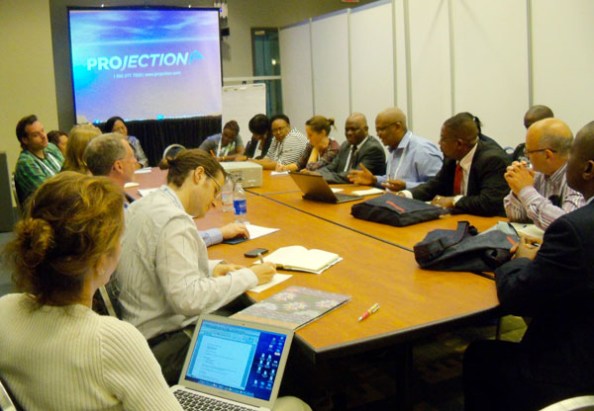
At the Conference, HEARD organised two side presentations at the IAS office. Mine Step Forward the Economists: the changing dynamics of AIDS Funding – was attended by just five people! Kay’s (HEARD’s Research Director) turnout was slightly better (seven). Media events included doing interviews for the Centre for Strategic and International Studies and for a film Positively Beautiful.   The second interview was under lights. Given my lack of hair and the heat I needed make-up to reduce the glare! This worked so well I made sure I powdered my head for the Rapporteur Session, sadly I doubt anyone noticed. I have now got a reputation for rushing about and asking who has make-up available! All HEARD’s outputs presented at the Conference are on http://www.heard.org.za/heard-resources/aids-conference-2012

As I was also present at the meeting as a DFID Senior Research Fellow I had the opportunity to work with my colleagues from London and South Africa. This was a real learning experience as they produced both a ‘Telegram’ and an excellent ‘Back to Office’ Report. I am lifting from my contribution to the report for my reflections on the meeting.

There were two major tensions. First biomedical science now rules. There was little discussion of behaviour change. Second participants heard much about the cost of response and what the funding gap is, but there was no reality check on how the gap might be filled and what to do if it is not. The central theme was moving to ‘an AIDS free generation’. I understand this to mean everyone who needs it is on treatment (thus people living with AIDS, but not dying from the disease) and there be zero new infections. One quick and obvious win will be to eliminate mother to child transmission. Mead Over of the Centre for Global Development has consistently pointed to the concept of an ‘AIDS Transition’ where the number of new infections falls below the number of AIDS deaths. Until this happens the number of people living with HIV and AIDS will increase (as will the need for resources).

Funding was a hot topic. There was an excellent debate at the World Bank offices on the motion: Continued AIDS investments by donors and governments is a sound investment, even in a resource-constrained environment on Monday (which I missed as I was at the British Embassy). It was well attended and put many of the issues out in the open. Here is the podcast. One argument was money is not a constraint! We live in a rich world. Others responded that low and middle income countries do not have access to this money, sadly, true. Interestingly capacity constraints were not mentioned. Bernhard Schwartlander of UNAIDS noted: “The lives of more than 80% of the people who receive AIDS treatment in Africa, depend every morning on whether or not a donor writes another check.”

Much has been written about the Conference. I can especially recommend the blog of Laurie Garrett of the Council for Foreign Relations in New York.

In summary it was worthwhile and fun. The fact that the IAS has been able to bring the conference back to the US (due to the lifting of the travel ban for HIV positive people) was mentioned frequently, and is significant. This was the conference where economists should have stepped forward but did not. Hopefully they will be present, vocal and listened to in Melbourne the site of the XXIAC in 2014. My prediction is that Melbourne is the conference where behavioural science should be prominent and probably won’t. Despite this I do have a sense that we are beginning to win the battle against the epidemic. The challenges will be, as always, to prevent new infections; treat people already infected; and provide for those who are impacted, the orphans, the elderly, and address the needs of the health care services.

At the end of the conference there is always a party for the IAS staff, volunteers and Governing Council Members. It started at about eight o’clock and finished at one o’clock the next morning. Generally these are great fun and this was no exception although I was a little taken aback when my neck was nuzzled by an unshaven male. Clearly I was sending a wrong message.

This posting would not be complete without mention of the Olympic Games which are going on in London. It very much reminds me of the mood we experienced in South Africa at the time of the Soccer World Cup. A major sporting event, it is an opportunity to have a party, and unite in supporting one’s own teams, while making all the visitors feel comfortable and welcome. Britain had not done all that well in terms of winning medals at the time of writing but there is time. On Wednesday I saw two women win the first British gold medal for rowing. Cyclist Bradley Wiggens (who had just won the Tour de France) took gold in the final trials, an amazing achievement. The speed at which they ride is a dangerous 50kph. All the venues are great, and because they are spread out across London and the South East there is a sense that it is more than just one city hosting the games. The train from Norwich to London goes past the Olympic site and I have watched with interest as the building began and was completed. I do hope that this provides a sporting legacy for the country.

Books

Peter Piot, No time to lose: a life in pursuit of deadly viruses, WW Norton & Company, New York 2012, 387 pages.

This autobiography tracks the progress of the HIV epidemic since its earliest days. Peter was the head of UNAIDS from its inception to 2008 – a total of 12 years. This is his story, from the early adventures in Zaire where he was part of the team engaged in the identification of Ebola virus, through to his stepping down from the executive directorship of UNAIDS. It is a fascinating book and an easy read. I took it to my gym and found myself losing track of time. Any book that does this for me has to be excellent. It is particularly engaging since I both know the history and was a part of it. Having finished the book and reflected on it I feel that it is a factual account of what went on and Peter could have put more of his personal story into it. There are gaps, for example the Commission on HIV/AIDS and Governance in Africa, set up by Kofi Annan is not mentioned. I was a member of this, which may be why I wanted to see it cited. The last 50 pages appear to have been written in a rush. Nonetheless this book is an important chronicle of the time of AIDS and deserves to be widely read. One thing that is clear is that we were all ‘making it up as we went along’, there is no way we could have done anything but this. Peter’s comments on the origin of the denialism in South Africa show how bizarre this period was. “Mbeki was an intelligent, indeed coldly rational man; and yet here he was impervious to my reason. What could be the origin of this denialism? I had thought maybe it was economic – the cost of treatment – but after that evening I was convinced that this could not be the case. Psychological, then. …”. Page 280.

Andrea Camilleri, The Track of Sand, Picador, London, 2011, 279 pages.

This is one of a series of books featuring Inspector Montalbano, a Sicilian detective. As always when reading a book that has been translated from a different language I wonder how important the original style of writing was and how important the translation is. The Scandinavian crime writers are a good example of this as they are extremely popular and include Swedish, Norwegian, Danish, and even Icelandic genres. This Montalbano series of books is great fun. It gives a sense of the complex society of Sicily and the characters are kindly portrayed. There is an awful lot of food and a little bit of love in the stories. This particular mystery centres on the body of a horse which appears in front of the inspector’s apartment. It is whisked away while he is trying to get his men to come and assist with the investigation. The story takes off from there and, pardon the pun, gallops to a thrilling end. I recommend these as something more than a light read.

Films

The Best Exotic Marigold Hotel a 2012 British film directed by John Madden. It has a starring cast of older actors Judi Dench, Bill Nighy, Maggie Smith and Tom Wilkinson are the ones I recognised. It is about British pensioners moving to a retirement hotel in India, run by an eager young Indian entrepreneur. He sells the Best Exotic Marigold Hotel, in Jaipur as a hotel “for the elderly and beautiful”. There are a series of stories: an impoverished widow; a gay High Court judge who grew up in India, and who is seeking his first love; a working class racist, retired housekeeper who needs a hip replacement operation (quicker and cheaper in India); and a couple of love stories. The acting was outstanding, the story plausible, and I really enjoyed the fact that I have spent time in Jaipur and so recognised the setting.

Salmon Fishing in the Yemen a 2011 British romantic comedy-drama film. This is the story of a sheikh who decides to introduce salmon into the Yemen as part of a ‘civilising’ and economic development process. His consultant asks the British government for help and the press secretary decides that this is a good news story and a time of really bad news from Afghanistan. The main character is the Scottish expert in salmon fishing who also has mild Asperger’s syndrome: “You can’t insult me because I don’t understand it.” It is also a love story and there are probably many metaphors in it. It has the potential to become a cult film. I am pleased to note that it has been a box office success. The Internet chat between the press secretary and the Prime Minister is beautifully captured on the screen and in the story.

The Girl with the Dragon Tattoo a 2011 American made thriller.

This is the first of what, I hope, will be a trilogy of films since there were three books. It is based on the Swedish novel by Stieg Larsson and stars Daniel Craig and Rooney Mara. It is the story of journalist Mikael Blomqvist’s (Craig) commission for a wealthy Swede to find out what happened to his niece who disappeared 40 years earlier. The film builds and then introduces computer hacker Lisbeth Salander (Mara), who is the ‘Research Assistant’ and while being extremely capable on computers is gauche and uncomfortable with people. There are some violent and distasteful scenes, and it does not end happily for all the characters. I had been hoping to watch it for some time. The flight from Washington to Amsterdam is about seven hours and this film is nearly three hours long. Given that I was in economy class (well premium economy) I decided this was the chance I had been waiting for, although, frustratingly it took over an hour for my seat’s entertainment system to start working, it was reset about three times. An excellent series of books and the first film in series is fantastic; I will look forward to the rest.

July: America, Americans and wonderful Durban winter

July: America, Americans and wonderful Durban winter

I flew from the United Kingdom to Durban on Monday, 11 June. It was the long daylight flight from Amsterdam so as well as working I saw the film  Warhorse. After an overnight stay at the Intercontinental Hotel in Johannesburg and I flew to Durban on Tuesday. I went straight to the office and got a lift home at the end of the day. The next morning was an early start, I went back to Johannesburg, met up with colleagues from the British Department for International Development’s (DFID) office in Pretoria. We drove down to Swaziland where we spend 24 hours in meetings talking about a possible regional HIV and AIDS program. This included a dinner with members of Swazi civil society.

I had less than a week in Durban and then headed for Florence for a UNICEF meeting. On the Wednesday I flew out on the Air France A380, the biggest plane in the world (and it is quite fantastic), to Paris and changed for the flight to Italy. I was rather exhausted when I got in and so slept for part of the day before going out and wandering around the city. The weather was perfect, and it is without doubt one of the most spectacular cities I know. The two day meeting on child well-being was deeply interesting. We finished at about three o’clock on Saturday and I headed for the airport to get back to Paris, Johannesburg and Durban. The EUFA cup game between France and Italy was being broadcast in the lounge. I was the only one who cheered when Italy scored – and they won. I had one night in Durban and then flew to Cape Town to visit the Children’s Institute.

In Cape Town I managed to both deliver a birthday present to my niece in Hout Bay and meet up with my uncle, aunt, cousins and second cousins for dinner. Uncle Fred was one of those people who was an absolute role model for me. He and June live in a retirement home in Pinelands just outside Cape Town. They originally bought two units expecting to be allocated ones adjacent to each other so they could create a decent living space. The elderly lady who owned the one changed her mind about moving. They spent at least a year living in two separate apartments on two floors. When the lady died they were finally able to consolidate. I knew the whole story and happened to be visiting on the day that they got the news of the woman’s death. I am afraid that my reaction was:

“Oh good now you can settle in properly”, which is exactly what they have done.

The University of Cape Town put me up in a nearby guest house. After checking in and having a shower I went back to the reception and took a manager to my room to point out all the things that were wrong with it. These ranged from the steps into the room without a guard railing, actually quite dangerous; through to blankets on the bed – good establishments have duvets which can be washed between every guest, that doesn’t happen with blankets; a faulty shower and a number of other minor issues that were annoying. It was a rather twee establishment and they had a blackboard in the reception area with a quote on it, something like “happiness is a state of mind” and as I walked past it with the manager I pointed out that happiness only has only one ‘p’. Afterwards I thought ‘and so does pedantic’.

I then had less than two weeks in Durban before heading back to the United Kingdom and on to Washington for the international AIDS conference. It was very busy. The buzz in the office, as people prepare for the conference: writing papers, making posters, planning the stand, sending material  and generally getting ready, is exciting and rewarding. HEARD will have a significant contingent and it will be great to see how they do. Probably the best part of my job is seeing people grow and develop.

I was invited to the United States Consulate General’s home, along with several hundred other people to mark the 4th July. He, sensibly, arranged parking at a primary school down the hill and had a shuttle bus taking people to the house. There was a significant police presence as the guests included the provincial premier, various members of his cabinet, the American ambassador, King Zwelithini and other dignitaries. I decided to walk back to my car. Two Metro Police driving past saw me strolling down the hill. They knew where I had been, and asked if I wanted a lift. I have not yet been in the back of a police car and did not feel this was an appropriate time to start so thanked them very much and walked on. I slightly regret this now.

I was planning to return to Norwich on Tuesday. Our university decided to migrate our e-mail system to Microsoft outlook over the weekend. On Monday and Tuesday there were to be teams going around our campus ensuring that the changeover went smoothly. It did not! My PA spent most of Monday at the walk-in center with my laptop trying to get it set up to work on the new system. On Tuesday I went down with her and we kidnapped one of the technical people and brought him back up to the offices to try and sort things out. It took nearly all day. The level of stress was considerable and I correctly made a call that it would be better to delay travel by a day and ensure that I had all the technology that I would need for the next month. It does seem to be working now.

Coming through Amsterdam I had a really pleasant surprise. I used the business class lounge shower, and emerged wearing nice fresh clothes and feeling clean to bump into Father Michael Kelly, a Jesuit priest from Lusaka. He was a really critical part of our AIDS and education work 12 years ago. Apart from being a fantastically nice and thoughtful person he is an individual who I admire and who has mentored me over the years. He is now 83 so these encounters are extremely valuable and need to be savored. We had about 45 minutes to talk before he went off to catch his plane. He is one of the unsung heroes of the fight against AIDS, a most compassionate sensible man.

 The next posting will be after the Washington conference. There will be a great deal of activity on the HEARD website though – www.heard.org.za so you can follow events there.

 Films and books

Warhorse. The story of a horse Joey, requisitioned at the beginning of the First World War from a farm in Devon. The son of the farm, Albert, joins up. Towards the end of the war Joey, after being captured and ‘serving’ the German forces, gets caught up in the wire in no-man’s land. He is released by a German and British soldier in moment of armistice. He is to be put down but is reunited with Albert. The children’s book is by Michael Morpurgo was first published in 1982. The film was directed by Steven Spielberg. It is a moving story and is beautifully made. It is also complex and sometimes there seemed too many subplots for me to entirely follow. The message is war is hell!

A Thousand Words.  This was billed as a comedy drama starring Eddy Murphy. It is a simple tale of an literary agent who is cursed by words. It was badly reviewed, and deservedly so. However on the 23.20 flight from Johannesburg it was watchable and I saw the last 30 minutes over breakfast so did not feel it was wasted time. There are other films on the KLM flights I am looking forward to seeing.

Random Violence by Jassy MacKenzie, Umuzi, Houghton, 2008 238 pages. This is a novel set in and around Johannesburg that has been on my selves for some time. I found it, initially, very difficult to get into. However I persisted and was pleased I did. I hope that she writes more. She has the potential to develop into another good South African crime writer. The end is a bit too much ‘and with one bound he was free’ but in general it was believable, well observed and well plotted. It is set in the period leading up to the World Cup and MacKenzie catches the nation’s mood very well. The heroine is a private detective named Jade de Jong, the daughter of murdered white senior policeman, who returns to SA after 10 years away and gets caught up in a complex plot involving property development and crime.

Relativity

Relativity

I think Durban is one of the nicest cities in the world. I have lived there for nearly 30 years. Ailsa and I bought our first house there and it is the place the children were born. The university has been, for me, a good work environment. At the beginning of my career I was well mentored and then given space and support to start my own unit. HEARD is going well with an amazingly good research output, high staff morale, adequate funding and a throughput of talented young researchers. All this is in our annual report, which will be on the website very soon.

In the middle of April I was in Nairobi, Kenya for a meeting on Efficiency, Effectiveness and Sustainability which the International AIDS Society organised. I am an elected Governing Council member and the Treasurer up to the International AIDS Conference in Washington in July (see www.iasociety.org.) It was a quick trip, flying up on Wednesday evening and returning to Durban on Saturday – I flew on the late flight from Nairobi to Johannesburg on Friday evening, slept at the City Lodge at OR Tambo airport and caught a flight down to Durban at a sensible time.  I used air miles to upgrade the ticket so it was relatively painless. I had a colleague travelling at the same time as me so we chatted and went to the airport together. He will remain nameless given the story I am about to tell.

A while ago I noticed that my Yellow Fever vaccination was about to expire and so went and was re-immunised. Just as well, my companion had forgotten the card. The check-in staff would not let him on the plane without one, and they were quite adamant about this. He had to go across the airport to the clinic and get the shot, paying above the odds for it. Of course it takes time to become effective but this is generally overlooked. Indeed we were not even asked for the certificates! However the South African authorities can be very fierce about this!

I had two nights in Durban and on Monday the HEARD team flew to Johannesburg for the biannual donor and board meetings held at the aforementioned City Lodge. These went very well, with an excellent turnout for both, only one board member was not able to make it. From there I flew, in economy class, to Cape Town, a long two hour flight on a packed plane. This was for a Council on Health Research for Development meeting on the theme of Beyond Aid… Research and Innovation as key drivers for Health, Equity and Development, all the details are the websites at www.forum2012.org and www.cohred.org. This was most interesting.

There is no doubt Cape Town is stunning. I think it is the most beautiful city in the world. Driving in from the airport at about 6 pm the evening light was an amazing rosy shade. Coming round the side of the mountain on de Waal drive and seeing the centre of the city, the harbour with the huge gantries like a row of storks silhouetted against the south Atlantic, and in the distance, Robben Island, was breathtaking. I feel I have a champagne lifestyle on a soda water salary. I get to travel, stay in great hotels, see new and interesting places and meet all sorts of people.

The conference started on the Tuesday, so unfortunately I missed the first day. I was staying at one of my favourite hotels, The Cullinan, they describe themselves as ‘stylishly grand and perfectly majestic’ and I think this is fair. It is just a few minutes’ walk from the international convention centre. The relative merits of Durban and Cape Town are very different. I must admit to being tempted by Cape Town, as one of my friends said it has “the mountain factor”. This must have been the magnet that has drawn my extended family there. Friday was a public holiday, Freedom Day, marking the end of apartheid and the new democratic government. I spent most of it visiting family.

My brother Derek Whiteside was away on business and so I took Lynn, my sister-in-law and my three nieces Emily, Sarah and Katie out for lunch in Hout Bay – to a restaurant called Dunes. It is a stunning setting looking out over the bay with a band of ultra blue water just beyond the breaking waves. In the last while the euphonious dunes have blown away and now the view is straight on to the beach. We were at the restaurant joined by distant cousin Neil Hodgson and his daughter Lisa. He is a captain with South African Airways. As I am silly about aircraft and flying it is always great to talk to him and I (a minority perhaps) find discussing airline routes and types of planes to be deeply interesting. From there I went to visit my Uncle Fred and Aunt June (also Hodgsons) who live in a retirement home in Pinelands. This is on the way to the airport which makes dropping on them very easy. We were joined by my cousin Linda and her daughter Hayley (who has nearly completed her PhD at the University of Cape Town) and her sister, my cousin Sandra who was visiting from Uitenhage. The most family I have seen in a very long time.

Perhaps this posting is not just about relativity but also about reflection. Fred was very senior in de Beers Diamond Company and I have always looked up to him as a role model. Nearly 20 years ago he had a hip replacement operation that went wrong. As a result now finds it difficult to get around. He has a mobility scooter for inside the flat and a more robust one for going out. I still see him as a role model because of his attitude and stoicism.

They moved into the home two years ago expecting to get a large apartment. That arrangement fell through and they ended up with two apartments on different floors. They lived a schizoid life until the space next to theirs became available. Now they have been able to consolidate and expand at the same time, and actually have a very nice warm set of rooms.

Part of the conference ‘package’ was an evening out at Groot Constania, the original wine estate in South Africa, the vines being planted by the first governor of the Dutch settlement of Cape Simon van der Stel. We were taken there by bus, the scenic winding route round the coast, which left me feeling quite ill! However I soon recovered. The food and wine were fantastic and the entertainment was provided by South African diva Yvonne Chaka Chaka. This is what I mean by a champagne lifestyle. Of course one of the questions is who pays, because at the end of the day someone has to. We were told that it was the World Bank, and yet they were hardly represented which was a great pity. Fortunately, after the copious quantities of alcohol and excellent food, we went back on the short straight route.

I learnt, at the meeting, that health is underfunded, but more worryingly the health people do not understand how to advocate for more funding. They think that the fact that their cause is noble, it’s sufficient and this, sadly, is not the case! We know from our work that ‘crowding-out’ is a real issue. If foreign money is given to health then governments will tend to reallocate domestic resources. This is good, basic and responsible public administration. It is not what donors intend! I shall have to reflect on the meeting and write up some notes, since I was there in an official capacity as a person from the Department for International Development, although I would not presume to speak for the organisation. What was interesting was to meet people from a different circle from the one I normally operate in.

Reviews

Music

There has been a lot of music in Durban recently. I went to the University Jazz Centre to listen to a folky duo from Cape Town Andrew James and the Steady Tiger, I was so impressed that I went to hear them again at St Clements, a cafe on Musgrave Road. Their style is great; both are excellent guitarists with mellow voices. I thought they spent far too much time tuning the instruments though and exchanged emails with them about this. Some of their music is on their website. On the Friday evening The Collective, a new venue in Durban, hosted The South Jersey Pom-Poms, which is lead by a colleague from the University.

Books

The suburb of Manor Gardens, which was beautifully and evocatively written about by Barbara Trapido in her book Frankie and Stankie (Bloomsbury 2003), is where we bought our second house. It was let to chaotic tenants for about four years and they left a month ago. When I first went to look at it my heart absolutely sank. There has been work going on and I went to check on progress on Saturday and then went to lunch at a new cafe in the neighbourhood. Exhibit owned by Eunice van der Vloet is a house with an art gallery, table chairs and a limited menu. It is an encouraging addition to the neighbourhood and I hope it prospers. Sadly the estate agents tell me Manor Gardens is a leafy green quirky suburb, and that is not what people want.

I have finally finished reading Catherine Hakim’s Honey Money: The Power of Erotic Capital, (Allen Lane 2011, 384 pages). I found it a thought provoking book. The two key points were: What is erotic capital and the idea of a male sexual deficit. It makes a number of rather challenging statements, but will certainly be of use in understanding behaviours and responding to AIDS.

Pirates and Snow

I was invited to give a plenary presentation at the Caribbean AIDS conference in Nassau in the Bahamas in November 2011. I had never been there, reason enough. An additional incentive was that Roger MacLean, of the University of the West Indies, who invited me, is someone we have worked with in the past and he is a really solid academic. It was too good a chance to pass up. Of course it fitted in very well with other travel plans – invitations to New York and Boston and a meeting HEARD was hosting in Washington. I had a week between meetings and was wondering what to do with the time, as I did not want to travel back to either the UK or Durban. It takes about six days for me to get over the jet lag, and then it would be time to set off again.

Continue reading

Swaziland, The Beloved Country Bleeds: August 2011

Swaziland has been high on my agenda for the past few weeks. I travelled there in late July before returning to Durban. There were two main reasons for my Swaziland visit. First was to meet up with my colleagues at theNational Emergency Response Council on HIV and AIDS (NERCHA), a body formed by the government in order to respond to the epidemic. I have been working with them since they were established. The second was to go to Waterford Kamhlaba School for a number of events including our mid-year Governing Council meeting.

I flew into Matsapha airport, and as usual, picked up a car. Driving through the industrial estate, I found myself behind a mini bus with five large colour photographs in the back window. Moving from left to right they were of: Che Guevara, Osama Bin Laden, Muammer Gaddafi, Robert Mugabe and Julius Malema. The last may need some introduction; he is the young firebrand leader of the African National Congress Youth League who makes frequent intemperate and irresponsible speeches. Most recently he and his comrades called for the overthrow of the Botswana government as it is “led by capitalist lackeys”. This did not go down very well in South Africa, and of course was even less appreciated in Botswana! I wonder why the driver put up those particular photographs, and in that order. It was clearly a message but it went over my head.

The visit to NERCHA was, as always, inspiring. The staff are an excellent bunch and I am proud to be associated with them. The country is facing a crisis which is the subject of two separate postings on this website. The first is a briefing that I am putting up on this website separate from my usual monthly blog and the other was co-authored with Jacqui Hadingham for the Royal African Society.

When I was in Mbabane (and this is reflected in the postings) the talk was of imminent government bankruptcy. Swaziland had asked the South African government for a E1.2 billion loan as the International Monetary Fund and the African Development Bank had turned them down. On my return to Durban the news came that the King secured an E2.4 billion loan from South Africa on quite favourable terms. He was hailed in the (government owned) media as the saviour of the nation. The Swazi opposition and some of South African unions are outraged. Quite what will happen next is not clear: it is not time to give up.

I was invited to open the student’s annual art exhibition at Waterford. It was a flattering invitation. I took it seriously and carefully prepared my brief opening remarks. There was, I hope, one key message: hard work and practice are necessary for good art. I hung the message on the example of Lucian Freud who died the previous week. His obituaries described how long it took for him to complete his portraits. The second example I gave was that some years ago I exhibited a piece of work as part of the annual ‘Member’s Exhibition’ at the KwaZulu-Natal Society Gallery. This convinced me that, as an economist, I do not have an artistic bone in my body but also good art requires good craftsmanship. I was told that my remarks were well received and appreciated.

The Governing Council meeting was long but productive. For the first time in a long time there were no major issues or crises to deal with. The school is running well. It looks as though there is more demand and then there are places and the calibre of the applicants remains high. Big issues we had to consider were at what level to put the fee and salary increases at for next year. This is always the task of the July GC meeting. There was a discussion of the economic crisis and the effect it will have on Swazi parents. The best way forward may be the creation of a ‘hardship fund’ of some description. We already give a significant number of bursaries, cannot set differentiated fees, and need to be pro active and imaginative.

Films and books

Lincoln Lawyer (2011) based on a book by Michael Connelly, this is the story of a lawyer, Mickey Haller, who works from his car in Los Angeles County. He is employed to defend a wealthy Beverly Hills playboy, Louis Roulet, accused of beating up a prostitute. Initially the lawyer believes his client was in the wrong place at the wrong time. He then sees similarities to an old case where he persuaded the client to plead guilty. Haller decides Roulet was guilty of this killing but cannot divulge this because of attorney-client confidentiality rules. He gets Roulet off on the case he is retained on, but manages to get him arrested on the earlier charge. The book is good and this film is an excellent courtroom drama that I found gripping. 8/10.

Green Hornet (2011) is what we would have called a ‘skiet and donner’ movie. Literally a ‘shoot and beat up’ film. It was not my first choice on the plane. Even given the heightened emotions of travelling, it turned out to be fun and quite thought provoking. It begins with the relationship between a boy and his wealthy father who publishes an influential paper. The son inherits the paper and, with a former employee of his father (a kung fu expert) the two join forces to fight crime. . The son Britt Reid creates a superhero persona for himself, ‘The Green Hornet’. At one level this is a simple film packed with action. On another, it looks at father son relationships; the relationship between the two young men (platonic); how one can be spoiled by having too many resources; and the role of the press. Of course the classic study of this topic is Edmund Gosse’s Father and Son, published in 1907, which was one of our set books at school. 6/10

Eat, Pray, Love (2010). Based on the runaway best seller by Elizabeth Gilbert this is the story of discontentment. Julia Roberts plays Gilbert, a young married woman with everything a modern woman could want – a husband, a house and successful career, yet, she finds herself lost, confused and searching for what she really wanted in life. She gets a divorce and travels for over a year to three destinations spending four months in each: Italy (eat), India (pray); and Bali (love). It is the story of a journey of self-discovery. I read the book some years ago and found it interesting but indulgent. The sequel Committed is more interesting but

Swaziland: The Crisis Continues: 5 August 2011

In May 2011 I was asked by the Royal African Society (RAS)2 to prepare a short commentary on the current political situation in Swaziland. There had been an increase in attention towards the country with news of protests and economic decline. The analysis was intended to stimulate discussion on whether political reform was likely.

At the end of July, I spent a few days in the Kingdom. The primary reason was to attend a Governing Council Meeting at Waterford Kamhlaba School but I also took the opportunity to meet with a number of people outside this community. I spent time with the National Emergency Response Council on HIV/AIDS (NERCHA) and presented an update on recent events, including the IAS Pathogenesis Conference.

We were briefed on the Swazi economy; the political situation; and the rule of law. On the basis of all of these meetings, and other observations, I am reporting on the situation. It does not make happy reading. If I were in the prediction business then I would say in the next six months the crisis will reach its peak.

The Economy

The economy is in dire straits and the country is bankrupt. Earlier this year, the International Monetary Fund suggested the government declare a ‘fiscal state of emergency’ and offered support subject to Swaziland following a road map of measures. This would have included laying off staff and reducing government expenditure. The government declined to do this. There was a view that the country would not meet its July 2011 salary bill but it has in fact done so. The civil service and security forces are now under pressure to take cuts in pay.

The country has seen a 60% fall in revenue, primarily because the South African Customs Union (SACU) payments have dropped (SACU members are Botswana, Lesotho, Namibia, South Africa and Swaziland). This was not a surprise. The government, international agencies, donor community and Swaziland watchers have been aware of this expected fall for many years. See for example our brief and longer article on our website. Brief at: www.heard.org.za/downloads/health-expenditure-implications-of-sacus-revenue-volatility-in-blns-countries-issue-brief.pdf.

In early August the King went to South Africa, cap in hand, asking for emergency funding. The country has received R2.4 billion. South Africa has put conditions in place for better fiscal governance (but there are few on democratization, this has caused great unhappiness among South African unions and others). This loan is a stopgap. Until such time as there is good economic governance there will no new investment in the country. At best the economy will slowly contract, with debt rising steadily.

Politics

Swaziland is the last absolute monarchy in Africa. King Mswati III seems oblivious to pressures to reform; the suffering of his people; and does not understand basic economics. Quite how the country operates politically is unclear, even to informed Swazis. It is a nepotistic, autocratic, kleptocracy where the ruling elite treat the national treasury as their own personal bank. The election system of tinkundla is Byzantine and impenetrable. Although there were constitutional reforms in 2006, political opposition remains banned. Nonetheless there are a growing number of protests and the trade unions – possibly with help from across the border – are flexing their muscles.

The Legal Situation

There is a crisis of law and the independence of the judiciary is under threat. Chief Justice Michael Ramodibedi was appointed as Chief Justice by King Mswati. He is from Lesotho and also sits on the appeal court in Botswana. He issued an order preventing anyone from “directly or indirectly” suing the King. He then suspended High Court Judge Thomas Masuku. In a case filed recently with the Judicial Service Commission, the Law Society accused Ramodibedi of sexual harassment. The Judicial Services Commission banned Swazi press from publishing details of the complaint.

There is an excellent source on Swaziland at: http://swazilandcommentary.blogspot.com.

What Does this Mean for HIV/AIDS?

Swaziland has the world’s highest HIV prevalence. In the last ante-natal clinic survey 42% of women tested were HIV-positive. The 2006 Demographic and Health Survey (DHS) found that 26% of all Swazis between 15 and 49 years were infected; among men prevalence was 20% and among women 31%. Overall HIV population prevalence was 18.8% across the nation meaning about 200 000 Swazis are infected. The response, coordinated by NERCHA, ironically is one of the country’s few success stories.

NERCHA was created through an Act of Parliament, in 2001 under the Prime Minister’s office. It is charged with coordinating and facilitating the HIV/AIDS response and implementation of the national strategic plan. Its main sources of funding are government and the Global Fund to Fight HIV/AIDS, Tuberculosis and Malaria, and it acts as a conduit. The second major source of funding in the country is the US government. PEPFAR provided $38 million in the 2011 financial year.

The exceptional measurable progress is that approximately 70% of those who should be on anti-retroviral therapy are receiving the drugs. This is 65 000 of 84 000 people and therapy is administered at the 350 or lower CD4 cell count level which is extremely impressive. There has been great success in the area of prevention of mother to child transmission. Approximately 97% of women visit the ante-natal clinics, and 85% of those who need drugs are started on therapy. Prevention has been slow to show results. There is a major programme of medical male circumcision with over 30 000 men circumcised in the last three years. Various other initiatives are also in place.

Threats

The lack of government money means that NERCHA’s funding is under threat. They asked for E63 million3 for the April 2011 to March 2012 financial year. They were allocated E47 million (about E4 million per month). For the four-month period ending 31 July 2011 they have only received E4 million of the E16 million allocated. There is no indication as to when, or indeed if they will get the next subvention.

Swaziland was unsuccessful in its last Global Fund bid. Globally there are concerns about US funding. The US House of Representatives Appropriations Subcommittee Bill would cut 9% from current global health funding levels and 18% from President Obama’s FY2012 budget request. It is not clear how this will operationalise in Swaziland.

The Ministry of Health is charged with implementation but government is creaking and it is unclear as to how sustainable the response will be.

Conclusion

As early as 1993 we were warning of the potential social and economic consequences of this epidemic for Swaziland. While it has taken longer than anticipated, the AIDS epidemic in combination with the failure of governance and economic contraction means Swaziland faces a bleak future. Ironically the glimmer of hope is in the response to HIV and AIDS where civil society is powerful and the receipt and disbursement of outside funding is efficient and honest.


1Alan Whiteside grew up in Swaziland and maintains close links with the country. He has written extensively about Swaziland, and is working on a book The Political Economy of Swaziland intended for publication in early 2012
2The RAS undertakes research, analysis and host lectures and meetings of African interest. Its website with commentary is African Arguments
3The Swazi Currency the Emalangeni (sing. Lilangeni) is on a par with the Rand, and Swaziland is in a Common Monetary area with South Africa.

Prime Circle: Easter 2011

This posting could be entitled ‘Pregnancy, Prime Circle, and Team Building’ as these are the three dominant themes of the past couple of weeks. Most of the Easter weekend has been spent working. I have finally emerged from a mass of administration and planning to resume writing my Swaziland book. ‘A Political Economy of Swaziland’ is what I have optimistically titled it. I am over half way through now and do need to get it to the publishers since it is at least 18 months late. But I have really enjoyed working on it. Swaziland is such an interesting and usual little country, and at the moment, there is a degree of political change which is exciting.

I went to Swaziland for a few days at the beginning of April. Apart from doing some additional book research this was to attend the first Waterford Governing Council (GC) meeting of the year. I have been on the GC since 1994 so have some institutional memory! In 2008, for the first time, since I joined, the GC was faced with having to make a decision around pregnancy. One of the female students, from a poor area, had fallen pregnant. We decided, probably wrongly, that the main concern was the baby. I say wrongly because as Governors our prime concern should always be the well-being of the school. We took a decision that the girl should be sent down for a year, but could return at the end of this. She did and is now a scholarship student at an internationally known university. Having set policy, the Headmaster then took the same decision in 2010 when he was faced with a second pregnancy. The same outcome was reported, the student is back at school and doing well.

At this GC we had a variation on the theme. A pregnant female student, but the father acknowledging his paternity, is also at the school. A policy decision had to be taken. What was most interesting for me is that while we can make a broad policy, we cannot cover every eventuality. What if the girl says she was made pregnant by a male student, but he refuses to acknowledge this? Given that he would face sanction this probably makes sense for him. Do we carry out a paternity test? What do we do if the girl says she was raped? It is clear that while there are in many instances there have to be rules, flexibility is necessary. Of course in other cases there should be no leniency, for example the school has a zero tolerance rule when it comes to drugs.

Back in Durban I have been very busy with work but found time to go to two gallery openings, one at theKwaZulu Natal Art Society Gallery. The main exhibitor was a botanical artist which I do not find terribly exciting. The second at Durban ArtSpace is a very unusual gallery in an industrial area of town next to the railway line.This was entitled wo.man and was way over my head. Most interesting though, I did not know a single person there although I did recognize one, he had been at the KZNA opening. Perhaps this is a little sad!

Cultural activities continued when I went to listen to ‘Prime Circle’ a South African band who described themselves as South Africa’s leading rock band http://www.primecircle.co.za This was at the Gateway shopping Center about 35 km from my flat. I find I drive slowly along the motorway, trying to treat the car with love and respect. It is after all nearly 20 years old now, bought new and registered in 1992. However as it has only done 130,000 km I think it is good for a few more years yet.

We have been looking at ways of building the HEARD staff into a more cohesive unit. Much as I hate the term, ‘team building’ is a good idea. So last Thursday we headed off for a team building experience. The decision was taken to go to cooking school for a half day. Fusion is not very far from our campus in Westville see and they have a great restaurant in Durban We were divided into three teams, and set to the task of cooking Thai style chicken breasts stuffed with various herbs and spices. For the vegetarians stuffed mushrooms were the option.

This slideshow requires JavaScript.

Each cooking station was allocated a student, described as a ‘cooking fairy’ to assist us. It was quite an experience. The key learning for me was that you need equipment and enthusiasm. The desert was banana pancakes skewers lightly brushed with a reduction of sugar and flavorings, including vanilla, and rolled in grated chocolate. A good time was had by all, and certainly I feel less intimidated by the thought of cooking now. To be fair the bulk of the work was done by one or two people on the team.

I am amused to look at my browser and see that I have two websites open one for Fusion and one a classic article by Sidney Kark on the ‘Social Pathology of Syphilis’ published in 1949. It identifies migration as one of the major drivers of sexually transmitted diseases in southern Africa.

This week I have twice been reminded of how nice it is to be fit and young, although it is possible to be young and not fit. I played squash with Jeremy Grest and his son Adam, who is in his early 20’s. Adam gets round the court without stopping, it was only guile that allowed me to win points and he beat me! On Sunday evening I went for a long run (in time rather than distance). Two of the children from the flats were playing by the gate.

“Are you going for a run”, asked one.
“Yes”, I replied.
“My brother has just gone”, he said. This brother being a lean lad of about 14.
“I’ll try to catch up with him”, I responded as I started my standard slow plod.
“He was running much faster than that”, said the boy disdainfully.

I ran up past St Augustine’s hospital to Ridge Road, and then down the bottom of the Pigeon Valley nature reserve. The monkey troop that live there were raiding across the street and looked at me with disbelief. From there to the Howard college campus, then back along what was Manning, and is now Lena Ahren’s, Road. It was the magical hour when the sun has a particular evening tint, and Durban was stunning. Interesting up the hill, security gets tighter, and the dogs bigger, more numerous and louder.

Films

Men who stare at Goats, we bought a DVD of this film a while ago. It was seriously damaged and so unwatchable, but this only became apparent about 40 minutes into it. I hired the DVD the other night and so have finally seen it. I really enjoyed it. It is just about credible that people could behave in this bizarre way in the interests of … what? It is the story of reporter in Iraq who meets Lyn Cassaday who claims he was part of the New Earth Army who employ paranormal powers. George Clooney stars and there is no love interest!

On The Road Again: March 2011

The train journey from London to Norwich is one I have done countless times. On the third Sunday in February I flew from Durban to London, spent Monday at the DFID office in Palace Street (the building actually overlooks Buckingham Palace), then headed for Norwich to spend a few days with the family. It was dark by the time we pulled into Norwich in the late afternoon, I had forgotten how early the night begins in February in the UK. Long summer evenings make up for this to some extent, but it was still a shock.

On Friday I went back to Heathrow to fly to Boston for an International AIDS Society Executive Committee meeting. The railway company advertised wireless access on the train and I decided to try it. It cost only £2.95, which seemed reasonable. The signal was excellent the whole way down, better than mobile phones which fade in mid-conversation! It is a pity the battery on my computer is not keeping a charge at the moment. It is really good to see technology that works well.

I wish the same could be said for Virgin Atlantic. They were flying a small Airbus on the route from Heathrow to Boston, and the only way to get computer power was to spend £50 for a special adapter. The cabin controller explained to me that Virgin had ‘incidents’ when passengers left their laptops on and there was overheating and fires (I think she meant potential fires). I said that my usual carriers KLM/AirFrance and South African Airways did not have this problem, and why was that? There was no sensible answer. I gave her my card and she assured me that the airline would write and explain. I am still waiting for the letter. It may, of course, be that they do actually send a letter and it has gone to Durban, but surely most people use e-mail.

In my few weeks in Norwich in February and March, there was evidence that spring had finally arrived. There were snowdrops and crocuses out in the gardens, looking very pretty, and the daffodils appeared by the time I got back from the second trip. I love the scattering of flowers across the lawn, looking like islands of colour. There is a small pond next to my office window, and this year there were probably four or five pairs of frogs busily laying their eggs in it. There was been a chorus of croaking, which I have not heard before in the UK. It has taken a few years for the frog population to build up to this level. I wonder if part of the causality may be that the cat is older and less likely to hunt them. The pond will be full of tadpoles in a few weeks, then the garden crawls with tiny frogs.

I was in Durban for about five weeks in January and February, although it is hard to believe that looking back. I did get to the beach a few times with my body board, and can confirm that I really don’t know what I am doing. In a 45 minute session I am lucky if I manage to catch one wave! It is time to get a few lessons; fortunately the former boyfriend of one of Rowan’s friends was the KwaZulu-Natal champion body boarder so I know where to go. Learning to surf (well body board) was one of my 50th birthday resolutions. The other two were to learn to fly and ball room dance. It is possible to be bad at body boarding and dancing and I am; flying is another matter.

I normally dread February in Durban, it can be so very hot and humid. This year was surprisingly clement, and although I used the air conditioners, it was not excessive. Towards the end of last year I noticed a small bird nesting in the unit that cools the lounge. It had to be cleaned and serviced before it worked. My decision was to wait until the chicks had fledged and departed. Fortunately the Berea Gym, http://www.fitnesscompany.co.za/FC_home.php which is where I go in Durban, attracts a range of people and my trainer recommended one to do the work. It was at my convenience and a reasonable rate, both hugely advantageous for me. There is now a new wire mesh in place so the birds will have to look for a new site next year, they have been given notice. There are definite advantages in belonging to a good gym that attracts a range of people, from professors (at least three I know) to artisans.

The highlight of relaxing time in Durban (and there was not all that much of this), was going to listen to Mango Grove http://www.mangogroove.co.za at the Botanic Gardens on Monday 14th February, a Valentine’s Day concert. I told the staff at HEARD that this was where I was going and that people were welcome to join me. There were not many takers! Why be surprised though, Valentine’s with the boss is not what people would immediately think of. It was a beautiful evening, not too hot fortunately and not raining, which is always a danger for events there. Sitting listening to great music of Africa with, as background sound, the piping of the tree frogs and the chirps of the fruit bats was a treat. The Gardens are an asset for the city, over 100 years old now.

An unexpected occurrence was the passenger window of my car falling into the door. This is one of the things that happens as the car ages. It is nearly 20 years old, but only has 120 000 kilometres on the clock. Another reason to be grateful for the weather is that the car’s air conditioning stopped working about five years ago. I was told that it was simply not worth getting it fixed, it would cost nearly as much as the car is worth. I don’t mind driving with the windows open though, an environmentally friendly, manual mode of cooling.

The team at HEARD is working really well. We have a large number of academic publications, which is one of the key metrics by which we are judged in a university setting. More than that, I believe that the work we are doing is influencing policy and even making a difference in people’s lives. The direction seems reasonably clear; we have a very good senior management team with Kay Govender having joined us from Psychology for two years as Research Director. Samuel Gormley has been there nearly a year now as the Operations Director. We even had good news, finally, on a grant that we ran for 10 years. The close-out accounting they produced suggested we needed to pay back about $40 000, our figures said we were due about $66 000. Having gone backwards and forwards our figures were finally accepted and this money will pay a salary for a year or more.

I hope that in the course of this year we will see a couple of staff graduate with PhDs, or at least submit them. There is a good chance that some can do this via the publications route. I need to find some time to sit with the CV’s and as we say in South Africa “make a plan”.

Having been in Boston for two cold days on the Sunday I went on to, even colder, Ottawa. Travelling is mostly fun and I am really lucky to be paid to do it. Leaving from Boston encapsulated the human condition with two vignettes. As I went up the escalator to the departure gate I looked back down to the arrivals area. There was a little tot of a girl, bundled up to the nines in a puffy pink coat, pulling her case which, standing up, would have been as tall as she was. She caught my eye, beamed at me and waved furiously. I wonder why? Then at the top of the top of the escalator were two airport staff, both Hispanic. He was weeping, red eyed and desperate; she was standing uncomfortably but clearly wanting to give solace. What was going on there? Airport stories are frustratingly fleeting. There was a US security officer who stood solemnly, watching the passengers who had passed through the screening. What was going though his mind, what a waste of a person. But perhaps not, it is a job and one of the real challenges we face in Southern Africa is employment creation.

From Ottawa I flew to Montréal and then to Geneva, a direct flight which was a blessing. I had the Sunday mostly free, found a gym, had a long workout but also did a great deal of work in the hotel room. I have been going to Geneva for a long time and have always found the hotels to be of a mediocre quality. This is one I had stayed in before, Hotel Rue des Alpes, and I have to say it is transformed. The rooms are comfortable, light and well furnished. Quite a change from the pokey, dark and expensive hotels I stayed in on previous visits.

I returned to the UK via Stansted airport on EasyJet. This was a complete shock; it is years since I was on a budget airline. The way costs are cut seems to be to reduce customer service to a minimum. I had my boarding card, it actually constituted the ticket. Arriving at the airport you are required to print your own baggage tag, not complicated for people who are used to doing this, but as a first timer I found it very stressful. When I get stressed I sweat, not an attractive sight at all.

The next step is to queue up and deliver your luggage to the check-in counter. As an EasyJet passenger you have no access to any lounges and once you board the plane there are no allocated seats. There was a trolley service but you pay for everything. The plane was about an hour late leaving and 30 minutes late getting in to Stansted and then there was a huge queue for the immigration control which I was not expecting. It is clear that budget travel has transformed the way people think about distances. My view is I would rather not travel at all if this is the way I have to do it. However this may be mediated by the fact that at the moment all my travel is paid for. I might have a different view in the future.

I was back in Norwich for a couple of days and we drove up to York for a night. The dog came with us; as did the dog food was in a rather nice Tupperware container. This was unfortunate because in the hotel in York I took a pinch of it and ate it thoughtfully, thinking it was muesli. I don’t know who was more offended, me or the dog. She looked at me with shock. Douglas had a day with a friend, and we went into Scarborough, a Victorian seaside town. It is really nice, and I observe that budget airlines and cheap travel mean that these resorts are battling to sustain themselves, a great pity. The town is nestled in a little hollow on the eastern coast in Yorkshire. There is a ruined castle sitting brooding on one of the headlands. There is a small harbour, which is used by fishing vessels and pleasure craft. The fishing boats ranged from tiny to trawlers with their own rubber ducks.

In mid-March I was invited to present at a briefing for the Africa All Party Parliamentary Group (AAPG) at the Houses of Parliament in London. The title was: ‘Swaziland: a kingdom in crisis? HIV AIDS, gender and rights’. This was a joint meeting between the AAPPG and the Royal African Society. The main speaker was Siphiwe Hlope, the founder and director of SWAPOL (Swazis for positive living). She is a powerful individual who spoke authoritatively and from the heart.

It is always amazing to go to the Parliament, the building is remarkable and to walk through the Great Hall where both Charles I and Guy Fawkes were tried and condemned gives one a sense of history. Today most people simply hurry through, oblivious to the story that the stones, have to tell. My brief intervention was to say: to understand the HIV epidemic in Swaziland, it is important to know the history of the kingdom. I believe, and this is what I am trying to write in my book, that colonialism, alienation of the land, capitalism, apartheid, gender relations, the monarchy and migration have all played a critical role in allowing HIV to get a foothold in the country and to spread so rapidly. If we understand the history we may be able to act.

I had a couple of weeks in the UK and then headed back to southern Africa. I will get to Swaziland for a Waterford Governing Council meeting and HEARD is hosting a number of conferences and trainings in Durban. One is on systematic reviewing; it is something I am very keen to attend as it seems a methodology that we can use in our research. It is a way of getting one’s head around the big picture. We will have someone from the South African Medical Research Council come up to Durban and teach it to over two days. Somehow I have to get going on the Swaziland book and finish it, it is long overdue. So let me end this update here.

Films

RED is the story of ex-CIA agents being hunted down and killed because of an event they witnessed or were involved in decades earlier. It has an all star caste which included Helen Mirran and was great fun. I regard it as perfect airplane viewing.

The American by contrast was excellently made and full of suspense. It is the story of a hit man hiding out in a picturesque Italian village. The characters are well developed and sympathetically drawn. There were only three main characters; the hit man, a prostitute and a priest. The star is George Clooney, which is why I choose it in the first place. This was shown on the Virgin flight and all the entertainment was on a cycle which meant that it was important to be sure that you wanted to watch the film when it started! The ending was quite unexpected and moving.

Black Swan. This is a disturbing film. It is the story of a ballet dancer pushed to the limit. For me the big question was:’to what extent did she have agency’? Was she a helpless pawn in a system that takes people in, uses them, and spits them out or was this what she wanted? What was her mother’s role in this? The director came across as a total shit, but maybe that is the way you have to be if you are leading a company and have to turn out commercially successful productions. I am glad I saw it though and will now try to see ‘The King’s Speech’ which is what I have been looking for on the flights I have taken, but it has not been on.

Love and Other Drugs is a the only film not seen on a plane. It is a 2010 comedy based on the non-fiction book Hard Sell: The Evolution of a Viagra Salesman. The story is of a young man who becomes a medical representative selling a Viagra. He meets and beds the patient of a doctor he visits, she is suffering from Parkinson’s disease. The film describes how they negotiate their relationship and is done sensitively. It is typical aeroplane viewing, but I went to see it in a cinema.

Slow Durban: January 2011

In front of my flat there is a jacaranda tree. Since I am on the third floor I look straight out into the upper branches. The first blossoms begin to appear in October. By November the tree is covered with purple flowers. Gradually the green leaves take over, and today, in early February, there are only two sprays of flowers. The rest of the tree is a verdant green. The birds enjoy it, constantly flitting in between the branches. I have slightly mixed feelings about the birds. I am woken up by the dawn chorus, which begins at about 04:30. By five o’clock it is light. I generally get up soon after this and make my breakfast.

For the last week I have been at my office by 06:30. This has its advantages. One is that the world seems clean and bright at that time of day. Driving up through the bush and nature reserve surrounding the University the other morning I saw the largest gathering of monkeys I have ever seen in Durban. I suspect that a number of troops had joined together, because with all the rain we’ve had food must be abundant. A few minutes later there were two mongeese next to the road.

I have even seen a legavaan. As an aside I note that my computer does not like the word mongeese. What is the plural of a mongoose? Mongeese or mongooses? Nor does it recognize legavaan (a species of monitor lizard) the link is: http://en.wikipedia.org/wiki/Varanus_albigularis.

I got back to Durban in the middle of January, having spent four nights in Johannesburg at a Global Poverty Dialogue. This was organised by the Brooks World Poverty Institute of Manchester University. The out of town delegates stayed at Melrose Arch in a very nice hotel, and the meeting was in Turbine Hall in downtown Johannesburg. This was once the city power station, coal fired and huge. It has been turned into a spectacular and historical conference venue and it was great fine to be there, although having to board buses and go backwards and forwards in rush hour traffic was not so much fun.

I have rather enjoyed Durban. January, February and March can be very difficult months as it is often hot and humid. So far, touch wood, this has not been the case. We’ve had a fair amount of rain but also there have been cool breezes blowing. This was just as well as the air conditioner in the lounge was not working. I noticed a small bird nesting in it just before I left last year. When I switched it on it just blew hot air. Today one of the chaps from the gym came up and pulled a mass of twigs from the inside of the unit and gave it a service, so room is cool and it did not cost me a fortune. I had not switched it last year on as I did not want to disturb the fledglings.

This past month has been marked by two sad events, the deaths of two people who were very much part of our Durban experience. The first was Dinah, who lived in the servant’s quarters at Manor Drive. She had been there for a long time when we bought the house and we allowed her to stay there, as she worked in the neighbourhood. It was a real eye-opener to see how people were treated under the apartheid regime. The room had no ceiling, only one window, no electricity, and no hot water. The walls were of a thinner brick than was used in the main houses. We put in a ceiling, a second window, and ran a power supply to the khaya, as these little houses were called. Dinah retired about six years ago and moved back to her home in the Transkei.

She was in regular touch with her last employer. Apparently he phoned her couple of weeks ago. She asked after his ancient parents. He replied, “they are very tired”.
She said, “yes I am tired too”.

The following evening Dinah went to bed and simply did not wake up. This is not a bad way to go.

By contrast the death of my past time domestic helper has been difficult for everyone. About three years ago she got TB, which was I learnt, because she was HIV-infected. Fortunately in South Africa people with TB and HIV go on to antiretroviral therapy earlier, and although her CD4 count was about 350 she got the medication. Unfortunately some of the drugs have side effects and she was one of the unfortunate few who experience this. In particular a drug called d4t causes difficulty for the peripheral nervous system and makes it very difficult to walk. This affected her. It was clear that she would have to stop working and her other employer and I were discussing what pension arrangements we could make.

Before Christmas she had a bout of flu and never really recovered. She was bed ridden and extremely unwell. Early in the new year the person one whose property she lived took her to a nearby private hospital where they diagnosed dysentery, TB and pneumonia. She was relocated into a government hospital and a few weeks ago transferred to a TB hospital for recuperation. Unfortunately she did not recover. Her daughters were able to visit her the day she died and learnt that the plan was to send her back to the main hospital. She was just not doing well.

She was one of those powerful women who held the family together. She got her two grandsons into good local school in Manor Gardens and was very ambitious for the grandchildren but less patients with her two daughters. I was appalled to learn that her eldest grandson, having had the benefit of an excellent primary education, is currently not in school because his parents have been unable to find a place for him. Had she been well enough she would never have allowed this to happen. While the proximate cause of death may have been TB, I suspect she was simply exhausted. She was about 54 years old, two decades younger than Dinah. You will have noticed I have not written her name, the stigma surrounding HIV means I am very reluctant to identify her.

I had intended to spend my first Saturday of February working. This did not happen. I went to the gym at eight o’clock, and met the person who was to fix my air conditioner. He came to the flat after he had trained, worked out that is – he knew what he was doing with the units. This meant I only left for my office at the university at about 11.00. I discovered that the air-conditioner there was not switched on, and it was far too hot to concentrate.

I came back to the flat and decided to go to the beach with my body board. On the way there I went to the voter registration station. At the moment the government has a campaign to register voters and since I have moved I needed to get on the electoral roll. There are local government elections coming up. This registration was surprisingly painless: an interesting combination of high and low technology. The form was filled in with a pen. Then the identity documents of both the person registering me and mine were scanned by a hand held device. The machine spits out a piece of paper and this is glued (prit) in the ID book, to prove that I am registered and have the right to vote.

I headed for the beach and discovered that there was no one else even thinking about going into the waves. The sea was incredibly choppy and unfriendly. Not a great end to the day.

Books

Malla Nunn, Let the Dead Lie, Simon and Schuster, 2010, 382 pages.

This author lives in Australia, was born in Swaziland, and writes about crime in 1950s South Africa. This is her second book, the first was set in an area just north of Swaziland. The story in this book takes place in Durban. Many of the areas are familiar to me. The key character is working undercover in Durban’s docks and witnesses a murder. The story is about how he solves the crime. The book is set at a time when the apartheid laws are just being introduced and the classification of Emmanuel Cooper, the hero, is ‘coloured’, although at the end it seems he regains his status as a ‘white’ South African. Nunn is an excellent author, she astutely observes the tensions of the 1950s, the rise of the racist regime, and the complexities of relationships in this setting. I look forward to her next book.

David Mitchell, The Thousand Autumns of Jacob de Zoet, Hodder and Stoughton, 2010, 469 pages.

This is a complex and fascinating book. It is set in Japan from 1799 to 1817. It is the story of the Dutch trading center and the interactions between the Dutch and Japanese men and women. The heroes are Jacob, and the woman he falls in love with, Orito Aibagawa. In the course of the book they meet perhaps half a dozen times before she is sent to a monastic order. Mitchell has clearly done a great deal of homework and his depiction of life in Japan in the 1800s is deeply fascinating. The story is initially slow but engrossing.

Looking Back At 2010: December 2010

At the end of the year it is a time to reflect on some of the highlights and lowlights. I have been spending time with Douglas looking at his AS level psychology book, which has been fascinating. On the basis of that I think events can be divided into personal, professional, and ecological (this last meaning what went on around).

The World Cup in South Africa was an absolutely fantastic experience and has to be one of the best things that happened in 2010. I was fortunate enough to see four games. The first was the USA versus UK in Rustenburg. I was invited by the Corporate Social Responsibility people from South African Breweries. It was a great start, one of the smaller stadia, but a fantastic atmosphere. We had an opportunity to look at some of the SAB projects in the area, which was deeply interesting and inspiring. There are communities that are ‘making it’ and it does not take much.

The other three games were all at Durban’s new, Moses Madiba stadium. Over the years we had watched this stadium being constructed, between the Berea Ridge and the ocean, and wondered if it would be finished on time. Indeed that was a theme across the entire country: could we get everything completed? The fact is that we did it! All the infrastructure was delivered on, or even well ahead of, schedule.

I will admit to being prejudiced. I think that our new airport and stadium are the best. The stadium’s the sweeping white lines, the arch, and the majestic and imposing presence all make it quite wonderful. And then, of course, going to watch the games in it was also special. We had been warned that there might be problems in finding places to park, but I was never more than a 35 minute walk away. The match I enjoyed most was the Portugal:Brazil game when I met up with my old school friends David Crush and Owen Sharp. None of the games I saw were particularly inspiring from a football point of view, but all were great fun and the atmosphere amazing.

The airport is quite magnificent and is designed to last for many decades. Although means an extra 20 minutes on the road, I don’t mind. It means that in the course of the next few years we should start seeing direct flights from Durban to European cities. To be able to fly direct without the annoying change in Johannesburg will be convenient.

South Africa came together around this World Cup. We showed that we were a friendly, competent and hospitable nation. Almost everything worked, almost all the time and there was comparatively little crime. The press reported that “only one tourist had been seriously injured, he had been shot in the arm”. But, as though it somehow made it all right: “he had not been in the country for the World Cup”.

One of my personal highlights was having a flying lesson in Swaziland. I have now flown four different types of aircraft, from three airports, with four different instructors. The flight in Swaziland was fantastic for many reasons. The first has to be the beautiful landscape. The countryside was at its green and lush. Second, flying amidst the mountains. The country round Norwich, where I have had most of my lessons, is very flat. It is here that, during the second world war, all the major airfields and bomber stations were constructed. The general flying area in Durban is also flat. In Swaziland if you take off from the airport and turn left, it only takes about five minutes before one is flying in mountains. It was such a thrill to fly with down a valley seeing the mountains on either side. Third was flying over areas that I know well. We flew up to Mbabane and over Waterford school, which we circled twice. I have always wanted to fly over the country and so this was my chance. Finally there are no landing fees at Matsapha airport, so while the cost of the lesson is the same, going and doing circuits will be cheaper. It is something I intend to do next time I am there.

I have completed my list of flights taken during 2010 and I do not seem to have been on the more scheduled flights than usual. Travelling on the new Airbus A380 was a thrill though. I had not expected to be on it, and only realised when, on a rerouted journey from New York to Johannesburg I ended up on the Air France plane from Paris. I asked the steward where my seat was and he said that he would have to look at the map!

Meanwhile back in Durban at HEARD we have had an extremely successful year. I guess that one of the measures is the number of publications produced from the unit. These have shot up and it all the staff are productive. Although this is being led by one or two individuals this is okay. We ended the year with renewed funding for HEARD, which will take us through the next five years, which is really encouraging. Not as much money as before, but that too is a good thing as it means that the staff will have to write grants which are an important part of being a researcher.

At the end of the year we needed to restructure. This meant some downsizing and realignment of activities. Fortunately our new operations director, Samuel Gormley, has shown himself to be extremely able over the past six months. He joined us from Tafta, an old age Association which provides a considerable amount of residential accommodation for the elderly in Durban. He does not know a great deal about HIV and AIDS, although he is learning, but this is not a problem because we did not appoint on the basis of such knowledge. At the very end of 2010 we have made a further four new appointments and I believe that they will give the organization a wide range of strengths.

In Norwich the house and garden continue to give pleasure. My writing is most done here and it is a very conducive environment. Douglas turned 16 and completed his O’ levels. These are the first major public exams a child has to sit in the UK. I had not appreciated that they can also be the only exams in the public sector. Once you have turned 16 education becomes a privilege and not a right. Douglas did us proud. He got the passes that enabled him continue on to A levels. He has registered to do English, psychology, and history. Decades ago I did history, English, and geography A levels, so am pleased by his choice. He and I went to Belgium to look at the First World War battlefields and cemeteries, it was deeply moving and quite bonding experience. My father ran away from school, aged 15 or 16, to join up and serve in the trenches in this war so it was also something of a pilgrimage for me.

Rowan has a new job with an excellent book chain called Waterstones and so gave up her other shop job. She was delighted by this move and is thoroughly enjoying being surrounded by books. This gave rise to a moment which I am still savouring: she sent me a text saying, “Dad I have just sold a copy of your book to a customer”. I thought this was very cool indeed. She will complete her degree next year, before she turns 20 and some of her writing is exceptional.

I am left with just a paragraph to mention the low points of the year. There were not many, and tended to revolve round aircraft not leaving on time, loosing key members of staff, and the frustration of waiting for people to respond to letters and requests. Ironically we have faced problems with two of the organisations I am involved with in a voluntary, or service capacity. In both cases these issues were beyond our control. One was around exchange rates and the other about incompatible staff members. Both required careful thought and input to steady the ship and ensure there was certainty going forward.

In summary 2010 was a good year. I know I am a very fortunate person. I look forward to 2011 and will continue to put occasional posts on to my website along with photographs.