My Australian Experience: October 2010

I have been invited to speak at the Australasian AIDS conference on a number of occasions. This year, the invitation came early, there were no clashes in my diary, and I was able to plan a trip. As a way of reflecting on and sharing the experience, I have written this ‘blog’, the formal trip report is extremely tedious. I’ve tried to capture some of the highlights. This posting cannot hope to capture all that went on, but let me give it a try. There are three broad themes: people, places, and miscellaneous snippets.

Australia is a long way from anywhere. I decided if I were going such a great distance, then I’d at least plan a week in Melbourne so that I could take in more than just the conference venue in Sydney. The jet lag was appalling (both ways). I did the right thing by spending the Monday after I arrived just walking around the city: across the Darling Harbour Bridge; to the Sydney Opera House; through the magnificent Botanic Gardens to Kings Cross (the red light area according the novels I have read, in particular those of Jon Cleary who died in July this year; and back to the hotel. I could feel blisters starting to develop, so I took the monorail for the last couple of kilometres: bitter experience is this is not a good way to start a trip. People are right when they say that Sydney is beautiful. This was definitely one of the times when I regretted not carrying a camera! It is a spectacular, clean, liveable city. Interestingly, the tap water in both cities was incredibly tasty and lacked the chlorine that we get in most of Africa.

I packed as though I was going to a Durban climate, so found myself unprepared for the cool weather. In Melbourne, it was downright chilly in the evening! The lightweight African shirt had only one outing, as I was determined to wear it for my keynote speech. I was generally surprised by the number of men wearing ties and suits, even at the conference. There seems to be an innate conservatism in Australian businessmen and professionals, although my evidence is not up to ‘Randomised Control Trial’ standard.

Everyone living in Australia will inevitably face the distance issue. This challenge is related to not only the physical demands of getting anywhere, but also to the major time difference for overseas family and colleagues. People in Europe, South Africa and the USA are asleep when you want to talk to them! When I was contemplating a position in Melbourne, one of the people on the interview panel gave me some sound advice: “If you come here, you need to commit to Australia.” I also heard the professional scene described not as ‘big fish in a small pond’ but as ‘minnows in a tear’-a delightful metaphor. One Australianism which amused me was ‘fair suck of the saveloy.’ Saveloy is a type of sausage and the phrase itself meaning equity or possibly redistribution.

I stayed in three hotels and no less than five rooms over the two weeks. The conference hotel in Sydney was at Darling Harbour, a touristy part of the city with restaurants and gift shops. Think Victoria and Albert Waterfront in Cape Town and you will have the picture. I ate there a number of times and the meals varied from outstanding to quite ghastly. The hotel was a reasonable Novotel, but, and this was my experience across the country, the window did not open. What is it with modern hotels and their objection to fresh air?

In Melbourne I stayed in the north of the city and opposite the Royal Melbourne Children’s hospital, just up the road from the Women’s and General Hospitals. This was a really bad hotel. The design was Soviet-a soul-less block of a building with purple patterned carpet. I stayed in three rooms during my six nights there. The first had a faint odour of talcum powder and faeces, but the window opened a bit so I thought it would be ok. The next morning I had to tell the staff that it was too noisy. It overlooked a major road which had a tram track down the middle! The combination of the rattle of trams, numerous ambulances (hardly surprising given the location), and boy racers in souped up cars and motorbikes made it impossible to sleep. They moved me to a room facing the inside of the gulag. I gave up my bath in exchange for a shower that produced a trickle of water, which changed temperature whenever anyone flushed a toilet in the building – or perhaps even in the neighbourhood.

The talcum powder smell persisted and indeed seemed to permeate the pillows. I understood the reason for this on the Monday when, I saw for the first time, the coach. This hotel was the destination for coach tours for elderly people, and of course women predominate in the cohort. They tottered along the corridors and down the stairs in clouds of powder. Each day a different group, but the same odours, halos of permed hair, and frailty.

I was ok with the hotel, it was convenient for most of the meetings I was attending and just ten minutes away from a nice little gym in a vibrant neighbourhood. I managed to train a good few times, and really enjoyed the jog to the gym. The houses were typical for Melbourne, row or terraced houses with wonderful wrought iron on the porches; very similar to parts of Pietermaritzburg, which makes sense since it was the same era. What is different though, from the colonial periods, is the scale. Durban is just one city; Melbourne and Sydney were many municipalities, each with its own town hall, post office and centre. There is far more variety.

It was great to know so many people in another otherwise foreign city. On the Saturday evening Kate Taylor and her fiancé, Rod, took me out for a Thai dinner and then to a jazz club. Sadly we ended before the music did. They also invited me to dinner in their house (with her mother and father), so I got to see the inside of a typical central Melbourne house. It does smack of South African colonial architecture. The space (and probably building material) allowed them to build single story brick terraced homes, but the need to get to work restricted the sprawl and meant that the old suburbs radiate out along the tram tracks. The new suburbs are typical of any city in the (warm) western world, they sprawl for kilometres along the freeways and lack charm, although the good rains made it verdantly green.

On my last day I got back to the hotel to discover they had, unilaterally, without telling me, changed my room. I was furious because I had unpacked everything, and my sweaty gym kit had been festering on the floor for the previous two days. This had been put, with all my clean clothes, into my case, which was then zipped shut and left in the room. Of course, it meant everything smelt faintly of ammonia. Fortunately the hotel had a do-it-yourself washing machine. The receptionist on duty did not like confrontation so we had to escalate up to the duty manager. I pointed out that they had seen me every day and that I was willing to move, but would have wanted to pack my suitcase myself. The proposed new room was facing the road and the trams, so we negotiated yet another one, even smaller, and still no bath, but the shower actually worked really well! In the end they did not charge for one night’s accommodation, which is why I have not named them (but if you read this you know who you are).

I went to Sydney on Friday to avoid a really early start on Saturday. This stay was in an ‘apartment’ hotel, which meant no food. They sold ‘breakfast packs,’ two chocolate biscuits, cartons of long life milk, cereal, and fruit salad. However to get a bite to eat I had to walk up to a little row of shops. The area was Bantry Bay municipality and it was clearly a working class area. There were food outlets: pizza, Chinese and Thai take-aways and kebab shops.

The worst meal I had was so-called Lebanese, but it owed more to grease than any other national cuisine. This was when Zahed and Shamim Cachalia, who had been a year below me at Waterford School in Swaziland and I arranged to meet for a drink and then decided on the spur of the moment to get supper. Zahed works for ABC TV, for which I had a four minute and thirty two second spot (on ABC news 24). Looking at it again I find myself asking am I really that fat? But the powder really made me look good; yes powder has its place! I also did a radio show with other guests for Late Night Live with an amazing presenter called Phillip Adams-he really had done his homework and asked a series of very sensible questions. I also mentioned I like the sea and surfing and had to clarify in the discussion that I did not mean ‘standing-up-on-a-board’ surfing but ‘lying-on-a-body-board’ surfing.

A week later in Melbourne, I encountered another old friend, Alan Herman, from Swaziland days. He was a paramedic for many years, and now runs his own business and is a pastor. It was really good (and astonishing) to catch up with people I said goodbye to 35 years ago. Would I have recognised them? Probably, and we certainly did not run short of conversation.

It was clear that Waterford was a defining moment in our lives. I was sent there because it was our local school. The Herman family fled Cape Town and washed up in Mbabane where the dad was taken on to teach music, while the mum worked as a cook at the school. They were political exiles without papers. Shamim had been sent to Waterford by her Moslem parents as one of the very few girls to be admitted. She was hundreds of miles from home.

There are so many stories that need to be told about the circumstances under which students attended at Waterford. I was not really aware of the backgrounds of many of the kids and their parents. Mind you it emerged as we talked this lack of awareness was not unique to me. With few exceptions, most of us were insulated and isolated as students. All of it rings as drastically different from today’s world of instant communications.

Overall, the travel was quite exhausting, but I was in business class – using airmiles! I would hate to have to do it in economy. I voyeuristically walked to the back of the plane and there were quite a few empty seats. It would really annoy me if I had paid for a premium economy seat and then discovered that in the back I could lie across three seats. On the flight back to Johannesburg there was a fair amount of turbulence on the way out of Sydney and the purser made a unique announcement:
“Would all passengers please make sure their seatbelts are on, and their children are safely stowed”… [a pause and an embarrassed giggle], “I mean secured.”

The trip was, from my point of view, very successful. I gave five talks and took part in a number of other events, including a really fun debate at the main conference. The debate centered on whether testing and treating was a viable option for ‘our region’. I went first for our team, which meant defining some of the positions. I think we won with a convincing swing because we had actually talked it through and prepared our presentations. I visited four universities in the two cities and walked mile and miles.

Would I, could I live in Australia? It is a hugely attractive country and it works. The informality grates a bit. I was surprised to have the hotel receptionist to glance at my booking and say: “Hello Alan, how are you doing?” I will be thinking about it for some time to come. The next posting will try to capture some more of my processed thought about the country. Because I was spending so much time travelling I have quite a number of books and films to review as I have done below.

Films

Greenburg

I decided to watch this on the way to Sydney because I rather like Ben Stiller. It is the story of a carpenter who moves into his brother’s home on the west coast of the USA to look after the house while the family are on holiday. I think it is set in Los Angeles. Stiller’s character has had a mental breakdown and this story is about him falling in love. I watched it most of the way through and was not impressed. So as with books, I skipped to the end and still did not find it appealing.

Kick-ass.

I chose this film because it had Nicholas Cage as one of the leads. It is the story of a teenager who decides to become a super hero but with no special powers. It was a great action comedy and I really enjoyed it. Good escapism.

Books

Sue Monk Kidd, The Secret Life of Bees, Penguin, 2002, Harmondsworth, 302 pages. 

The story is set in a Southern state in 1964 at the time of the beginning of the civil rights movement. It tells of a young girl who runs away from her father with her African American nanny. They find the women who took in her mother a generation previously. The household comprises August the matriarch, and her sisters, June and May. May is somewhat disturbed, and commits suicide in the course of the story. The title of the book is based on the women’s jobs as bee keepers and honey makers. The theme of bees and how they operate carries throughout. It is a wonderfully observed book about powerful women and is well worth reading. I was quite surprised to discover that the book was first published in 2002, as it only really hit airport bookshops recently, and I became aware of it. I bought it from a second-hand bookshop.

Dave Warner, Exxxpresso, Picador, 2000, Sydney 376 pages

In the same a second-hand bookshop I asked for any good Australian crime writing and this was recommended to me by the owner. It is the story of a man who is released from prison and decides to go in to the cafe business, making and selling coffee. The storyline is extremely complicated but it is a rollicking good book. It is set in western Australia between Perth and Kalgoorie; the characters spend a considerable amount of time driving the highway between the two cities. A good read and I shall look for other books by the same author.

T. C. Boyle, The Women, Penguin, New York, 2009, 451 pages

Frank Lloyd Wright is one of the best architects of the 20th century. Many years ago I was brought to look at some of the buildings he designed in Chicago and was very taken with them. Of course, as with many people of his time, he designed more than buildings. This is a work of fiction but is based on facts surrounding the three main women who shared his life and were his muses. He seems to have lived a completely chaotic life with rocky finances and a series of lovers, one of whom was quite clearly deranged. The book purports to be written by one of his Japanese pupils/apprentices who observes the scene. The only minor failing of the novel is that it does not take us into Lloyd Wright’s head as well as it portrays the women’s perceptions. It is quite hard to read, but well worth persisting.

Gill Schierhout, The Shape of Him, Vintage Books, London, 2009, 210 pages

As is often the case with reading a book written by someone you know, it was a pleasure to read Gill’s work. It was not however what I expected. The story is of a middle-aged woman, Sarah, who is making a living in South Africa by managing a boarding house. She spends most of her time reflecting on the past including her love affair with a diamond digger. He has what seems like Huntington’s disease, a progressive genetic neurological disorder, and is hospitalised during the book. It seems as though he has a daughter and that this child is sent to Sarah who proceeds to look after her. A twist in the tale is when Sarah has an affair with an Indian textile factory manager called Hafferjee. The book is set in Cape Town, some of the small mining towns of the Transvaal, and the diamond diggings. It is beautifully observed both from the point of view of scenery and characters, and was quite thought provoking.

Imran Coovadia, High Low In-between, Umuzi, Roggebaai, 2009, 268 pages

There are a small number of Durban novels that I consider to be excellent for capturing the nuances of the city. There are others which don’t – I found it impossible to read Sally Anne Clarkes ‘Small Moving Parts’ even though it is set in Umbilo, a neighbourhood I know well. I have really enjoyed Barbara Trapido’s books – Frankie and Stankie and Sex and Stravinsky. Coovadia tells the story from the point of view of an Indian photographer who has lived outside the country for many years. He returns for his father’s funeral. It is initially believed that his father committed suicide but transpires that he was murdered by a colleague. Set against the Indian background and in the medical school and hospital of Durban, this is partly based on the real events of kidneys being sold and transplanted in the city (from poor Brazilians to rich Israelis). It is gripping. Most characters are believable and his writing about AIDS and race relations in South Africa is accurate and perceptive. I savoured the last few chapters, and did not want it to end.

Dan Ariely, Predictably Irrational, Harper Perennial, New York, 2010, 349 pages

This book is of a similar genre to those of Malcolm Gladwell and Nicolas Taleb. It is thought provoking but easily readable. The author has two Ph.Ds-one in cognitive psychology and the other in business administration. In this book he looks at how and why we make decisions which so often seem irrational. Examples of chapters include: ‘The cost of social norms: why we are happy to do things but not when we are paid to do them’; ‘The cycle of distrust: why we don’t believe what marketers tell us’, and ‘The effect of expectations: why the mind gets what it expects’. It is worth reading, probably best with a pen in one’s hand to pick up the key points.

Out Of Place, Out Of Time: Snippets And Reviews. September 2010

I have been pondering what to put up on my website for the next installment, thinking that I did not have much to say. I was wrong, with the reviews, this turns out not to be the case, although it will, perhaps, be a bit disjointed.

I went to the ‘last ever’ gathering of the Durban folk club on Saturday, held at the Center for Contemporary Jazz at the University of KwaZulu-Natal. The audience was almost entirely white, elderly, and hairy (both the men and the women, but in different ways), with some impressive beer bellies. The music was mixed, good and bad sets. A folk club of this type really does seem out of place in tropical Durban. On the other hand, I admire people so taken with an area of interest that they gather to share it with similar and likeminded souls. I have noticed this in all the things I have dabbled in over the past five years: from flying to ballroom dancing to surfing. Each has their own set of aficionados, who are ardent in the extreme. Perhaps this is what it means to be social, find an area and get totally involved. Perhaps this is why people are lonely, because they have not found their niche and without one it is hard to link.

I went onto the little veranda outside, the Jazz Center, the place where people go to smoke. Looking inland there was a crescent new moon, with the star Venus shining brightly below. The juxtaposition was, of course, the sign of the Muslim festival of Eid, but I have never seen it so clearly. We had just had rain in Durban, as a cold front swept up from the Cape, and this washed the dust and pollution out of the atmosphere. It sparkled.

Rowan is working part time at Waterstone’s bookshop in Norwich. She was pleased to get the position as it puts her in proximity to books.

She sent me a text to say, “I sold someone your book today!”.

She then followed up with a second text: “he chose it all own :-) you should be pleased. XXX”.

I guess it closes a circle. To have your daughter working in a bookshop selling books that you have written is a good feeling. I just wish I could write the best seller, preferably fiction.

When I started this website it was to let people know what I was doing and thinking. I also hoped it would be a way of keeping in touch with friends: they know where to find my thoughts, pictures, and schedule. Of course Facebook and other social networking sites also do this. The advantage of the website is one can put longer items here.

Indeed, as it is my site, I can do what I want with it. On this theme I was looking through my desk the other day and came across two poems I wrote some years ago. One has been aired in public, the other has not. I am going to put the first on the site.

I need to give some of the back story. We, (Tony Barnett and I), were running a training workshop in Durban and ran out of things to do, as sometimes happens. This requires quick thinking and it usually points to the participants being asked to do group work, a chance for the facilitator to gather their thoughts. As I recollect, we asked them to put on a short play or skit, to illustrate something they had learnt. One group acted out a poignant little story; a man and woman, sick unto death in two different countries. The poem tries to convey the scene.

Consequences

Their eyes meet across the crowded hall
He winks, she smiles
That night, beer fueled, again the fall,
Sweaty bodies, fevered love

Later asked, “Were condoms your defense?”
She simpers, he grins.
“No need, this was our fourth conference.”
Sexy bodies, alive in sin.

Eight years later, miles apart
He groans, she writhes
Sickness, pain and still the heart
Sweaty bodies, fevers grip.

Books

Committed: A Skeptic Makes Peace With Marriage By Elizabeth Gilbert 285 pp. Viking, New York January 2010.

A few years ago the book ‘Eat, Pray, Love: One Woman’s Search for Everything Across Italy, India and Indonesia’, was a publishing sensation. The author, Elizabeth Gilbert, documented the collapse of her unhappy marriage, and described her year in search of herself and of ‘meaning’. This included time in Italy learning about good food; months of prayer and meditation in India; and ended with a sojourn in Bali, where she fell in love. Published in 2006, it was an instant hit.

‘Committed’, tells the story of what happened afterwards. She and her boyfriend/lover move to the USA and set up home together. He, Brazilian by birth, but with an Australian passport, travelled in and out of the United States on three month visitor’s visas. Eventually he was denied entry by the Department of Homeland Security. The officer who did this suggested that the best way forward, indeed the only way, if they wished to live in the USA, was to get married.

As Gilbert says she was really skeptical of getting married. This book tracks her progress towards accepting that being married is okay! In it she looks at marriage through the centuries, what it means to women, and how it fits in with broader society. It also tells the story of wandering around South East Asia while unable to return to the US, and waiting for the paperwork to allow them to get married.

This is an honest account of building a relationship, and what it means for these individuals and for society. It is not a comfortable book; it vacillates between being a travelogue, biography, and historical/sociological assessment of marriage and its meanings. It is, however, well written, thought provoking and worth reading. I think it is a better book than ‘Eat, Love, Pray’. It won’t be as popular, but is a truer account.

Weekend by William McIlvanney, Hodder & Stoughton, 2006 260 pages London.

I generally review books I have enjoyed and that I can recommend. This is the exception. Douglas and I went to the library as there is a new series of Sherlock Holmes on television, and he was eager to get copies of books by Conan Doyle. I looked for something to read and came across this. The quote on the front cover, from the Daily Telegraph, says: “The finest Scottish writer of our time”.

The story is of a group of students and lecturers who go to a Scottish island for a literature study weekend. They all bring personal and psychological baggage. The author describes what goes on before they arrive; the events during their stay; and some of the consequences. It is a plot line that has great promise. I found it far too complicated, with too many characters and over written. Among the plots was one of interest: the tale of a writer who ‘showed great promise in his early years’. He walks out of the flat to travel to the event, carrying three unopened letters. About halfway through weekend he finally opens them. All three are rejections of his work. I may look for other books by this author, but am not enthusiastic.

The Memory of Running by Ron McLarty, Time Warner, London 2005 406 pages.

This book was a complete surprise. I would have expected it to have found it on the stands in airports and railway stations. It is exactly the sort of well-written book that should take the market by storm. It was published in 2005, so unless the author writes a new book that hits the bestseller list, I fear it will remain a little-known story. It deserves better.

The central character in ‘Memory of Running’, Smithson Ide is 43, overweight, living alone, working in a dead-end job, and drinking too much. His sister, Bethany, suffered from mental illness, a type of schizophrenia and disappeared some 20 years before. The story begins when his mother and father are killed in a motor accident. He is going through his father’s mail and it includes a letter informing the parents that his sister’s body has been identified and is in a mortuary in California.

He gets on his bicycle and cycles across America to bury his sister. In the course of this journey he loses weight, gains respect, and makes a connection with Norma, a woman in a wheelchair, who lives next to his parents. It is a touching story of a quest for meaning and for one’s self; believable and well-written. I am surprised that it is not a better known novel and would recommend it. There are some issues with the book, the alternating chapters between the present and the past do not always work. Smithson is depicted sympathetically, but comes across as risk-averse prude who should have taken control of his life sooner. It is not clear why he is such a wimp, and this is not explored.

The Game by Neil Strauss, Cannongate Books, Edinburgh. 2005. 452 pages.

This book is about picking up women, the story of a journalist who writes for Rolling Stone, and who enters “seduction community” to become a “pick-up artist”. I found it a troubling book, the story of people who lack confidence and are actually sad. Strauss explains anyone can become “pick-up artists” by learning, by rote, a set of methods and tools and basic psychology. Of course the story of the successes is written not the ones of the failures. It depicts men as the predators and women as the prey with little agency or control. I am glad I read it, but be came away feeling disheartened by the fact this behavior can be learned and it makes men poorer as a result. It tells an awful lot about human interactions or the lack thereof. It is a poorly written book considering the author is a journalist.

Brightsided: how positive thinking is undermining America by Barbara Ehrenreich, 2010 Picador in the USA and Granta in the UK. 256 pages

Interestingly this book is called ‘Smile or die’ for the non-US market. It is a fascinating read, confirming the view that pessimism is an attribute which we should not ignore. In this excellent and thought provoking publication Ehrenreich describes how the middle classes are constantly being fooled into believing life must be become better and better, and, if it does not, it is somehow their fault. It looks at Christian organizations, positive thinking and a range of other things. It is initially quite hard reading but once you are into it, it is well worth it. There are eight chapters. The first is probably the most poignant which is “Smile or die, the bright side of cancer”. She goes on to look at the reasons why we are required to be optimistic and the issues around positive psychology. Her penultimate chapter is on how positive thinking destroyed the American economy. The book was conceived of when Ehrenreich became ill with breast cancer and found herself ‘surrounded by pink ribbons, bunnies and smiles’.

Music

There is an amazing amount going on in Norwich. In addition to the theatres, there is the excellent Norwich Arts Centre. We went to listen to music by Leddra Chapman, who is described as young singer-songwriter ‘with a quintessentially English voice which is both pure and unique’. The supporting act was a Welsh singer Alun Lewis who sang with Sarah Howells. The supporting act was at least as good as the main one. I suspect that this was because Chapman had not played with this band before and as a result the sound mix was a bit overwhelming. Alun, on the other hand, played his guitar softly for accompaniment.

I first went to the arts centre with Rowan to listen to an unusual group called the ‘Hot Club of Cow Town’, a band who began in New York’s East Village. They combine jazz and Western swing. We bought the CD and it has been listened to on numerous occasions. One of the real pleasures of Norwich is having this range of entertainment, live music, and events going on. We do not make enough use of the resources available, even if in Durban it (was) the folk club.

Films

Y tu mamá también

The film is directed by Alfonso Cuaron and is set in Mexico. At one level it simple. It tells of two boys, just starting university who meet an older women, Luisa, (a cousin by marriage) at a wedding. They invite her to go to a wonderful beach with them. Following the wedding she receives news of test results at the doctor and a drunken phone call from her husband to say he has cheated on her. She decides to go the beach and the boys, who were making this all up, drive, hopefully, with her, to the sea.

The drive is through poor, rural Mexico and they spend two nights on the road, the second within a few hundred metres of the beach. It is in part a classic road movie.

There is a great deal of sexuality but little sex in the film. It opens with the boys making love to their girlfriends who are leaving for the ‘European tour’. Both have sex with Luisa during the course of the journey, which creates its own tensions. At the end there is a scene in which they are dancing together, go to the room, and all begin to undress. She sits in front of them and they turn to each other and begin kissing. The scene then switches to the next morning when the boys wake up naked with each other. They are shocked and return home leaving Luisa behind. The final scene is the boys having a cup of coffee much later and one informs the other that Luisa died of cancer a month after their trip; she knew she was ill while they were together. The narrator tells us they never saw each other again.

The film combines straightforward storytelling with periodic interruptions of the soundtrack, during which the action continues, but a narrator provides additional out-of-context information about the characters, events, or setting depicted. In addition to expanding on the narrative, these “footnotes” sometimes draw attention to economic/political issues in Mexico, especially the situation of the poor in rural areas of the country.

It was telling about attitudes of boys to girls; girls to boys; to sex and sexuality. It is the type of film best seen and then discussed.

The Messenger

This was my plane movie. It is about a US Army Staff Sergeant Will Montgomery, who is injured in Iraq. Back in the States while convalescing he has a sexual relationship with long time girlfriend Kelly, despite the fact that she is now engaged. The army assigns him to the Casualty Notification Team in his area and he is partnered with a career soldier, Captain Tony Stone, played by Woody Harrelson, who teaches Will the protocols involved in the job and they are bleak!

Will falls in love with one of the widows he has to tell of her husband’s death, while Tony battles with alcohol problems. An interesting film, that raises some real issues, but not as deeply as it could.

Bloody Battlefields In Belgium

Bloody Battlefields In Belgium

In early August Douglas and I flew to Amsterdam, caught a train to Brussels, and hired a car for a couple of days. Our goal: to visit some of the sights of the First World War, (perhaps I need to be honest and say it was my goal, and Douglas went along with it, which was very decent of him). We drove down to Ypres or, as the Belgians spell it, Ieper in Flanders in the south of the country. A note to oneself is to make sure one knows about different spellings because driving the motorways looking for signs for Ypres would have been pointless.

This part of Belgium was the scene of some of the bloodiest battles of the war. It was a deeply interesting and moving trip. Dotted across the countryside are a series of cemeteries, all meticulously maintained by the Commonwealth War Graves Commission. We visited the largest war cemetery in the world. Originally this was a German defensive fortification nick-named Tyne Cot (meaning cottage) by British soldiers, the Northumberland Fusiliers, from the Tyneside. The cemetery bears this name: Tyne Cot. It has nearly 12,000 graves, some 8000 bodies are nameless and on the walls of the memorial are the names of 35,000 men whose bodies were never found or could not be identified. Click here for more information.

Many particularly ghastly and pointless battles took place in this corner of Belgium, and they were for small gains of ground. It is striking how dreadful the carnage was, and this is evidenced by the number of graves whose stones simply say: “A Soldier of the Great War Known unto God”. There was no dog tag or any other form of identification on these corpses. Even more poignant at each cemetery is the list of those “missing in action”. Some will have been buried as unknown, in other cases their bodies would have been vaporised, lost without trace. In the early days of the war the ‘dog tags’ the soldiers wore round their necks were made of compressed cardboard. As can be appreciated they did not last long in the mud of the front line.

We began our visit by going to Essex Farm Cemetery just north of the Ypres. It was notable for two reasons: this is where Canadian doctor, John McCrae wrote the poem ‘In Flanders Fields’; and secondly it has the grave of one of the youngest soldiers to die in the war. McRae served here in a field dressing station. The bunker in which he worked is still there, a dank concrete cavern. He was to die of pneumonia on 28 January 1918, while commanding No 3 Canadian General Hospital at Boulogne. The first stanza of the poem is:

  In Flanders fields the poppies blow
Between the crosses, row on row,
That mark our place; and in the sky
The larks, still bravely singing, fly
Scarce heard amid the guns below.

In this cemetery lies the body of Rifleman VJ Strudwick of the Rifle Brigade, killed on 14 January 1916 at the age of just 15. This is one year younger than Douglas is now. My father ran away from his school, and joined up age 16. When the war ended he was 19 and a Second Lieutenant. He was a year younger than Rowan. Thinking of his age and those of my children put it in perspective. It is hard to grasp the horror he lived through and the impact it must have had on him. I am glad we made this trip simply because I think I understand him a little better now. He would tell us as children of his adventures in the Second World War, when he served in India and Persia in the Royal Engineers, but he simply would not talk about the First War at all.

While the serried ranks of headstones stones are deeply moving, both in terms of the numbers and uniformity, it is the unusual ones that stick in my mind. At Tyne Cot there is stone commemorating a Navy gunner. He is so far from the sea: one has to ask what miss-chance brought him to his doom in the mid of Flanders. There are four graves of soldiers who were identified as German, but only one is named: “Otto Bieber 4 Okt 1917 Und Ein Deutscher Soldat 1914 1918”. Why were there just four Germans buried here? Who was Otto?

The majority of headstones have crosses on them. The Jewish soldiers have a Star of David. The literature for Tyne Cot tells that there are 30 stones there with no religious marking. The families requested there be none on the grounds that the soldiers were atheists. This is of course this is the family’s judgement, and I wonder how it squares with the saying that: ‘there are no atheists in the foxholes’, if these men died as atheists or calling for a God.

There are also reminders of the quirks of history. The men of Canada and men of Newfoundland are commemorated separately. Newfoundland was not yet a part of Canada when the war was fought. There was an exhibition in the Ypres museum about the Chinese labour brought to work behind the lines. There were 140 000 men who travelled from China as indentured labour; some brought over the Pacific to Canada, by rail across the country (and they were not allowed to get of the trains), then on by sea to Europe; others through the Suez or round the Cape. These men were carried in the holds of the ships and were terribly exploited and badly treated. They have also been forgotten in the historical annuls of the war.

On the walls of the Menin Gates Memorial are thousands upon thousands of names (54 000 in total). Again it is the odd one that captures the attention. In the list is “Clarke R. Served as Carrington F, DCM”. Why did R Clarke serve under a different name: had he been dishonourably discharged; was he standing in for another person; was he trying to redeem the family honour? If so he succeeded because the DCM stands for Distinguished Conduct Medal which was the second level military decoration awarded non-commissioned soldiers. It was seen as a “near miss for the VC”. What ever the story, he is dead and is commemorated on the Menin Gate.

In Ypres we went to the daily commemoration held at the Menin Gates. This is this takes place without fail at 8 pm every evening, and has done since 11th November 1929, with the exception of the period of German occupation during the second war. Click here for more information.

There is an order to the event. The traffic under the gate is halted at 8pm; the buglers step forward; and the ceremony commences. The last post is usually played by buglers from local volunteer Fire Brigade, although there may be more involved ceremonies and, quite often according to the literature, there will be a piper. The words of poet Laurence Binyon are spoken: “They shall not grow old, as we that are left grow old. Age shall not weary them, nor the years condemn. At the going down of the sun and in the morning We will remember them”.

The assembled crowd says: “We will remember them”. This is followed by the minute’s silence. Then wreaths are laid. Finally Reveille is played to end the event and remind us that life goes on.

It was extraordinarily moving. The crowd, judging by the languages I heard, was Belgium/Dutch then British with a few South Africans, Australians, Canadians and New Zealanders mixed in. There was silence and respect. Quite remarkable.

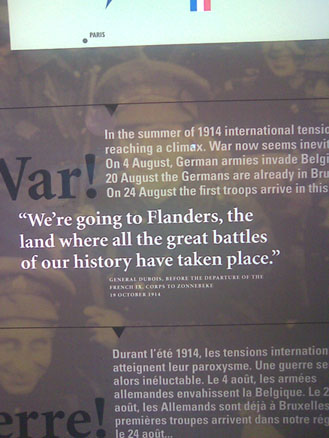
I have in the past, flippantly, described Belgium as a country designed or designated for European wars by the French and Germans and British. It was ideal: reasonably flat; not too many canals or rivers – the reason why Holland would not work; a divided population who don’t get on – the French and Flemish; and a weak government. Others have even suggested that the location of the European Commission in Brussels represents a continuance of wars but in a different format. While this was said, somewhat in jest, I learnt in one of the museums that I am not alone in this. The words of Gen Dubois before the departure of the French IX Corps to Zonnebeke, just outside Ypres, on 19th October 1914 were: “We are going to Flanders, the land where all the great battles of our history have taken place”. Pity the people of Flanders.

To the victor the spoils, and it seems from the visit, the right to commemorate the dead. There are German cemeteries as many if not more Germans died, but they are not marked or celebrated in the same way. Indeed puzzling is that in most allied cemeteries there may be one or two German graves. It is not at all clear to me how they came to be there.

What is deeply interesting and disturbing is how absent the Belgians are, both from the written record and the monuments. Of course most of Belgium was occupied; the government and the King would not commit the remains of the army to battle; rightly believing that one major engagement and the entire force would be wiped out. And history is written by the victors; but there was a Belgian army and there were millions of civilians affected and killed; the fields yield not just corn and maize but also a harvest of munitions as well as the occasional skeletal corpse.

Driving on the right hand side of the road is a challenge for me at the best of times. Driving on the Brussels’ ring road with heavy traffic, huge juggernauts, and in a cloudburst will be an event that I will remember for a long time. In a way it a bit like flying, once you’re committed to getting airborne you know you will have to land at some point. Equally going round the ring road to try and find the exit to the airport was a commitment. We managed, but it does mean that I will think quite carefully about hiring cars in the future.

So having made it to the airport, Douglas and I got on the train to Brussels and then an InterCity train to Amsterdam. On getting there we then queued up in the tourist office to get a hotel room. That was a mission. We waited for about 40 minutes. Amsterdam was really heaving, the weekend marked the gay pride events.

Film

Toy Story 3 by Pixar and Disney

This film had rave reviews, almost without exception, male reviewers wrote of how moved they were and how difficult they found it to keep from weeping. While I did not find the entire film to be as good as was suggested, it is worth seeing. In common with most of the men in the audience I was definitely sobbing by the end. What is it about the film that makes it so touching? It is because many of the male audience will have met and identify with the characters in both the past but also it is about a male rite of passage.

Books

Brighton Rock by Graham Greene various publishers as it is now a classic

Douglas is going to do A-levels in English literature. The school suggested a number of books to be read over the holiday. These included Brighton Rock, Doctor Faustus, King Lear, and Clockwork Orange. We took Brighton Rock with us on holiday. I read it and then managed to leave it in a hotel room. It is extraordinarily well-written, but what the miserable story. In fact most of that list is pretty miserable. Brighton Rock is set in 1938 in Brighton and tells the story of a 17-year-old gangster (Pinky) and his girlfriend Rose. It is described as a ‘Catholic novel’ since both the main characters are Catholics, but it is more a story of poverty of mind as well as finance.

The 18th International AIDS Conference In Vienna (And Associated Events)

Vienna was an interesting place to spend time. My first impressions some years ago, were not favorable, but having spent 10 days there I have changed my mind. I arrived in the early hours of Friday 16th July and left on Saturday 24th. The travel schedule was a bit hectic because, on the 14th (Bastille Day in France), I went to Marseille to be part of the panel examining a PhD.

On the plane from Amsterdam to Marseille, I had a new experience. There was a couple sitting in the first row looking somewhat drunk, the bleary, out-of -focus behaviour that is a real tell-tale. The stewardess confiscated a bottle of whiskey from them about 30 minutes into the journey, explaining that they could not continue drinking. While the cabin crew was serving drinks, the man went to the toilet at the front of the plane. There was suddenly an earsplitting alarm; the women abandoned the trolley, and came flying up the aisle in a panic. I did not see what happened next, but when the man returned to his seat, I heard them tell him they had found a cigarette in the toilet, and he would be arrested on arrival in Marseille. When the plane got to the air bridge six heavily armed gendarmes took him away with them. The announcement was: “Will passengers please remain seated as the police will be boarding to take a passenger off”.

I had always wondered what the smoke alarm sounded like, I now know.

Travelling takes time, even with good connections. I was on planes, in airports, or taxis from 9.30 am to 6 pm. And it was hot and humid – two shirt a day weather. The hotel sulked in an alley two streets away from the harbor. First impressions were of dark wood and hostile receptionists. It had a themes for each floor, level one Japanese, level two ethnic, three French and so on. My room was on the ethnic level and I had shields, masks and faux animal skins.

The examination was probably straight forward. I have to say ‘probably’ because, although most of the thesis was written in English, (it comprised a number of papers published by the candidate with linking commentary), all most all of the defense, including the examiners’ comments, was in French. When I accepted the invitation to do this exam I made it clear that I do not speak French. The candidate passed and the thesis and experience were both most interesting.

The supervisor Jean-Paul Moatti, and I were scheduled to fly on the same flight to Vienna: Air France to Lyon then continue on Austrian airways. Immediately after the exam the panel were invited for lunch in an excellent restaurant. The lunch was exquisite, it comprised six courses, all, except the desert, involved very tasty fish. This was the compensation for doing the exam as there is no fee. Unfortunately we had hardly sat down when Jean-Paul’s phone rang. Air France were calling to say that the Austrian airlines flight to Vienna was cancelled. They, unhelpfully, said we could only travel the next day. This would have been disastrous for me as I was chairing a meeting from 08.30 in Vienna. Jean-Paul spent the next 30 minutes on the phone, talking to his secretary, his travel agent and the airline and trying to make a plan. Eventually he succeeded and we were re-booked on Lufthansa to Vienna, going via Munich. At that point we could relax and enjoy the meal, but we were already on the desert. It was altogether annoying and stressful.

Jean-Paul offered to take me to the airport. He met me at the hotel, while his colleague hovered illegally on a busy road by the harbor. Rushing down the stairs I miss-stepped and somehow pulled a muscle in my calf. We had a tight connection, the plane left Marseilles a little late, and we were feeling mildly panicky. When the bus pulled into the terminal in Vienna we found the gate we were departing from was just a few steps away from where we entered the terminal. It was just as well because I could hardly walk. In the end this plane was late and I did not get to the hotel until the early hours of Friday morning. This is when predicable hotel chains are appreciated. The room in Vienna, at a Courtyard Marriot, was perfect: sterile and predictable. There was a well equipped gym on the top floor, with a television for each machine which meant I could catch up with the news while working out.

There were many lessons from the conference. The thing I found most fascinating, beyond the ‘core business’ of HIV/AIDS, was the range of high tech methods of delivering water for hand washing in the bathrooms. The days of a turning on a tap are long gone, in fact I did not see a single old fashioned tap, it is all levers and innovative ‘water delivery methods’ these days. Three noteworthy ones were the ‘hold out your hand and hope’; ‘tap tap’ and ‘water fountain’. The first is based on a sensor which reacts to a hand being put in the basin and delivers a gush of water. The second, which looked exactly the same, required a sharp tap on the top to start and the same to finish. The final one was quite bizarre, there was a large metal grill with a lever and no discernable outlet for the water. I turned the lever and the water sprang up from the middle of the grill, just like a water fountain.

The food in Austria was mostly heavy and dull. It leans toward the ‘potatoes and meat’ end of the spectrum. At the end of the conference we had an International AIDS Society staff and Governing Council dinner and party at a wonderful location, the restaurant: Österreicher im MAK – www.oesterreicherimmak.at which is in the Museum der Angewanten Kunst, (this seems to translate as the Museum of Applied Art, but I am not sure that this is correct, it could also be the Museum of Modern Art). The location was superb: the food, meat with meat!

The party was great fun. Due to the weather it was a moveable feast, we started in the garden and then moved inside as the heavens opened. Three of the events I went to were rained on (one was rained off). The other two were a reception at the Norwegian Ambassador’s home and the Life ball. This last was a great shame as the show had to stop because of the lightning -it was potentially really dangerous. I should very much like to go a proper full Life Ball again. Their website is www.lifeball.org.

I spent the last Saturday in Vienna. I got up late, packed, checked out, and took the metro into the city to visit a museum. I choose the Leopold, an art nouveau museum, although I’m not certain what is ‘nouveau’ about it as most of the artists were painting over 100 years ago. I was particularly taken by the works of Gustav Klimt, the painting ‘Life and Death’ was the one I spent most time in front of, and Egon Schiele. The art was thought-provoking and somewhat bleak. Of course Vienna was the original home of psychoanalysis. I found myself wondering which came first, the gloomy depressed artists or the psycho analysis. Maybe the psychoanalysis led to gloomy artists!

Since getting back I have been going through my books and writing up my trip report. This is over six pages which obviously to long for a letter or a web post. So what were the highlights? Undoubtedly the news of the microbicide trials: this is a female controlled protection against HIV. The research originates from colleagues at the University of KwaZulu-Natal, so that was really exciting. There was also much thought about the resource constraints that we face in this field, and of course the proximity to Eastern Europe was important for understanding drug use.

I moderated two sessions and chaired three. One was the rapporteur session on the last afternoon of the conference, just before the closing ceremony. There were two hours allocated for this, with nine people speaking. I briefed my panel very carefully and cut the introductions and interventions down to the minimum. Normally chairs take the opportunity to put their own views, I did not. In the end we finished three minutes ahead of schedule. This was a record and somewhat embarrassing for me. Nonetheless most people were happy with the way we rattled through; and all were informative and impressive. If anyone really wants to see it, it is on the conference website – www.aids2010.org – but I am not going to give the exact url.

I did two fun things in this session. The youth report-back was last, poor people, this meant they had ample time to get nervous. I introduced their representative by saying: “The fact the youth are the last to report does not mean that they are unimportant. They are very central to the fight against AIDS. We looked at a Kaplan-Meyer curve and decided they were the people most likely to be still alive at the end of the session.”

The hall is so big that the session is broadcast to big screens at various locations in the room. At the very end I looked at the camera and said: “During the World Cup in South Africa I never had the opportunity to see myself on the screen and wave madly, I am going to do it now.”

And I did, and some people understood what I meant.
Books

“Sex and Stravinsky” by Barbara Trapido, Bloomsbury Publishing London 2010, 320 pages.

Trapido is not to everyone’s taste, I really enjoyed “Frankie and Stankie” her growing up novel set in Durban in the 1950s and 60s. The latest book revisits this grant ground. The main characters are Josh, who grew up in Durban, whose parents were engaged in anti-apartheid activities and flee the country. He travels to Oxford where he meets and marries Caroline a statuesque Australian Amazon. This is the story of their life from the time they meet, to about 20 years later set in Oxford and Durban. The other characters are Jack coloured boy adopted by Josh’s parents. He is sent to a school in Swaziland which has got to be Waterford. Also involved in the story are Harriet, Josh’s first love; her husband Herman; the two daughters’ and Caroline’s truly ghastly mother. The plot is fun, the settings are well observed and if you like richly comical beautifully told stories that feature Durban this is excellent. Thinking about it I really appreciate the few characters and the way the story is woven around each of them.

Football Madness Continues: Early July 2010

This posting should go up soon after the World Cup semi finals, but before the final. It has been an amazing month both for me personally and for the country. My personal score card is four games in two stadia. The first was the England against the USA in Rustenburg on the 12th June. On the 23rd July I went to the Moses Madiba stadium in Durban for the Nigeria versus Korea game. Three days later I returned to see Portugal play Brazil, and on Monday 28th I saw Netherlands versus Slovakia. On Saturday 3rd July I joined friends at the Fan Park next to the Suncoast Casino to see the Germany Argentina game. In addition to this I have watched numerous games on the television in my flat or with friends.

It is hard to describe the events of the past month without getting emotional. The general consensus in South Africa was that we could (probably) deliver the World Cup and we have done so and exceeded out own wildest expectations. So far everything has gone smoothly, more smoothly than we believed possible. In part this is due to the way the event was built up by the Government and our media. There were extensive advertisements on the television telling us: the World Cup was coming, we should be gearing up to it, getting excited and preparing to welcome the many tourists flying to South Africa, for this once in lifetime event.

As time went on the message changed to say: ‘Ayoba: It is here’. After South Africa were defeated there was another switch in emphasis to say: “Well we didn’t get very far but let’s keep welcoming visitors and ensuring that they have a good time”.

I think we have succeeded. One concern was around crime, and it has been amazing how little there has been. The press reported on the first tourist to be shot (and wounded), an American walking in a very sketchy part of Johannesburg. I think we all have been taken aback, and people have just been lucky. I had two people from Sweden staying in the flat. One day they set off to walk into town, which I think is safe! They had just reached the Warwick Junction area when they were accosted by a lady driving through who said: “You can’t walk here. It is really dangerous. Get in the car at once”.

Sadly she then took them to the Suncoast Casino, which would not be my first choice of an environment for visitors. She also proposed that one of them, both being blonde Swedes, might be a perfect match for her son. Mind you I wonder about the some people and their naivety. A colleague had a ticket for the semi-final that he cant use. He gave it to a friend to sell. This person got a buyer, a Nigerian who took the ticket to ‘authenticate it’, and also took the bank details so he could deposit the money. I wonder how that story will turn out!

There has been flag waving patriotism. It has been enthusiastic and inclusive, when teams were knocked out their flags have continued to be flown on the cars and drivers have added second and third team national flags. At one point I estimated that one in five cars was flying a flag for someone. It has been a profitable time for the hawkers who operate at traffic lights. Instead of pineapples and coat hangers they have been selling flags and, something I have not seen before, mirror socks. These are little material socks which fit over the side mirror on vehicles. It has also been fascinating to how the nation has come together. All the crowds have been very multi-racial. At the Suncoast park the audience was largely Indian but there was a good smattering of visitors, mostly German fans and a number of black spectators.

I found the comment of a bright young white South Africa very telling. He said “Well we don’t expect to do well because we are not a soccer nation”. How typical that he should not understand that, for the majority of South Africans, we are a soccer nation. I really do think this will change.

What about the football? Of the games I have seen perhaps the most exciting was the Netherlands – Slovakian match. The stadium was packed with Dutch fans, who stood out in their bright orange jumpers and football shirts. They cheered their hearts out; the team played its heart out; and beat Slovakia. Then on Friday 2nd July they managed to knock the favorites, Brazil, out of the competition which was fantastic and now they are thought to the final. That match I watched at the gym, carefully taking my distance glasses so that I could be on the cross-trainer and actually see what was going on. I got there for the second half and the co-owner of the gym came to join me on the next machine. As a result we were able to get rid of the normal terrible music and listen to the commentary. That was a plus side, but I guess the minus side was that the gym was completely deserted. I think there were four people in the cardio section and another five in the rest of the building.

There will be huge economic benefits to South Africa. In the long-term we have invested in infrastructure which will serve us well for decades to come. In the short-term there is tourist money pouring into the country, and one has to recognize that there are some advantages in having the wealthy nations staying in the competition. It has been patchy though, I have been on aircraft that were virtually empty and others that have been jam-packed. I think that we overestimated the level of spending there would be. The other evening I went to one of the best restaurants in Durban, Fusion : there were only four people, and we outnumbered the staff. At the same time there have been sudden influxes of people, the airport at Port Elizabeth had more large aircraft on the hard standing than at any time in its history.

Things have not always worked perfectly, but when they went awry most people have been good humored. For example the Fan Park where I watched the Germany Argentina game, with all my German friends, had the live feed collapse just five minutes before the end of the match. At that point Germany were three nil ahead so we were pretty certain of the result. I was impressed by the good humor of the crowd both as they got up and left a little early, and as we navigated our way out of the ghastly Sun Coast Casino parking area, with its cones and tortuous routing to the exit.

Of course, this past month has not just been World Cup. On the 1st and 2nd of July we had our annual HEARD Retreat at a hotel called the Caledon near Ballito. This is a boutique hotel, one of the Life Group. I have written about them previously in my blog. I’m not impressed. It is situated inland and I am somewhat perplexed by its location. It will have to trade on something other than its non-proximity to the beach. It is in an area which seems to rapidly be developing into retirement villages and golf estates. It is, however, close to the new airport. The retreat was well facilitated and was helpful and useful to get an idea of where we will be going in the organization.

Football Mad: Mid-June 2010

I got back to South Africa on Thursday 3rd June having spent over a month in Norwich, where Douglas was preparing for his GCSE examinations. He worked really hard, and I left feeling proud of him. I travelled on the 06.20 flight out of Norwich to Amsterdam, then took the daylight flight to Johannesburg. It is an arduous journey, but I made good use of the time, marking a PhD, and watching two films, (which are reviewed at the end of the posting). The theme is sport though.

The World Cup kicked off on the 11th June. South Africa held Mexico to a one all draw in the opening match. The mood in the country has been just amazing. The previous Saturday there was a rugby test between Wales and South Africa at the Millennium Stadium in Cardiff. I played squash with my friend Jeremy Grest. After the game we had tea and watched the first 20 minutes of the game. I took his gardener to the bus stop and, on the way home, drove past my local shopping mall. There is, beside the road, a rather seedy bar behind massive steel burglar guards. The clientele are mainly older white people some with missing teeth and most with uncombed hair. I have been there twice and find it a bit odd. In order sit in the bar and watch the television you need to be buy drinks. There on the pavement was a group of, mainly black, car guards, delivery people and security staff, all peering in and cheering wildly as South Africa took the lead. It was truly an astonishing moment to see this engagement around what was, and still is largely, a white sport.

I had the good fortune to be invited by SAB Miller to attend the game between South Africa and the United States in Rustenberg. I spent three nights in an idyllic cottage in Magaliesberg mountains to the east of Pretoria, flying up on the Thursday evening and back on the Sunday. It was a real privilege and very intense. Let me try and bring these events together.

The first theme has to be distances, traffic and infrastructure. Everywhere seemed a ‘long way’, and the traffic made it even longer. My airport pick-up was organised by SAB and we were driven around by a team of older black entrepreneurs. They have set up a co-operative company to provide shuttles and chauffeur drive services. It was a pleasure to be driven by people who are working together. It means, among other things, that all the drivers get a decent salary and most have an investment in the organisation. I have been quite shocked by the salaries paid by the big companies, who, through out-sourcing, totally exploit their drivers.

The traffic generally was quite appalling; on Friday the itinerary had us visiting a project, going to the Indaba Hotel in Sandton for lunch and then dispersing to our various hotels to watch the opening game. We left the project site late, and on reaching Johannesburg, the traffic slowed to a crawl. It took two hours to do 10 kilometers. We abandoned the idea of lunch, bought sandwiches from a shopping centre and went into a bar to see the game. Two outstanding features were the great good humour of everyone we interacted with and the good South Africa response of “we will make a plan”. South Africa came to a standstill on Friday. Most offices and places of employment closed at 12.00 and I gave my staff the whole day off on the grounds that it was not really worth coming in just for four or five hours.

The great achievement of the World Cup (apart from the mood) is the new infrastructure, including the public transport system which is working extraordinarily well. The problem is that South Africans don’t trust it and so clog the roads with their cars. This will be a legacy for a long time.

My cottage was at Phefumula (see www.Phefumula.co.za). The site is well worth looking at. They describe it as: “Against the slopes of the Magaliesberg range is an escape from the hectic Highveld rush, a place of peace and quiet romance. A place to breathe, or just take a deep breath”. It is indeed right up in the mountains at the end of a truly appalling dirt road. Driving the three kilometers from the main road to cottages took 20 minutes in the saloon cars run by the shuttle service, and the undercarriages of the cars kept hitting the ground. It only took five minutes in a 4×4.

The second theme is the amazing feeling in South Africa. It is hard to describe the vibe in the country at the moment. Fans everywhere, the constant blast of the vuvuzelas. I traveled down from Johanesburg on Sunday and the plane, a large Airbus, was jam packed with German fans, all very good humored with occasional football chants being heard about the plane. The announcement is: “passengers are requested not to blow vuvuzela’s on the plane”.

South Africans have put their hearts and souls into making this work. Our crime problem is being addressed by very visible policing and swift justice. Near where I was staying is a lodge where Portuguese journalists were accomodated. They were held up by armed robbers and relieved of cash, laptops and valuables. The police acted incredibly swiftly: the men were arrested, tried and sentenced all within four days. The media, or at least the South African media, made a point of telling us that two of the culprits were Zimbabwean and one was Nigerian. The reason for the speed of the justice is we will only have our visitors in the country for a month and so could not ask them to return for trials. As long as this is real justice I don’t have a problem with it.

We visited two SAB Miller projects. On the Friday a bar in Duduza Township which is part of the “Men in Taverns” project. The goal is to develop responsible drinking and we sat and talked to a number of the participants who are involved in this initiative. The question is whether or not it is possible to have responsible drinking. I believe this is achievable but it is the whole culture that must be changed. I found it most encouraging project.

The second field trip was to the Masakhane Village outside of Magaliesberg. This village of 55 households and approximate 700 people comprises of farm workers who were evicted from their land in 1994. They were allocated land and built their village of corrugated iron shacks. What is unique about this is that they own title to the land and it is run as a form of cooperative. SAB has supported them in a number of ways. We sat in their brand new community hall and walked around the village. What was striking was that this is a community led initiative with SAB and other partners responding to community needs. They have water, a community center and an investment in training people in areas of empowerment and health (a first aid course but wow, it works and people feel empowered). The Masakhane Project website is: themasakhaneproject.blogspot.com.

Each household in this community has a small plot of land and on it, with one or two exceptions were shacks, made of leftover bits of corrugated iron. While what there is available seems minimal and the community poverty stricken we found this community is moving forward in substantial and substantive ways. The young men who were appointed as our guides were articulate and confident.

Nonetheless South Africa is a land of contrasts and from there we went to have lunch in a 5-star luxury hotel called De Hoek http://www.dehoek.com . What a contrast and how unjust it seems that there can be so much wealth and so much poverty right next to each other. We sat in a superb dining room; were fed a world class meal, incredibly meticulously prepared and served with aplomb and dignity by staff whom probably spends time in poverty stricken surroundings not dissimilar to those of Masakhane.

We drove from Masakhane straight to Rustenberg for the game. It was amazing. The streets were well patrolled and our movement into the stadium area went very smoothly. Of course we had parking available right next to the stadium which made life very much easier. The English supporters were out in full force with St George flags, face paints and enthusiasm. I made the mistake of saying use my forehead as a canvass and the picture is in the gallery! There were some Americans but they were in a minority. We arrived on schedule at 4.30 and discovered that the hospitality area did not open until 5.30. We waited outside, but it was all very good humored; people standing around chatting and enjoying the vibe and the environment. Once in the hospitality area we had drinks and yet more food before going in to take our seats. The Royal Bafokeng stadium holds about 42 000 people and was almost full. I suspect the empty seats were those people who had been unable to get tickets to travel to South Africa. It was a sea of colour and wave of noise. I can’t even begin to describe it. We had been very well provided for and this included earplugs. They were most necessary as the vuvuzelas are quite deafening. I was absolutely amazed by the volume. Our seats towards the middle of the pitch and just nine rows back. The game itself was scrappy as there are high levels of nerves among the teams. Nonetheless everyone was out of their seats when England took the lead and again when the USA scored an equalizer.

Traveling back afterwards was a lengthy process. The roads were clogged but it turned out that this was due to a motor accident, something that one cannot plan for. My World Cup experience has begun with a bang and I really feel that we, in South Africa, should be proud and pleased with what we have achieved to date. It is remarkable.

A few striking things. For some reason there were real glass bottles available in the stadium. This has been banned at rugby matches in South Africa and I believe in most other settings. It meant that trying to move down the row was treacherous as it was like walking on ball bearings. I cannot believe that they will allow these to be sold at future matches. The way the game is supposed to work is when the ball goes out of play one of the six or seven strategically placed ball holders around the field will throw a new one in for a quick continuation of the game. Clearly this experience was not one that the staff had had and as a result it was very funny to see a ball being kicked into the crowd and the man almost pleading that it be returned as soon as possible. The teams are transported to and from the matches in coaches and these are provided with a police escort. I’m not certain that I altogether approve of this blue light cavalcade as it disrupts traffic for everybody else.

Films

“Crazy Heart” is the story of a moderately successful country and western singer. It is similar to “Walk the Line” the Johnny Cash story. The key character is played by Jeff Bridges, who sympathetically portrays an older man, with a serious drinking problem, battling to make his way in an unforgiving world. The film ends with him having cleaned up his act, but not making it with the woman he falls in love with. It is an unusual but touching ending.

“Invictus” directed by Clint Eastwood, tells the story of the Rugby World Cup won by South Africa in 1995. It describes the astute politics of Nelson Mandela in allowing the Springboks to keep their name and their colours, in the face of opposition from the new Government. The story covers the period from the release of Mandela up to the when Francois Pienaar played by Matt Damon accepts the Cup at Ellis Park after beating the All Blacks. It is a remarkable story in terms of rugby and the politics around it

Mandela is sympathetically portrayed by Morgan Freeman. There are some little twists in the story that make it intriguing. For example there is mention of the danger of an attack on Mandela at the rugby game. A few seconds later we see a white male looking at the stadium through binoculars, but nothing comes of it. It also showed the jumbo jet flying low over the stadium at the opening match. I wonder how legal this was. This film proved to me how much altitude and wine heighten emotions. I sobbed my way through it.

“Where the Wild Things Are” is based on a children’s book. I found the film to be gloomy, odd and quite unpleasant so only watched 20 minutes.

Sunshine At Last: Early June 2010

I have had a busy few weeks in Norwich. I started writing this while sitting at the dining room table as Douglas read me poetry. He is preparing for his GCSE exams and I am here, firstly in solidarity, and secondly hoping to be of some help. His first major exam, where he had to sit and write for a long period, was English Literature. One of the good things is that I am hearing lines from poems I had long forgotten. For example, from WB Yeats, The Second Coming:

   Things fall apart; the centre cannot hold;
Mere anarchy is loosed upon the world

This is where Nigerian writer Chinua Achebe got the title for his first book, Things Fall Apart, published in 1958, which we read at Waterford School, and found a real revelation. By then it had, I think, been published in the Heinemann African Writers Series. So it seems what goes around comes around.

Life here has been un-anarchic, albeit busy. We have been to the beach, about forty minutes away. It was most beautiful driving through the Norfolk countryside. The long winter meant the flowers have delayed their opening and all seem to be blooming together. On this road the sea appears in the distance with striations of colour: a muddy blue hugs the beach; then the aquamarine shades into gray in the distance; and shimmering patterns across the whole surface.

It was the first decent weekend and so the beach was busy. A few hardy souls ventured into the water. According to the data at the life-guard’s station, the sea temperature was only 14 degrees so I am filled with admiration. The North Sea is shallow, so there tend not to be big waves, indeed it would be accurate to say they ‘lap’ rather than break. Despite this there are always optimists who have body-boards and even, in one case, a surf board. We walked a few kilometers and went to the Beach Café for lunch. It is excellent, good food and a great view, most important they allow well behaved dogs. Didi had a great time chasing up and down on the sand, running into the waves, and pretending to be brave. The village website is www.mundesley.org and the café has a page on facebook.

We got to see the ‘British changing style’. You clutch a towel round the waist, (which usually seems rather small by this time) and attempt to put on a dry costume, or even worse, takes off a wet one. In Durban, a couple of months ago, I was sitting on the beach with Rowan, her boyfriend and one of her friends; a group of German tourists arrived. No modesty for them, it was stand in a circle and strip to put on their swimming costumes.

A week or so ago I had the crucial flying lesson. This was the third since I returned and it took me to over 20 hours of tuition. The essential goal was: learn to land. Up to four lessons ago landing was not crucial – David, my instructor, would do this. However, as we know, pilots have to be able to land. It is not easy. I was lucky, the wind was very light, and straight down the runway. I walked away from this lesson thinking that I could actually do this. I went back a few days later to consolidate what I had learnt, this time in rather a strong wind. It was gratifying to find I can, indeed, land.

At the moment I am ‘in the circuit’, which means taking off and making a 90?; leveling of; setting the power and trimming the plane; turning another 90?; flying parallel with the airfield; turning into the approach; gently putting the wheels on the tarmac; then taking up the flaps; going to full power and going round and doing it again. The whole time one has to know where one is. My landmarks are not assets to the Norfolk countryside. The first turn is over the pig farm: little tin huts; barren ground and tubular pink bodies; then over the gravel pit, a scar in the landscape with mounds of yellow soil; and finally aim at the factory chimney. They may not be attractive, but they do stand out. I have even been practicing with Google Earth.

Does that sound simple? Well it is not! There are controls, speed, angles of bank, radio calls and checklists that all have to be included. The most difficult part is the touchdown. I am supposed to fly parallel to the ground, gradually taking the power off, holding the nose up while the plane sinks gently onto the runway. This is a ‘flare’ and takes judgment and experience. It has to feel right. David had said: “I can teach you to fly, but I can’t teach you to land, this is something that you have to get through experience.” A key is to get the approach right: the rate of descent and the speed; the line-up, so the plane is actually pointed at the runway; then, at the right moment, take the power off. The website for the flying school is www.nsf.flyer.co.uk.

That describes the non-work life here. My main work activity has been to get to grips with the Political Economy of Swaziland book. There has been definite progress on this. I want to describe how the history of Swaziland has lead to the current situation with regard to the politics, economics and HIV/AIDS epidemic.

Going to see a live production of Alan Bennett’s The History Boys at the Theatre Royal in the city last week was very helpful. A quote from the play on what history is: “How does stuff happen, do you think? People decide to do stuff. Make moves. Alter things.” This is exactly what happened in Swaziland and this is story I hope to tell. Over the past weeks I have been looking at the political trends in the region which have been crucial. In the 1980’s Swaziland and the other countries in the region benefited from the fact they stood against South Africa. Since then they have been quite ignored, and additionally they have slightly more wealth and so fall into the lower-middle-income country category, giving them less access to international resources.

Books

Joseph O’Neil, Netherland, Harper Perennial, 2009, 300 pages

This is a most unlikely topic. It is the story of a Dutchman, Hans van den Broek, living in New York, where he has been abandoned by his wife and child. He is a cricket player and the game comes to dominate his life. It is played mainly by immigrants from the former British colonies: the Caribbean Islands; Sri Lanka and India. Hans becomes particularly friendly with Chuck Ramkissoon, a charismatic Trinidadian entrepreneur and clearly criminal. It is his murder that leads to the reflection giving rise to the book. This book portrays a part of New York and the people living there, that is murky and subterranean. It is also a story of hope and friendship. At the end he and his wife are back together in London, attempting to make a go of their relationship. I had been looking at the book on airport bookshops wondering if I buy it, a week ago I was at the local library so I was pleased to be able to borrow it.

Andrea Camilleri, The Inspector Mantalbano series. These books have has their central character a tortured police inspector in Sicily. He is the local commander of a police station, staffed by a range of equally extraordinary characters. Camilleri is apparently a very well known Italian writer, but I have just been introduced to his books and am really enjoying them. They are published in paperback by Picador and are translated by Stephen Sartarelli. Obviously the translation is crucial in ensuring that the book remains good when it is put in another language.

“I Am So Sorry, I Missed My Airport” Reflections May 2010

Durban’s new international airport opened on 1st May. This was not a revamp or an upgrade of an existing airport, as has been happening across most of South Africa, this is a completely spanking new airport. On Friday 30th April, the last scheduled flight arrived at the old airport. During the evening a number of aircraft flew, empty and low, across the city to be repositioned for the next day’s operations. It was exciting for airport and aeroplane geeks like me. It meant that for a few days there would be chance to say: “I am sorry I missed my airport”, rather than “I am sorry I missed my flight”.

I flew out in the evening of the first day of operations. It was astounding how well everything worked. On the downside the airport is some distance to the north of the city. It will mean allowing 40 minutes to get there rather than the usual 25. It costs more in terms of taxi fares and there is not the small, intimate feel of the old airport. On the upside it is really beautiful, will handle all the projected traffic for the next 30 years (indeed it is planned to be operational in 2070), and I really hope we will start having direct flights to Europe. If that happens it will make a huge difference! At the moment there are many flights to Johannesburg and a fair number to Cape Town but for Durbanites there is only Emirates (with the connection in Dubai) for Europe. There is a really good Wikipedia page http://en.wikipedia.org/wiki/King_Shaka_International_Airport.

This sort of change gives me mixed feelings. When the planes approached the old airport from the north, the route was across the coast in the vicinity of Balito then down along the beach, across the harbour and coming in to land over the industrial area. As a passenger it was spectacular, and always made me feel we were coming home. Looking out of the window there was the Umgeni river mouth and the Blue Lagoon; then the stadia (the new world cup stadium, Moses Madiba is truly spectacular white, glistening and very large ); the green circle of the Greyville race course; the houses and blocks of flats spilling down the Berea ridge. Usually the plane would be over the central city so that was not visible, instead there was the highway bisecting the city and the University: with the gold dome of Howard College and the phallic Memorial Tower building dominating the skyline. Looking up from the ground it was as though the planes hovered over the city. That will all be a thing of the past now, instead it will be the sugar cane fields and perhaps glimpses of the Valley of 1000 hills.

Because it was the first day of operations, I was a little concerned that there would be some mess up in the handling. I got there extra early and even allowed for a longer lay-over in Johannesburg. It was unnecessary as it was one of the smoothest experiences I have had. The airport was really busy, but not with passengers, people had come out simply to look at it – they were local tourists; families who had decided: “Let’s not go to the beach today, let’s go to the airport”. According to one of the staff, some local people are excited that there is a new shopping mall in the area, and are saying: “and it has even got an airport”.

I actually approve. While there are arguments against air travel and spending huge amounts on infrastructure we did need longer runways: the existing one was not long enough to handle inter-continental traffic. There was a period when British Airways flew a jumbo in to Durban, but it had to stop in Johannesburg to refuel before going on to London. I doubt that there will ever be a Durban to Norwich flight, but I sincerely hope there will be one less connection to make in the future.

I was fortunate when I went into the lounge in Johannesburg to bump into Sigrun Mogedal, the Norwegian AIDS Ambassador. She was travelling with a colleague, and had just been to a meeting on foreign policy and health. We chatted, and as a result the layover went by quickly. We discovered that we were sitting next to each other on the plane, but true to airline etiquette put on eye masks and headsets and only spoke briefly in the morning.

The hostess brought me breakfast; it is my habit to have the granola with plain yoghurt but the pot had a picture of lush strawberries on top.

“Excuse me”, I said, “I asked for plain yoghurt”.
She replied, “Yes we were confused by this too so we tasted it, and this is plain”.
Then realizing what she had said she added, “Not this one of course”.

I will be away from Durban for a month. In this time I must make serious progress on my Political Economy of Swaziland book, which is now seriously overdue. This month is also the time when Douglas has to complete his revising for his GCSE exams so I will be here and hopefully he can revise and I can write. A form of bonding which I don’t think he will necessarily buy into. Oh well! It has also been a good month in Durban because we have finally managed to appoint an Operations Director for HEARD which has been a huge gap in our staffing. The person accepted the position, and will start on 1st June, so we will just have to get through the next month.

The recent films and books are

“A Single Man” directed by Tom Ford, based on a novel by Christopher Isherwood and starring Colin Firth made in 2009 and set in Los Angeles.

This is the story of the day in the life of a gay man whose partner of 16 years has been killed in a motor accident, while visiting his parent. It is set in the early 1960s. The man, an English Professor is informed of the death of his partner by a cousin and at the same time is told it is a ‘family only funeral’. The plot tells of his despair as he goes through a typical day – but this day he intends to commit suicide. The story of the partnership is seen through flashbacks. The theme of suicide is evident in his preparation: writing notes, cleaning his office and buying bullets for the gun. In the end he cannot find the right environment to kill himself, goes out to buy whiskey, meets one of his students, they have a drink and go swimming and return to his house where the boy tenderly dresses the cut on George’s head. The boy undresses, and there is a suppressed sexuality, but nothing happens. George blacks out and when he wakes the boy is asleep on the couch, holding the gun. George takes it away covers the sleeping boy goes through to his bed and has a heart attack and dies. At one level this is a touching drama about human relationships and the difficulty of being gay at that time and place. There are also deep questions, and it is one movie I would have liked to see with someone to discuss the meanings. Well worth seeing.

“Debunking Delusions: The Inside Story of the Treatment Action Campaign”, Nathan Geffen, Jacana Press Cape Town, 2010 248 pages.

The Treatment Action Campaign (TAC) is one of the world’s best examples of a social movement. It was established to push for treatment in South Africa in the face of overpriced antiretroviral therapy and subsequently denial of the existence of the problem in South Africa. Formed in December (10th December 1998) when it argued that the State should develop “a comprehensive and affordable treatment plan for all people living with HIV/AIDS” . For the first two years it targeted multi-national pharmaceutical companies in trying to get prices down.

Nathan Geffen one of the founders of TAC, tells the story of the organisation from 1998 to 2010. He covers the period of denialism, the deadly fights with the Government to push for antiretroviral therapy and get HIV literacy across the country. He describes the many “quacks” who operate, virtually unhindered, in South Africa. The back of the book says “the story of the TAC’s campaign is one of the triumphs of citizen activism for social justice and human rights”. I bought this book with enthusiasm. There are many books on HIV/AIDS in South Africa which look at the epidemic from various perspectives. The story of the Treatment Action Campaign has not been told. The second chapter “What we know about AIDS” was disappointing, written in over-simplistic language and covering old ground. I’m glad I pressed on; the rest of the book is excellent. It is written with passion and a sense of outrage but is also literate and an enjoyable read. Geffen has done us a great service by taking time to write this book and offer his reflections on what the TAC was, is, and will be. I strongly commend it to all scholars of HIV/AIDS with an interest in events in Southern Africa. Literacy 8/10, content 9/10.

Swaziland: Trouble In Paradise

Since the beginning of 2010 I have made three trips to Swaziland, twice flying in and once driving up. The reason is, primarily, that I am desperate to write my book The Political Economy of Swaziland. Although I know the country well, am a regular visitor, and try to stay in touch I need to collect data, do research and check facts.

There is also the Waterford connection as one of the trips coincided with the School Governing Council meeting. We have a new development officer in post and have great expectations going forward. Do visit the website at www.waterford.sz.


Swaziland is such a beautiful country, at the end of this summer it seems to be exceptionally green and lush. I drove from the airport to Mbabane in the late evening on my last trip. There had been rain and the sky was overcast and quite ominous. We had dodged thunderstorms en route from Johannesburg to Matsapha. There was a band of cloud halfway up the Mdimba mountains on the side of the Ezulwini valley. The contrast between the black glistening rock, the green of the grass and vegetation and the pure white of the cloud was remarkable. I wished I had a camera because words can not begin to capture the scene.

The story of Swaziland is being written slowly. I have divided the book into four key periods. The first the history up to independence in 1968; second the reign of King Sobhuza over the independent nation from 1968 to his death in 1983; then the time up to 1994, a defining moment when South Africa gained independence and Swaziland began to slip off the international radar screens; and finally the story to 2010. This last part is dominated by two themes, the change in South Africa and the inability of Swaziland to adapt to it; and the HIV/AIDS epidemic. As with many activities this book is so clear in my head, but then I sit down to write and it slips away like water between my fingers.

There are also distractions that mean I literally loose the plot. The big diversions have been the HEARD board and donor meetings and international travel. We gathered with our key donors in Durban on the 17th March and on the 18th we held the first board meeting of 2010. The good news is that the organization will continue to be funded; it seems that we will have support for the next four years. This means we can plan serious work, and I can continue to put time and resources into Swaziland, one of the themes of this letter. These meetings need a great deal of work, thought, preparation and co-ordination and are ‘core business’.

The most recent international travel involved going to British Department of International Development organized ‘High Level Meeting on HIV/AIDS’ which was held in the House of Lords. My word it was interesting, the setting alone was amazing. The Houses of Parliament must be among the most majestic gilded buildings of any national assembly anywhere in the world. The meeting was held in a committee room called ‘The Moses Room’ because of the huge painting on the back wall. This is of Moses bringing tablets of stone (the commandments) down from the mountain to the people of Israel. I suppose one could make a link between these tablets and anti-retroviral therapy – but it would be a stretch!

The purpose of the meeting was to assess how we, the global community, are doing in achieving the targets for 2010. It was attended by the core international leaders of the HIV response and I was invited to give the opening remarks and set the scene. Of course the power point presentation I had prepared was not on the projector and so I had to start without the pictures. Despite this it was a good presentation and a great meeting.

I flew from London to New York for the International AIDS Vaccine Initiative’s Policy Advisory Committee meeting and was there from Wednesday to Saturday when I was scheduled to fly back to Durban. The hotel in New York was at the end of the Island of Manhattan just off Wall Street. The weather was uniformly windy and miserably wet, so walking back to the hotel I ducked into a stationary office supply shop that had a most unlikely selection of secondhand books. One of these was called “How we die” and the details are at the end of this letter.

The highlights of New York were having dinner with Stephen Lewis and Paula Donavan of AIDS Free World (www.aidsfreeworld.org), this was really fun; and sitting at JFK Airport with no flights taking off or landing because of strong wind which was not fun. A key theme of the dinner was what is going on in Swaziland. Among Stephen’s many activities has been mobilizing grandmothers primarily in Canada to work with their African counterparts. The details of this remarkable initiative can be found on the Stephen Lewis Foundation website at http://www.stephenlewisfoundation.org . There will be a “Grandmother’s Gathering” in Swaziland in early May. One of the big questions is how to reach the political leadership in Swaziland and, specifically, the King. There is so much misuse of money that it becomes hard to argue for continued support without real changes at the top. This, importantly, does not mean change of leadership, but rather change of heart and style.

I expected to leave New York at six o’clock on Saturday and be back in Durban early on Monday having slept overnight in Johannesburg. It was a filthy day so I took the taxi to the airport well ahead of time, checked in and went to the lounge. The wind was incredibly strong, gusting across the airport, making the building shake and the luggage containers dance. There was no activity at all out on the apron. The boarding time came and went. We were informed that the airport was closed, flights were being diverted or cancelled and we just had to be patient. I know I had missed my connection and that there was nothing I could do so I just chilled out.

At ten pm that evening the flight was boarded and the captain came on the public address system and said something like: “Welcome aboard ladies and gentlemen, you all understand the reason for the delay. We have been told a lull in the wind is forecast, so we will taxi down to the end of the runway, and if it is safe we will take off. But don’t worry if it is not safe we won’t. I am afraid the wind was so strong that there has been no baggage or food loaded onto the plane. However we did bring cookies on through the front door”.

We duly taxied to the end of the runway. I could see from the windsock that the wind was blowing straight down the runway (which was good), and the lights of two other planes landing. I was reasonably confident that we would be able to leave. The crew put on full power and, after the shortest take off run, I have ever experienced we were in the air and on our way.

There was a small degree of chaos in Amsterdam, but eventually I got to the front of the queue to see what my options were. The ground staff had already booked me on a flight from Amsterdam to Cape Town the next morning, which was a rather a long way round so we looked at other routes. In the end the best option was to fly to Paris then go overnight on the Air France flight to Johannesburg. I only looked at my boarding card when I was in Paris – and then saw that I was in seat 68F. After a moment of bafflement I realized that this was the new airbus, the biggest plane in the world. I walked to the gate to look at it and it is amazingly huge! It does not feel that different inside. As I boarded I asked the steward where my seat was.

“Hang on”, he said with a delightful French accent, “I will have a look at the map”.

They are having teething problems, in the case of this flight the entertainment system did not work. Oh well what can you say. At least I got back to Durban and having been there a couple of days had the donor meeting then drove up to Swaziland with a colleagues from the SIDA team in Lusaka. Then back to Durban to welcome Rowan my daughter and her boyfriend for their ‘South African holiday’. They arrived and went to a party this evening so I headed for the cinema. The film that was on when I got there was called “It’s complicated”. With Steve Martin, Meryl Streep and Jack Baldwin. I found it both touching and though provoking.

I will in my next posting, describe going on a canopy tour , which basically meant being terrified, the pictures are on the website. They say: “The canopy tour involves traversing from one platform to another along a steel cable suspended up to 30m above the forest floor. The tour comprises seven platforms and eight slides that zig-zag down a pristine forested valley”. Nothing about the fear and horror and getting stuck!

Books

Thirteen Moons; by William Frazier Random House 2007 432 pages

About 12 or so years ago William Frazier published his first novel called “Cold Mountain” set in the American Civil War. He has not published anything since. A couple of weeks ago I was passing though the airport in Durban and Exclusive Books had a sale on. In among the piles of books I spotted “Thirteen Moons”. It is an excellent and thought provoking book. It tells of an indentured boy who is sent to manage a trading post in the Cherokee nation. The main characters are the boy, Will Cooper; his adoptive father Bear, a Cherokee Chief; Claire with whom he has a complicated sporadic relationship, but who the wife to an aristocratic Indian called Featherstone. The love story is between Claire and Will, but there is also a deep relationship between him, Bear and in complex ways, with Featherstone.

The Cherokee Nation and indeed all the Indians in the East of the United States were forced to move to ‘beyond the Mississippi’, something I did not know and which resonates with South Africa. Will and Bear fight to keep land for the Cherokee Nation and succeed in doing so. Will ends up re-meeting with Claire at a Spa towards the end of the book and the end of his life. According to Wikapedia again the book is loosely based on the life of William Holden Thomas who was the principal chief of the eastern band of Cherokee Indians and served in the Confederate Army during the Civil War who lived from 1805 to 1893. Charles Frazier was given an advance payment of over 8 million dollars for the proposal and of its initial print run of 750 000 only half were sold so the publisher may lost money on the advance. It deserves to do better. I learnt a huge amount from the book about the United States, the removals of the Indians and was surprised to learn that it was set in North Carolina. It is clear that this part of the world had a bloody history of which I know only a small part. I find myself wondering why we are so slow to learn from experience.

Perhaps the most poignant is the way in which the book is written as an older man sitting and reliving his life. He is perceptive but desperately alone, and I have to say I found it to be most moving especially as I have aged (although I am certainly not in my 90’s, I sometimes just feel it). I wonder if this is sort of thing that my father and others went through as they moved through their lives. I hope it is more widely read, it certainly is a classic and is deeply moving.

“How We Die: Reflections of Life’s Final Chapter” by Sherwin B. Nuland (Vintage 1995, 304 pages).

Nuland examines what death means to the doctor, patient, nurse, and family. It was thought provoking and humane. He draws on his own experiences with various people close to him: the deaths of his aunt, his older brother, and a longtime patient. Disease, not death, is the real enemy. However there is not much comfort as he warns most deaths are unpleasant, and painful. It is an excellent book and certainly one we should all read. I found myself thinking of it as the South African Deputy Health Minister Sefularo died in a car accident last week. I had met him some months ago and was so impressed, what an excellent man and what a loss