I have been back in Norwich for a month and there has still been virtually no rain. Day after day the skies have been clear, and the garden has steadily grown more and more desiccated. Fortunately, we have a number of large trees that are surviving and presumably will make it through. This means, at least, the garden is cool.
There is no doubt we are facing a climate emergency and it is really depressing to see how much denial there is about this. I do understand the feelings of helplessness that many have when faced with this inexorable crisis. The only way to deal with it is to come together and hold everyone, especially governments and capitalists, to account. That requires leadership across countries as well as within them.
We must learn from each other. When I look across the North Sea, it is evident the Dutch are able to keep their country from flooding (which may seem a little ironic in a drought, but it is mainly sea water they keep out). They have the technology and the will to do so. What is needed for climate change? More and unified planning!
I find it quite alarming that our local airports celebrate the opening of new routes, not even mentioning increased emissions and how they plan to combat those. Perhaps the biggest problem is the complete lack of understanding of what exactly is going on, and even what our chances are. As I’ve mentioned before, I find it very upsetting that in this neighbourhood, the default for many people buying houses is to uproot trees, level the garden and put down paving. Not only will it affect their microclimate, but it has adverse implications for the neighbourhood, city, county, country and, ultimately, the world.
I don’t want to seem too apocalyptic, but I have one other observation about the state of this part of the world. There are quite a number of flowers open out at present, but there seem to be fewer insects, especially bees, than I remember.
To some extent life in Norwich is dominated by our grandson, Rowan and Ben’s little boy: Ledger. He had his first birthday last week. Rowan organised a celebratory tea for the older generation of family. That meant Ailsa and I, my sister Gill; Douglas, Ledger’s uncle; Richard and Jane, the other grandparents; Tory, Ben’s sister; Jane’s elderly mother and Ledger’s great grandmother; and two other friends met at their house. It was great fun and Ledger quickly got the hang of unwrapping presents. It may be a prejudiced viewpoint, I think he is remarkably smart and goodlooking.
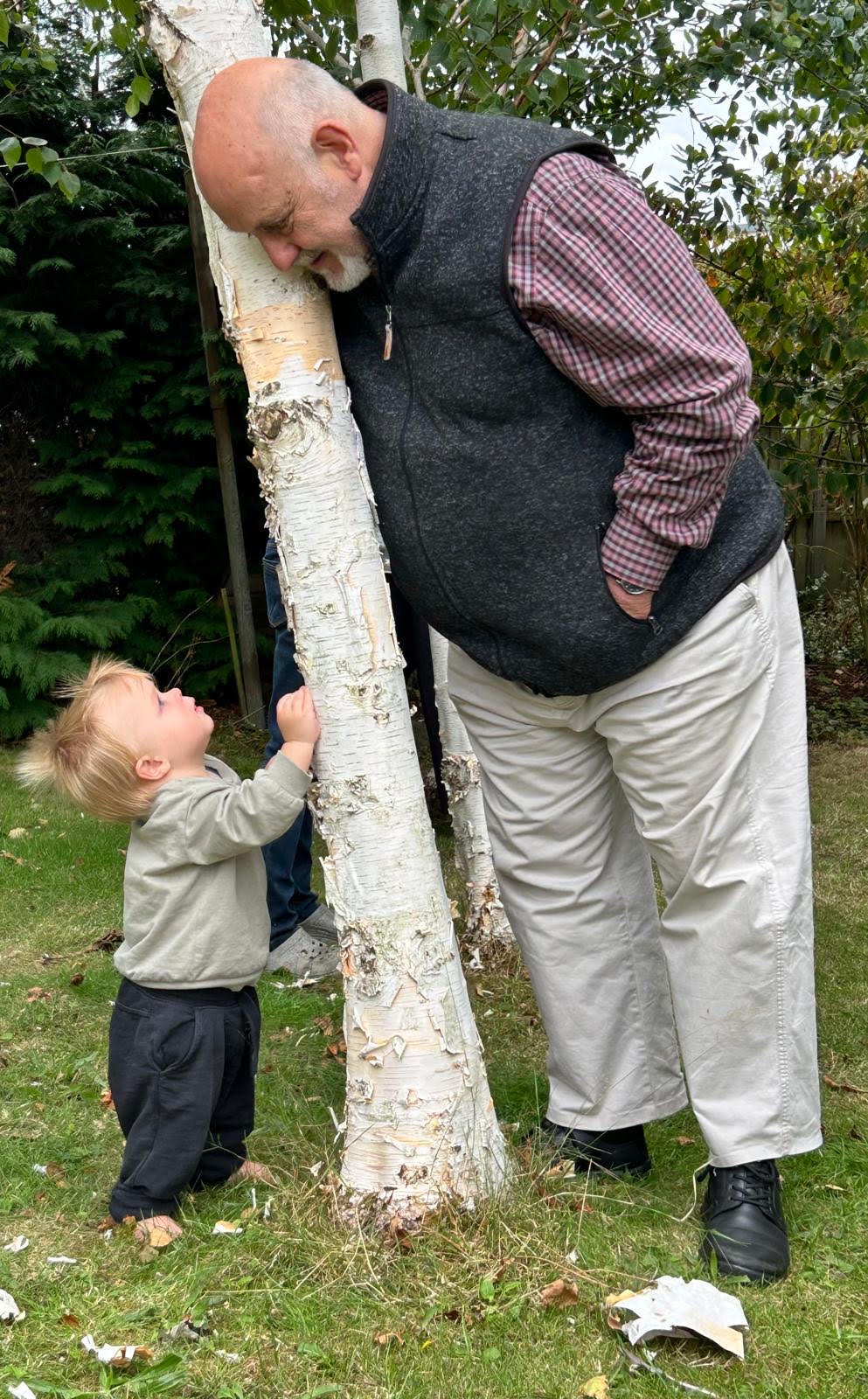
Ledger, Alan and Silver Birch
Ben, Rowan and Ledger popped in a few days later, and Gill took the photograph of Ledger and me communicating across a Silver Birch. Someone said it looks like ‘he is talking to the BFG’. I think it is a delightful photograph and I need to get it framed. I don’t have a lot more to say. I have been thinking, I should document other events I have experienced. It has been 25 years since the 9/11 attacks on the USA. I was in Washington and will write about that.
Part 1: What I did on 9/11/2001
On Wednesday the 26th August we watched a BBC2 documentary production called ‘9/11: Inside the President’s War Room’. It tells what George Bush did on 11 September 2001. This was a remarkable day in our history and was totally traumatic for the Americans and their president.
The documentary was compiled primarily from footage taken during the day with commentary from some of those present. It was thought provoking and I was reminded that I was in the United States, indeed I was in Washington on that dreadful day.
I have never really written about it or indeed even talked about it with friends and family. I suppose this is because mine was such a small part in a huge drama, but I also felt it was not my story to tell. In writing my memoir I have been wondering if there aren’t a few standalone pieces to be written. I am going to add a ‘Section 2’ to my blog over the next few months describing global events from my point of view. If I get positive feedback I can grow it, for example revisit the election and transition in South Africa in April 1994.
September 10th and 11th
It was bad timing, or maybe I was lucky to not be in the air and so it was good timing. I travelled from Norwich to Washington on 10 September for a series of meetings. Rowan and Douglas were 11 and 5 respectively and I always did my best to let them know they were in my thoughts. This meant I posted letters from the post box on the way to the airport (at 4.30am), which they would get within a day or two. I checked into the hotel and actually managed a meeting with USAID in the afternoon, I have no idea where I found the energy!
On September 11 my first appointment was at the World Bank with colleague Martha Ainsworth. I was sitting in her office talking to her when, at about 9:20, she looked out of the window and remarked that she could see people running in the street. At 9:30 she said she’d had an email saying that two planes had flown into the World Trade Towers in New York. She panicked in a controlled way, packed up, saw me out of the building and headed home.
I walked out onto the street where there was a sense of chaos, unease and fear, but it was surprisingly controlled. My next appointment was at the offices of USAID’s Africa Bureau on E or F Street. The quickest way would have been to walk straight in front of the White House on the road between it and Lafayette Square. That had already been blocked off by the police and the National Guard, so I turned north. As I walked the security cordon gradually expanded block by block which meant I had to go further and further north before I could turn south to my destination. The panic was spreading and the civilian population who worked in the area were shutting their businesses, evacuating their offices and heading home.
I was to see people who had expressly come to Washington for these meetings, so I thought it likely that I would see them at the venue. Sure enough, John Stover, a highly professional, deeply thoughtful person, who had become a friend, was indeed at the office, along with a woman who had come up from Carolina. We didn’t have a television, but there was a radio so we knew we would be able to keep up to date with what was going on. Pragmatically we decided to carry on with the work we had scheduled as there weren’t many other options. This was also a very economist reaction, appropriate as John is also an economist! We knew that the world had changed but were not certain what it would mean for us, or indeed anyone.
This was pre cheap and easy communication, and we had limited access to technology. I did not have a cell phone or internet access. As soon as I could I used a landline at the offices to phone my family in Norwich, where it was three in the afternoon to let them know that I was okay and did not feel in any particular danger. They knew where I was staying and I promised to phone later in the evening and give them an update.
The events in the USA were being covered live on British television, so they probably had a better idea than I did as to what was going on. Was our reaction normal, or indeed appropriate? I don’t think we have much choice and the last thing I wanted to do was go out and rubberneck on the street. There were no officials left in the building, but coffee, cookies and sandwiches had been provided, so we were able to keep ourselves going with those. We just got on with what we were supposed to do.
Towards the end of the afternoon John and I walked up to the hotel we were staying in, which was close to DuPont Circle, checked in and then met up for supper and to talk through the day’s events, not that we could make much sense of them.
We were also aware that all aircraft had been grounded which meant that John would have difficulty in getting back to Hartford, Connecticut where he lived and his company was based. I was quite uncertain as to when I would be able to return to the UK. However, there was nothing we could do, we just had to wait and see.
I was scheduled to talk at a major conference called ‘Listen to Africa’ being held in Chicago under the auspices of an organisation called the Global Alliance for Africa. Clearly this was in disarray as so many of the participants and presenters were not going to make it. As a South African I live by the phrase ‘we will make a plan’ and so the next morning I telephoned the organisers to find out what was going on. They said some of their speakers had been turned back to their home countries, others had landed in remote airports as part of the ‘clear the skies’ operation across North America. However, as a number had made it, they were going to go ahead as best they could. My response was: ‘don’t worry, I will be there, I will find a way’.
To be continued in the next blog.

