On 30 May I took possession of my new digs. It is an apartment in Seagram Lofts, an old distillery building, literally just across the parking lot from the Balsillie School of International Affairs. This will be the shortest journey to work I will ever have had. Given that I have always tried to take jobs that allowed me to go home for lunch, it is extraordinarily close, even by my standards. I will be putting pictures up on my website. The estate agent who took care of me Dave MacIntyre also introduced me to the Kitchener Squash club. This has been a great help in making me feel I can live here! The lofts are really fantastic space and they have been extremely well converted. The squash club does what it says on the tin, and provides a good useful space to get together with a minority who share at least one of my interests.
Tag Archives: Canada
Teeth are trauma
The idea that one should take good care of one’s teeth is drummed into us and we try to pass the message on. Boy, do I believe it now. The water in Kenya, where I was born and spent my early years, and Swaziland, where I grew up, did not have fluoride added. As a result I have more than the average number of fillings and crowns. It is likely the lack of brushing and eating sweets that were significant contributors, but I would prefer to think that fluoride was the issue.
All the N’s: Norwich, Nairobi, Norwich, New York
I wrote this post after travelling to Kenya and concluded it was a rather depressing trip in some ways. The reason for the travel was a board meeting for AIDSpan a small NGO whose mandate is to watch and support the Global Fund for AIDS, TB and Malaria. I went over from the UK on Wednesday and returned to Norwich on a late flight on Saturday evening arriving back on Sunday. The flight from Nairobi to Amsterdam is longer than the one from Toronto to Amsterdam. I don’t think I appreciated that Canada was so close, or maybe that Nairobi was so far.
Still Snowing!
Trying to start a new chapter is a challenge. I think though, the place to begin is to be grateful to have the chance to do it.
I arrived back in Waterloo in late March with the goal (other than work) of finding and buying a property. This has been made much easier by amazing modern technology. We have been able to look at properties online, mark them as favourites or possibles, and take virtual tours of the houses and flats. It is remarkable. Then, when it is bought, I will (I assume), be able to put a link on the website, and anyone who is interested will be able to have the same access.
Alps
I got back to Canada on 18 February after a short visit to the UK. It was, in my view, just long enough to thaw out. Of course most of the west of the UK was experiencing some of the worst floods on record. It looked quite desperate for many homeowners and farmers. Fields in the Somerset levels are still under water.
There was more snow in Waterloo and it continued to be bitterly cold. The time there on this visit was a little curtailed. I am getting a sense of the place, and what I need and want to do. Buying a car and finding somewhere to live is the next order of business.
Assault and Battery
I spent my first month in Waterloo starting in mid-January, and came back to the UK for 10 days in February. On the Saturday before I left, for the first time, the temperature climbed to 0°C. It has been as cold as -25°C. The town was covered by a white blanket. This is beautiful and has the effect of muffling sound; it makes everything seem very peaceful. There is a downside; it took me at least half an hour to dig the snow off the drive so I could get the car on the road. There is a snow plough that comes down the cul-de-sac where I am living that clears the road, leaving banks of snow across the driveway. The snow shovel is large and, although snow is light, I was sweating by the time it was cleared.
New Beginnings
The past month has been hectic but rather fun. I left Durban, as promised, on 19 December 2013. That was sad. The last days involved clearing out my office, deciding what needed to be shipped to Canada, stored in the flat, put in the suitcase, or given away. I know that to some extent, I keep my life in boxes. The University of KwaZulu-Natal box is now closed, and, hopefully, the important residual parts are in transit. There is a lot to reflect on, of course. How could there not be after 30 years?
I am extremely lucky to have had the opportunities I did, to connect with people, to build an organisation and support my team’s contribution to knowledge and science which, hopefully, makes a positive difference. I am proud of my own substantial publishing record.
Falling Leaves: November 2012
Autumn has arrived in Norwich (and in Canada). I head for Durban soon with the dual goal of topping up on sunshine and getting a great deal of work done. There is a lot happening and, at the moment, life is exciting so read on for more details. The big occasion taking me back to Durban is the HEARD World AIDS Day function. On 14 November, in conjunction with the Africa Centre, CAPRISA the University of KwaZulu-Natal Press, we are holding an event at the KwaZulu-Natal Society of Arts Gallery www.kznsagallery.co.za . The theme is taken from UNAIDS, Getting to Zero: Zero New HIV Infections, Discrimination, and AIDS-Related Deaths. We have advertised it as an event ‘Showcasing KZN research on HIV and AIDS’.
HEARD’s highlight will be the South African premier of our documentary Manguzi: Raising Children in Rural South Africa. This film is set in an area close to the Mozambique border where we did a project. I have seen it a number of times, checking it from an accuracy and political point of view. It will be great to be just in the audience. The team who did the work deserve high praise for overcoming many logistical challenges, collecting some fascinating data, and now are writing it up.
This will be the occasion where I formally tell my research colleagues and friends in Durban that I will be leaving HEARD in 2013. (I feel I need to put in a footnote here that says: subject to the paperwork being completed). This should not come as a big surprise to most people as the news has been out for a while. It is however a chance for me to combine some of my favourite things: the Gallery; the research and academic communities; and many friends. The idea of doing such an event germinated at a book launch at Ike’s Books and Collectable – also a Durban institution – a few months ago. Authors who have books launched there put their signatures on the wall. My name is up alongside the likes of JM Coetzee and many others. The walls are probably worth more than the stock.
At the end of October Ailsa and I travelled to Canada for a week – hence the leaves in the title of the posting, and yes they were amazing. We flew to Toronto and were taken down to Waterloo in Ontario. We spent four nights there and then a further two nights in Toronto. The reason for the visit is that I have been offered, and have accepted, the International Governance and Innovation Chair in Global Health Policy by Wilfrid Laurier University (WLU). This will be housed in the Balsillie School of International Affairs, a partnership between WLU, the University of Waterloo (UW) and the Centre for International Governance Innovation (CIGI), a public policy think tank. I have put in the links to these organisations and they are all worth looking at. The CIGI campus is amazing, part is a brand new, state of the art building while the old Seagram’s distillery has been converted and incorporated as office space.
The School represents a large global initiative in social sciences with over 60 faculty members who teach in three programmes: the PhD in Global Governance, the Master’s in Global Governance and the Master’s in International Public Policy. There are three new staff members: Simon Dalby, CIGI Chair of Political Economy and Climate Change; James Orbinski, CIGI Chair in Global Health; and in due course, myself. We had a ‘Blue Skies’ thinking session which was a great fun – the staff have very interesting ideas and a range of experience. One of the exciting opportunities for me will be working in an interdisciplinary manner. I am also very much looking forward to teaching and interacting with students at various levels.
Quite a lot of the visit was spent exploring the area. The streets are wide and driving on the right hand side is challenging. What I found particularly difficult was the traffic lights being suspended over the streets instead of on poles at the side. I nearly ran a red light. On the other hand, the hire car was automatic and seemed very powerful. We went out to an amazing farmer’s market at St Jacobs north of Waterloo. The area was settled by German Mennonites and there were a number of stall holders dressed in traditional attire. Indeed Waterloo was originally called Berlin. The name was changed at the beginning of the First World War. I am not clear where the decision to call the town Waterloo came from but I am sure I will learn in the next few years (or I could go on Wikipedia now of course).
On the Thursday we began seeing news of Hurricane Sandy moving out of the Caribbean and towards the east coast of the United States. There was a real sense of foreboding and many warnings. We were scheduled to leave Toronto airport at 18.30 on Monday and feared that there might be a disruption of travel. Indeed there was, most flights to and from New York airports and other American east coast destinations were cancelled. The storm hit Toronto at about midnight on Monday so we were able to get away, although I note with hindsight there was comparatively little disruption in that part of Ontario.
What an interesting visit. I spent a couple of days with the colleagues I will be joining. We also had a discussion with the immigration lawyer who is handling the paperwork. He gave us a great deal of material, everything from taking a dog to getting a social insurance number, which is abbreviated as the SIN. Being asked ‘Have you got your SIN?’ left me quite flabbergasted. It all looks feasible. The plan is to begin with a fractional appointment once the paperwork is done and move to full time by the middle of 2013. I started at the University of Natal (UN) as a Research Fellow on 1 September 1983 so I will be just a few months shy of having spent 30 years at UN and now University of KwaZulu-Natal (UKZN). There is a great deal of planning going on to make sure the transition works for HEARD. All staff, Board, donors and Senior Management at UKZN are aware of my plans.
Because I travel a great deal, and almost always on KLM, I have the highest grade of frequent flyer card they give. I also have it for life (my life not theirs). This means when they work their way down the list for people to be upgraded when there is overbooking in economy class I am usually close to the top. On the plane from Toronto to Amsterdam, as we handed over our boarding cards mine beeped on the machine. I was told I had an upgrade. Ailsa was also given one: she was in the front row of the premium economy class, not quite the same, but she graciously allowed me to go in the business section. We had sat next to each other on their way to Toronto in the ‘real economy’ class at the back of the plane. The return flight is only six hours and so was not too bad; however one arrives in Amsterdam at the equivalent of 2am North American time, and gets into Norwich at the equivalent of 5am. I am not sure how I will cope with all the transatlantic flights in my new position.
My son Douglas gave us time to unpack and spend a night in Norwich before heading up to Yorkshire to visit his girlfriend. He was in charge whilst we were gone and took good care of the animals, fed himself and his sister who was here a part of the time, and generally behaved in a responsible manner. On Fridays he delivers a free local paper to about 150 households in the neighbourhood. If he is away someone else has to do this, Ailsa and I shared the task. I think I am one of the most academically qualified people delivering newspapers. I find it deeply interesting, a window into another world.
I also recognise I am pedantic and quite hard to live with. I had a good example of this characteristic the other evening. Because Rowan has moved out there is more space in the house but we have vast quantities of books. These belong to all members of the family however I think the majority are hers. The other evening I set out to count how many books we have. I went from room to room and book case to book case. The answer I came up with was 1724. This is by itself quite staggering. The next morning I met Rowan for lunch. As we were walking from the bookshop she works in to the restaurant, I told her what I had done and asked her to guess how many I had counted. Quick as a flash she said, ‘About 1700’. I wonder how she did it. However on Sunday I discovered two more bags and half a book case that had been excluded from the count. At this moment I think we have about 1850 books although that excludes the ones in my office.
Films
Rock of Ages: This is a recent (2012) American musical comedy adapted from a 2006 rock musical. The stars include country singer Julianne Hough and Diego Boneta, also in it are Russell Brand, Paul Giamatti, Catherine Zeta-Jones, Alec Baldwin and Tom Cruise. It can best be described as light and fluffy. The story is of a girl going to Hollywood to seek fame and fortune as a singer. She meets a boy, loses the boy, and re-finds him as well as having a chance to perform. I enjoyed seeing Russell Brand in this film; he did a really good job.
Seeking a Friend for the End of the World: The un-promising premise for this film is that an asteroid is hurtling, inexorably, towards the earth. Humankind will be wiped out. The film opens with the news coming over a car radio that attempts to deflect it have failed. At this point the wife gets out and walks away leaving her husband of some years. He then links up with his neighbour and romance blossoms, all with a clear timeframe. It is a good, touching and thought provoking film. How would I react to the news of the end of the world? I had seen the reviews for this and wanted to watch it simply to see how the story was developed. I might even have gone to a cinema but as it was on the aeroplane I watched it there and enjoyed it. What was striking was the conclusion that most people would be phlegmatic and just get on with it.
Dark Shadows: This is a 2012 American horror comedy film. It is a Tim Burton film starring Johnny Depp. The story is of a 200-year-old vampire who has been imprisoned in a coffin. When he is released, after murdering all the workmen who unearth him, he makes his way back to his mansion, inhabited by his rather odd descendants. It is fun fantasy and horror film – but aeroplane only!
Snow White and the Huntsmen: This is definitely a ‘watch on the aeroplane’ film. It is a new version of the Brothers Grimm German fairy tale Snow White. I watched it for the actors, in particular Charlize Theron and British actor Bob Hoskins for whom it was his last role before retiring. The special effects were quite outstanding. It was a British and American production.
Books:
Michael Lewis, Boomerang: Travels in the New Third World, WW Norton New York 2011. The first book I read by Michael Lewis was also his first book, Liar’s Poker. This told the story of the culture in the investment houses and hedge funds before the crash in the 1990s. In Boomerang he visits a number of locations to try understand why the world faces such a financial crisis today. Each chapter is a fascinating insight into mismanagement. The first, ‘Wall Street on the tundra’ looks at Iceland. The second ‘and they invented maths’ is about Greece. He then looks at Ireland in the chapter ‘Ireland’s original sin’, passes through Germany ‘the secret lives of the Germans’ before ending in the United States, this final chapter is called ‘too fat to fly’. My main insights is the idea that we have ‘lizard brains’ which are set to acquire as much as we can of scarce things, especially food, safety and sex. This is ultimately the main lesson – the need to find ways to self-regulate rather than sacrificing long-term planning for short-term rewards. While the book is a very good read, it tells only half of the story, people do plan and regulate. The best example I have is the new airport built in Durban ahead of the World Cup in 2010. This is designed to last the city until 2070. How do we combine that sort of planning with the type of society we need? I think a spiritual life is necessary.
Shulasmith Firestone, The Dialectic of Sex: the Case for the Feminist Revolution, The Woman’s Press London 1979. This is not, I will be the first to admit, my usual reading. The reason for getting it is that I marked a feminist PhD thesis that left me feeling the need for more information and insight. This classic book has provided me with some perception into where the student was coming from. I really love the fact that The Woman’s Press has as its logo an iron. This sense of humour and forgive the pun, irony, is so refreshing and reminds me of the exciting times in the 1970s. It is a classic book and while not hugely readable is certainly worth glancing at.
Bloody Battlefields In Belgium
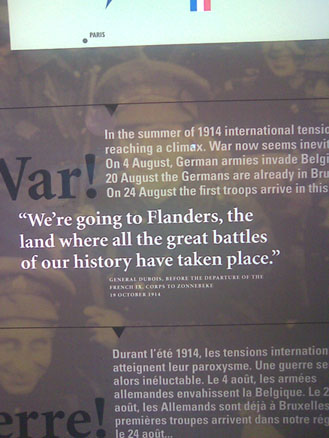
In early August Douglas and I flew to Amsterdam, caught a train to Brussels, and hired a car for a couple of days. Our goal: to visit some of the sights of the First World War, (perhaps I need to be honest and say it was my goal, and Douglas went along with it, which was very decent of him). We drove down to Ypres or, as the Belgians spell it, Ieper in Flanders in the south of the country. A note to oneself is to make sure one knows about different spellings because driving the motorways looking for signs for Ypres would have been pointless.
This part of Belgium was the scene of some of the bloodiest battles of the war. It was a deeply interesting and moving trip. Dotted across the countryside are a series of cemeteries, all meticulously maintained by the Commonwealth War Graves Commission. We visited the largest war cemetery in the world. Originally this was a German defensive fortification nick-named Tyne Cot (meaning cottage) by British soldiers, the Northumberland Fusiliers, from the Tyneside. The cemetery bears this name: Tyne Cot. It has nearly 12,000 graves, some 8000 bodies are nameless and on the walls of the memorial are the names of 35,000 men whose bodies were never found or could not be identified. Click here for more information.
Many particularly ghastly and pointless battles took place in this corner of Belgium, and they were for small gains of ground. It is striking how dreadful the carnage was, and this is evidenced by the number of graves whose stones simply say: “A Soldier of the Great War Known unto God”. There was no dog tag or any other form of identification on these corpses. Even more poignant at each cemetery is the list of those “missing in action”. Some will have been buried as unknown, in other cases their bodies would have been vaporised, lost without trace. In the early days of the war the ‘dog tags’ the soldiers wore round their necks were made of compressed cardboard. As can be appreciated they did not last long in the mud of the front line.
We began our visit by going to Essex Farm Cemetery just north of the Ypres. It was notable for two reasons: this is where Canadian doctor, John McCrae wrote the poem ‘In Flanders Fields’; and secondly it has the grave of one of the youngest soldiers to die in the war. McRae served here in a field dressing station. The bunker in which he worked is still there, a dank concrete cavern. He was to die of pneumonia on 28 January 1918, while commanding No 3 Canadian General Hospital at Boulogne. The first stanza of the poem is:
In Flanders fields the poppies blow
Between the crosses, row on row,
That mark our place; and in the sky
The larks, still bravely singing, fly
Scarce heard amid the guns below.
In this cemetery lies the body of Rifleman VJ Strudwick of the Rifle Brigade, killed on 14 January 1916 at the age of just 15. This is one year younger than Douglas is now. My father ran away from his school, and joined up age 16. When the war ended he was 19 and a Second Lieutenant. He was a year younger than Rowan. Thinking of his age and those of my children put it in perspective. It is hard to grasp the horror he lived through and the impact it must have had on him. I am glad we made this trip simply because I think I understand him a little better now. He would tell us as children of his adventures in the Second World War, when he served in India and Persia in the Royal Engineers, but he simply would not talk about the First War at all.
While the serried ranks of headstones stones are deeply moving, both in terms of the numbers and uniformity, it is the unusual ones that stick in my mind. At Tyne Cot there is stone commemorating a Navy gunner. He is so far from the sea: one has to ask what miss-chance brought him to his doom in the mid of Flanders. There are four graves of soldiers who were identified as German, but only one is named: “Otto Bieber 4 Okt 1917 Und Ein Deutscher Soldat 1914 1918”. Why were there just four Germans buried here? Who was Otto?
The majority of headstones have crosses on them. The Jewish soldiers have a Star of David. The literature for Tyne Cot tells that there are 30 stones there with no religious marking. The families requested there be none on the grounds that the soldiers were atheists. This is of course this is the family’s judgement, and I wonder how it squares with the saying that: ‘there are no atheists in the foxholes’, if these men died as atheists or calling for a God.
There are also reminders of the quirks of history. The men of Canada and men of Newfoundland are commemorated separately. Newfoundland was not yet a part of Canada when the war was fought. There was an exhibition in the Ypres museum about the Chinese labour brought to work behind the lines. There were 140 000 men who travelled from China as indentured labour; some brought over the Pacific to Canada, by rail across the country (and they were not allowed to get of the trains), then on by sea to Europe; others through the Suez or round the Cape. These men were carried in the holds of the ships and were terribly exploited and badly treated. They have also been forgotten in the historical annuls of the war.
On the walls of the Menin Gates Memorial are thousands upon thousands of names (54 000 in total). Again it is the odd one that captures the attention. In the list is “Clarke R. Served as Carrington F, DCM”. Why did R Clarke serve under a different name: had he been dishonourably discharged; was he standing in for another person; was he trying to redeem the family honour? If so he succeeded because the DCM stands for Distinguished Conduct Medal which was the second level military decoration awarded non-commissioned soldiers. It was seen as a “near miss for the VC”. What ever the story, he is dead and is commemorated on the Menin Gate.
In Ypres we went to the daily commemoration held at the Menin Gates. This is this takes place without fail at 8 pm every evening, and has done since 11th November 1929, with the exception of the period of German occupation during the second war. Click here for more information.
There is an order to the event. The traffic under the gate is halted at 8pm; the buglers step forward; and the ceremony commences. The last post is usually played by buglers from local volunteer Fire Brigade, although there may be more involved ceremonies and, quite often according to the literature, there will be a piper. The words of poet Laurence Binyon are spoken: “They shall not grow old, as we that are left grow old. Age shall not weary them, nor the years condemn. At the going down of the sun and in the morning We will remember them”.
The assembled crowd says: “We will remember them”. This is followed by the minute’s silence. Then wreaths are laid. Finally Reveille is played to end the event and remind us that life goes on.
It was extraordinarily moving. The crowd, judging by the languages I heard, was Belgium/Dutch then British with a few South Africans, Australians, Canadians and New Zealanders mixed in. There was silence and respect. Quite remarkable.
I have in the past, flippantly, described Belgium as a country designed or designated for European wars by the French and Germans and British. It was ideal: reasonably flat; not too many canals or rivers – the reason why Holland would not work; a divided population who don’t get on – the French and Flemish; and a weak government. Others have even suggested that the location of the European Commission in Brussels represents a continuance of wars but in a different format. While this was said, somewhat in jest, I learnt in one of the museums that I am not alone in this. The words of Gen Dubois before the departure of the French IX Corps to Zonnebeke, just outside Ypres, on 19th October 1914 were: “We are going to Flanders, the land where all the great battles of our history have taken place”. Pity the people of Flanders.
To the victor the spoils, and it seems from the visit, the right to commemorate the dead. There are German cemeteries as many if not more Germans died, but they are not marked or celebrated in the same way. Indeed puzzling is that in most allied cemeteries there may be one or two German graves. It is not at all clear to me how they came to be there.
What is deeply interesting and disturbing is how absent the Belgians are, both from the written record and the monuments. Of course most of Belgium was occupied; the government and the King would not commit the remains of the army to battle; rightly believing that one major engagement and the entire force would be wiped out. And history is written by the victors; but there was a Belgian army and there were millions of civilians affected and killed; the fields yield not just corn and maize but also a harvest of munitions as well as the occasional skeletal corpse.
Driving on the right hand side of the road is a challenge for me at the best of times. Driving on the Brussels’ ring road with heavy traffic, huge juggernauts, and in a cloudburst will be an event that I will remember for a long time. In a way it a bit like flying, once you’re committed to getting airborne you know you will have to land at some point. Equally going round the ring road to try and find the exit to the airport was a commitment. We managed, but it does mean that I will think quite carefully about hiring cars in the future.
So having made it to the airport, Douglas and I got on the train to Brussels and then an InterCity train to Amsterdam. On getting there we then queued up in the tourist office to get a hotel room. That was a mission. We waited for about 40 minutes. Amsterdam was really heaving, the weekend marked the gay pride events.
Film
Toy Story 3 by Pixar and Disney
This film had rave reviews, almost without exception, male reviewers wrote of how moved they were and how difficult they found it to keep from weeping. While I did not find the entire film to be as good as was suggested, it is worth seeing. In common with most of the men in the audience I was definitely sobbing by the end. What is it about the film that makes it so touching? It is because many of the male audience will have met and identify with the characters in both the past but also it is about a male rite of passage.
Books
Brighton Rock by Graham Greene various publishers as it is now a classic
Douglas is going to do A-levels in English literature. The school suggested a number of books to be read over the holiday. These included Brighton Rock, Doctor Faustus, King Lear, and Clockwork Orange. We took Brighton Rock with us on holiday. I read it and then managed to leave it in a hotel room. It is extraordinarily well-written, but what the miserable story. In fact most of that list is pretty miserable. Brighton Rock is set in 1938 in Brighton and tells the story of a 17-year-old gangster (Pinky) and his girlfriend Rose. It is described as a ‘Catholic novel’ since both the main characters are Catholics, but it is more a story of poverty of mind as well as finance.
Being a Distinguished Visiting Fellow And Freezing In Ottawa
I am now back in Norwich having completed the visit as Distinguished Visiting Fellowship in Ottawa. Here is my plane letter/diary, which I kept while I was there and finished on the way back to the UK.
The visit was hectic. On my first Friday I gave the Founders Seminar at Carleton which was reasonably well attended. I spoke on HIV/AIDS and social justice, not something I knew a great deal about so it was good to have the chance to get my head round the issue. The following Monday I gave a seminar which was attended by a crowd of two people, a third put their head round the door and fled. Fortunately, for my ego, on Tuesday I gave a class which the students were expected to attend so it was full. This was organised by Chris Brown a Professor in the Department of Politics. He came to get me to walk across the campus. I recognised him. I had met him in Botswana where he had been a District Officer “Development” based in Molepolole in Kwaneng district.
The first weekend was not active, mostly sorting out my work and actually writing a bit. The week had passed so quickly that I was feeling a little panicked at how much I had to do and how much had not been done. I was invited out on Saturday by Carolyn McMaster, a friend of long standing. She was in Pretoria in the early 1980s, handling the CIDA support to Botswana, when I was an ODI Fellow there. She invited two couples who had been posted in South Africa by the Canadian Foreign Ministry. We had a fun evening, mainly talking about things Southern African. I had asked directions to bottle store at the hotel and ended up in one that sold only Ontario wine. I got the most expensive, which was $29-00 a bottle. The fact that this was the most one could spend on a bottle is telling. It was a Syrah, and to be honest it was not too bad. Somehow the words Ontario and wine don”t go together in my mind.
I subsequently had an interesting interaction with the shop assistant at that store. There was a sign saying that they do not take $100 bills. I asked if this were legal. “Yes”, she said, “we don’t keep change”. I thought about this and it seemed a little illogical. “OK”, I asked, “If I buy $96 worth of wine then you will accept the $100”. “No”. “Then this does not make sense”. She agreed but was most upset that I had called her on it.
The 17th March was St Patrick”s day, not marked in the UK or South Africa, but very different here. The streets were full of people wearing green, with shamrocks inked on their faces (and possibly other body parts), and silly little hats. Either there is an Irish community in this city or any excuse for a party.
I usually took the bus from Ottawa University to Carleton. It is the large yellow American school bus. I have always wanted to be on one of those. However, interestingly the seats were really uncomfortable and there were no seat belts. Sitting at the back was quite unpleasant and made me feel ill. So the commute was 12 minutes fast walk to the bus, a 15 minute journey and then five minutes in the “tunnels” at Carleton. The tunnels are amazing, they join all the buildings. It is possible to walk from one end of the campus to the other without going outside. They are populated by people who drive “the carts”, which are sort of golf carts that scoot through the tunnels to do, who knows what missions. I wonder if there is a sub-culture developing, “sub” in both senses of the word.
The hotel room I was in had a small kitchen (it was really an apartment) and there was a laundry on my floor, which was good. Having washed shirts during my first week I set about ironing them. It was a very long time since I had done this, and the iron turned itself off every 15 minutes as a safety feature. So frustrating. I then discovered a laundry across the street that would do all this for $1-49 per shirt. My basic philosophy when travelling is to try to avoid have laundry done when the cost is greater than the price paid for the garment originally, but this was well below that and such a saving on time.
Right next door was a gym. I had originally chosen this hotel, (www.suitedreams.com) because it had the best exercise room of all the ones suggested, but then I spotted the gym. They charged $65 a month ($70 with the tax), so I joined. I figured if I went 10 times it would be worth it and was full of good intentions of going in the morning and evening! Hah! But I did manage 20 visits ($3-50 per visit says the economist in me) and also got a great deal of reading done on the bicycle and cross trainer so was pleased with myself.
Ottawa is an interesting little city. I soon developed a feel for the area round the hotel and the Universities. The weather was kind over the month I was there. There was snow on the ground when I arrived and the canal was frozen. By the time I left the canal was mostly thawed and almost all the snow melted. I got down to a vest, shirt and fleece by the end of the visit, which meant that some of the locals were going round in shirts with the sleeves rolled up. At the beginning my dress was vest, t-shirt, shirt, fleece and coat!
As the 18th was my birthday I decided to go to a “Comedy Club” round the corner, “Yuk Yuks” on Elgin. It was the fourth round of the Canadian stand up comedy championships. The club had an empty bar upstairs, with a faint sour smell of puke, and a packed basement. Some of it was very funny, some was not! Then I had a MacDonald”s vanilla shake as a special treat. I think what I particularly like is the chemical additive taste.
My second weekend was rather fun. On the Friday I was invited to the annual Royal Commonwealth Society Humanitarian dinner. It was attended by the great and the good of Ottawa and I think the average age was 60+. I was the only male present who was not wearing a tie (I simply don”t have one). It was rather like being one of the characters in a Robertson Davies novel. The people were nice and very earnest. The guest of honour had been Canadian High Commissioner in South Africa, where he was mugged rather badly. He spoke from the heart about his impoverished childhood and upbringing, and then went on to describe the despair felt by aboriginal children, who have an alarmingly high suicide rate. He is engaged in trying to improve their lives through literacy.
On the second Saturday I went out to the University and worked all day. I got a great deal done and felt very pleased with myself. My host here, is Michael Brklacich, Chair of the Geography and Environmental Studies Department (to see who he is and information about the department see http://www.carleton.ca/geography/faculty/brklacich.html ), was given tickets for an ice hockey game. His neighbour has season tickets and could not go. These were excellent tickets as well, costing $190 each, and about six rows away from the ice. Mike very kindly invited me to go with him. It was deeply interesting and a lot of fun. I ate the most unhealthy meal I have had for ages, a steak sandwich with fries. I avoided the beer and had a glass of red wine instead. The game was fast and furious and in the end the Ottawa Senators (our team) won by four goals to one.
Sunday I tried working, not very successfully I am afraid. In the evening I went and had dinner with Peter Henshaw who works for the Privy Council as an advisor. He is also an expert on post world war two history of Basutoland, Bechuanaland and Swaziland. I filled about four pages of my notebook which was really interesting (a small but select group of people share this enthusiasm).
The third week had to be one of writing, and it was. I decided, after the discussion with Pete to try “pitch” an op-ed proposal to the Globe and Mail published in Toronto. They showed interest and so that was an additional small task, altogether about a day of drafting, getting comments and submitting it. It was run on the 2nd April the day of the public lecture. An op-ed is only 700 words, so they have to be carefully chosen, see The Globe and Mail.
On Monday, Tuesday and Wednesday I wrote. On the Wednesday evening I gave a presentation to the Africa interest group, made up of past diplomats and are an interesting group of people trying to influence Canadian foreign policy. I then had dinner with Stephen Lewis, who is an iconic Canadian public figure. He is also a thoroughly decent person with a sense of humour, I came away having changed my mind on some things.
Thursday was a pain because I had to travel to New York, and that meant catching the 06h15 plane. It seemed to me, that, as I already had a boarding pass, getting to the airport an hour before departure would be ample time. Wrong! There is a US immigration office at Ottawa and this took for ever, indeed I resorted to asking people in the queue if they would mind me going ahead of them. It was ok but a bit stressful.
The cab ride in from La Guardia was simple and quick. The two day meeting was held at the Desmond Tutu Centre. This is a former seminary with outstanding 19th-century Gothic architecture. The dinning area or refectory was super with stained glass windows and wood panelling. It has been wonderfully developed and the bed was the most comfortable I have slept in for a very long time. The desk and chair were, on the other hand, totally inadequate. It is worth looking at http://www.ahl-tutucenter.com
In addition to the meeting I was able to see the multi-media show that was unveiled in Durban on 2nd April as part of the South African AIDS conference. This is based on the HEARD project on female truck drivers and was shot by Liz Rubincam. The pictures are on her website http://www.lizrubincam.com under “truck drivers”, and I expect both will soon be on ours http://www.heard.org.za.
It was a busy couple of days and I was quite pleased to get on the plane to Ottawa on Saturday afternoon. Both ways the planes were quite empty and so I was able to stretch out and work, although the flight is short, only 55 minutes in the air. That Saturday was apparently the nicest in Ottawa for months but in New York it was grey and rather miserable. On the Sunday it was pouring with rain but Mike very kindly took me to the Gatineau park outside Ottawa for lunch, it is not far, a 20 minute drive. It was amazing to see the amount of snow on the ground as one left the city and headed for the hills. There must be micro-climates. It was good to get out of the city and be reminded that there is countryside. It would, I think, be spectacular in autumn
By my last week the temperature had risen and there were joggers running wearing just shorts and t-shirts. One measure of temperature would be the number of people outside and what they are wearing. It still seems cold but there are chairs outside restaurants and a few hardy souls are using them. Before it was just the smokers! There was one day when walking to the bus I thought my ears were going to fall off!
The last week was really busy. On the Monday I gave a talk in the morning at the Ministry of Foreign Affairs; a lunch presentation at the IDRC, and then had a meeting and gave a seminar at the University of Ottawa (the other university in the city and quite different, it is French and English medium and much more part of the city whereas Carleton is suburban).
On the Tuesday I talked at the Canadian development agency, CIDA. The finale of my visit was a public lecture on Thursday. This was at Carleton and was, sadly not very well attended, hindsight tells us that it was right at the end of the term and so was a time when most students were either gone or rushing to hand in overdue essays. I began with a joke, well actually I began by saying I was going to tell a joke because “Canadians are terribly serious and you need to know that this is a joke”.
On my final night we organised a dinner at Thai restaurant. It was great. There were 12 of us including people I had not seen for a very long time including Chris Brown”s wife who I had known in Botswana. Jonty Crush (a friend from Waterford days – 37 years ago) was there along with his wife. The last week also saw a number of dinners.
It was a really good four weeks and although not as much was accomplished as I should have liked, it was intense and busy. There was not really a spare moment and looking back there were a number of unexpected achievements. It was a window into Canada and Canadians (they are quite serious and apologise a lot, but on the other recognise they are a favoured nation and take global responsibilities to heart).
I am going to end this letter here because for those people to whom it is being posted it in now four pages long any more words and I will have to either reduce the type size or go on for another two pages. Smaller type is hard to read and I want to watch a movie on the plane so two more pages is not going to happen either. It is also over 2000 words long, which is half the length of the article I wrote and more than three times op-ed.
 Alan Whiteside